
Learnewable Data Reveals What Trump’s Data Center Argument Misses
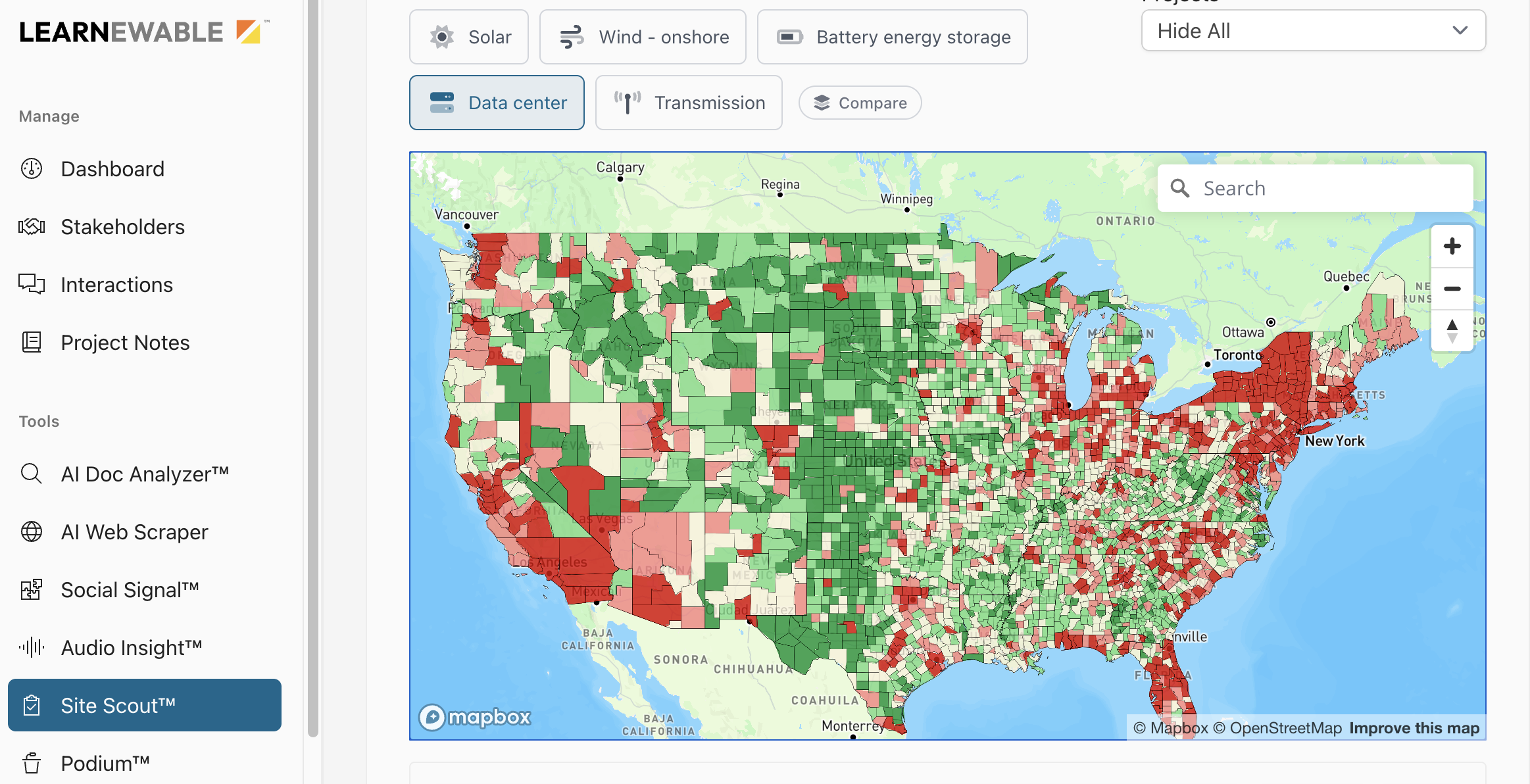
Learnewable County Data Center Sentiment Map
Nationwide analysis finds that community resistance reflects unanswered questions, local impacts and direct experience—not opposition to economic growth
Calling concerned communities anti-growth misses the underlying issue,” Solomon said. “Residents want answers about who benefits, who bears the costs and how local resources will be affected.”
PORTLAND, OR, UNITED STATES, September 1, 2026 /EINPresswire.com/ -- PORTLAND, Ore. — President Donald Trump recently argued that communities opposing data centers risk becoming “backwards and poor.” Learnewable’s nationwide research reveals a more complex reality: communities are not necessarily rejecting jobs, investment or technological progress. Many are being asked to accept major projects without enough reliable, locally relevant information to determine whether the promised economic benefits outweigh the potential costs.— Jeremy Solomon
Trump stated:
“The only reason that communities throughout the U.S.A. should not want Data Centers is if they want to end up being backwards and poor. If they want to be successful and rich, with far lower taxes and jobs all over the place, let Data Reign.”
Learnewable’s monthly analysis of community sentiment and permitting conditions across 3,144 U.S. counties shows that opposition cannot be explained simply as resistance to growth. Approximately 30% of counties are currently favorable for data center development, while roughly one in seven has adopted some form of prohibition, moratorium or restriction.
Population and direct experience are among the strongest predictors of resistance. The most populous counties impose restrictions nearly twice as often as the least populous—20.2% compared with 10.4%. Counties hosting 10 or more data centers are 4.6 times more likely to rank among the most hostile than counties with none. Once a proposed facility enters the public record, the likelihood of maximum hostility nearly triples.
These patterns suggest that opposition frequently intensifies as residents learn more about proposed projects or experience their local effects.
The deeper issue may be transparency. Learnewable analyzed 941 citations concerning data center development and community response. Importantly, none included operator disclosures addressing three of residents’ most pressing questions: projected electricity demand, water consumption and public tax incentives.
Without project-specific information, residents and public officials cannot confidently determine whether promised jobs, tax revenue and economic development justify a facility’s potential effects on utility rates, water supplies, public infrastructure and local finances.
“The real counter to a moratorium wave is disclosure,” Learnewable President Jeremy Solomon told Inside Climate News.
Learnewable’s research also reveals that community sentiment and local regulations do not always align. In 304 counties, residents appear supportive of data center development, but zoning or permitting rules create significant obstacles. Conversely, 222 counties remain legally open to development while facing substantial community opposition.
This distinction matters. Economic promises alone may not secure public support, and favorable sentiment alone cannot overcome restrictive policies. Successful development requires both community trust and a viable permitting pathway.
“Calling concerned communities anti-growth misses the underlying issue,” Solomon said. “Residents want concrete answers about who benefits, who bears the costs and how local resources will be affected. Developers that provide locally relevant information and engage before positions harden will be better prepared to earn trust and reduce permitting risk.”
Learnewable’s findings do not suggest that data centers are inherently harmful or unwelcome. They demonstrate that communities need credible evidence—not broad assurances—to evaluate projects that could reshape local economies, infrastructure and resource use for decades.
About Learnewable
Learnewable provides AI-powered stakeholder intelligence for data center, energy and infrastructure developers. Its platform analyzes community sentiment, permitting conditions, public meetings, stakeholder activity and emerging opposition across all 3,144 U.S. counties.
Jeremy Solomon
Learnewable LLC
+1 5035758365
jeremy.solomon@learnewable.com
Visit us on social media:
LinkedIn
Legal Disclaimer:
EIN Presswire provides this news content "as is" without warranty of any kind. We do not accept any responsibility or liability for the accuracy, content, images, videos, licenses, completeness, legality, or reliability of the information contained in this article. If you have any complaints or copyright issues related to this article, kindly contact the author above.
