
Why Depth-to-Water Measurement Matters
Odell Ward PG.
Beneath the Texas Panhandle lies the Ogallala Aquifer—a finite underground reservoir that sustains irrigated agriculture across millions of acres. Managing it wisely starts with one fundamental measurement: depth to water (DTW).
DTW is the vertical distance from the ground surface to the water table, measured in feet below land surface (BLS). When water is pumped out faster than it is naturally recharged, the water table drops—and DTW increases. Tracking that change, well by well, year by year, is the foundation of all aquifer management.
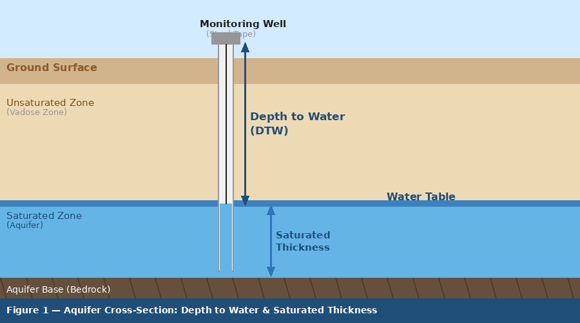
Figure 1 — Cross-section of a monitoring well showing depth to water (DTW) and saturated thickness. As DTW increases, saturated thickness, the usable water column decreases. (AI generated photo)
DTW is closely related to saturated thickness: the vertical depth of the water-bearing zone. As the water table falls, saturated thickness shrinks, reducing well yields and shortening the productive life of the aquifer. In parts of the Panhandle, decades of heavy irrigation have already halved the saturated thickness.
Annual measurements taken each winter—before irrigation season—reveal the long-term trend. The result is a hydrograph: a time-series record that shows whether the aquifer is stable, recovering, or in decline.
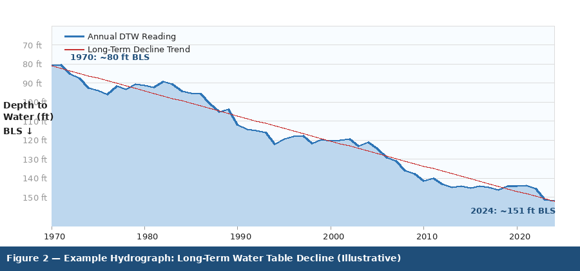
Figure 2 — Illustrative hydrograph showing a typical long-term water-level decline trend across a Panhandle monitoring well. Each point represents one annual depth-to-water reading. (AI generated Chart)
These records drive every major water management decision: district production limits, water rights valuations, irrigation efficiency planning, and state water availability models. Without consistent DTW data, sound management is impossible.
For producers and landowners, the message is simple: know your water level, measure it regularly, and contribute to the regional monitoring network. Every reading counts.
Legal Disclaimer:
EIN Presswire provides this news content "as is" without warranty of any kind. We do not accept any responsibility or liability for the accuracy, content, images, videos, licenses, completeness, legality, or reliability of the information contained in this article. If you have any complaints or copyright issues related to this article, kindly contact the author above.
