
Hosted.com Examines Prompt Injection Threats Affecting Websites Using AI
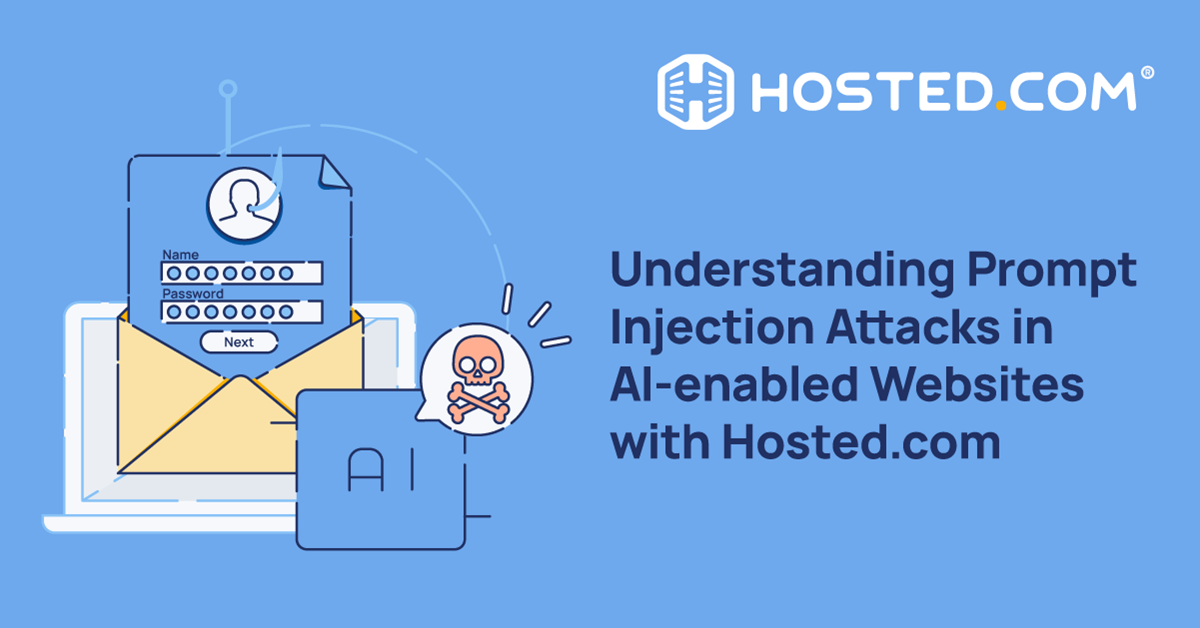
Understanding Prompt Injection Attacks in AI-enabled Websites with Hosted.com

Hosted.com - Harmful embedded inputs can influence AI systems’ behavior

Hosted.com - Server infrastructure security and monitoring help prevent AI attacks
Hosted.com examines the growing risk of prompt injection attacks to businesses using AI tools, including their potential impact, and ways to reduce exposure.
The Growing Role of AI in Business Operations
AI is increasingly integrated into online businesses for customer communication and support, content generation, analytics, and automation. This means models interact with and train on User-Generated Content (UGC), downloaded files, databases, and external sources, which may contain harmful prompts.
While traditional cyber threats often target system vulnerabilities or login credentials, prompt injection attacks focus on influencing how AI models act. These attacks are designed to manipulate behavior rather than exploit conventional security gaps.
How Prompt Injection Attacks Work
Prompt injection attacks involve embedding malicious instructions into data. These instructions may be hidden in form submissions, documents, website content, or links. When processed by Large Language Models (LLMs), the injected prompts can cause AI tools to override built-in safeguards.
Prompt injections can be used to expose sensitive information, perform unauthorized actions, generate misleading outputs, or assist in phishing to gain access to admin and banking accounts. Because they rely on manipulating AI rather than attacking software directly, detecting and preventing them can be difficult using traditional security methods alone.
The Risks for Online Businesses
For businesses that rely on AI to process customer data or automate workflows, prompt injection attacks present several risks. These include potential data exposure and theft, unauthorized changes to site content, and admin account takeovers.
This can, in turn, impact customer trust and business continuity. Security incidents involving AI systems may also lead to regulatory or legal issues, especially when sensitive or personal data is involved.
Infrastructure-Level Protection
Hosted.com’s article explains several infrastructure-level methods used to reduce exposure to prompt injection and related AI cyberattacks. These measures focus on identifying suspicious behavior before manipulated inputs are processed.
Comment sections, forms, and file upload areas are frequent entry points for manipulated inputs. Server-level file scanning can detect malicious scripts or embedded prompts in downloads and uploads.
Monitoring software can also identify unusual activity patterns that may indicate tampering during script execution. Request filtering can flag suspicious inputs before they reach websites or AI tools.
Traffic Filtering and Isolation
Web Application Firewalls (WAFs) provide an additional layer of protection by filtering inbound traffic and blocking anomalous requests from suspected AI bots.
Website isolation technologies further reduce risk by limiting the impact of a compromised file or script on other sites on the same server. By separating sites, isolation tools help prevent AI-related attacks on one site from spreading across the server.
According to Wayne Diamond, CEO of Hosted.com, “AI tools are used by businesses to operate and serve customers more than ever. When those tools are misused, the damage extends beyond technical issues. Understanding the risks and applying layered security helps prevent prompt injection attacks and other AI-based threats.”
Best Practices to Reduce Risk
In addition to Web Hosting infrastructure security, Hosted.com’s article covers best practices to reduce exposure to prompt injection attacks. These involve restricting AI permissions to essential functions, reviewing user-generated content before processing, and ensuring human oversight for sensitive tasks.
Monitoring for unusual behavior can also help identify potential manipulation early. While no single control can eliminate risk entirely, layered security, combined with operational awareness, can reduce both the likelihood and the impact of AI-related incidents.
Prompt injection attacks are continually evolving as AI advances, requiring security measures to adapt to emerging AI manipulation methods.
About Hosted.com
Hosted.com offers reliable domain registration, web hosting, and WordPress hosting services. The platform delivers secure, scalable, and easy-to-use website solutions for freelancers, content creators, startups, and businesses of all sizes
About Wayne Diamond
Wayne Diamond is the Founder and CEO of Hosted.com, with over 25 years of experience in the web hosting and domain services industry. He leads the company’s product strategy and operations, focusing on reliable hosting, strong security, and customer-focused website solutions.
Marketing Department
Hosted.com
email us here
Visit us on social media:
LinkedIn
Instagram
Facebook
YouTube
X
How to choose the best Website Hosting Plan
Legal Disclaimer:
EIN Presswire provides this news content "as is" without warranty of any kind. We do not accept any responsibility or liability for the accuracy, content, images, videos, licenses, completeness, legality, or reliability of the information contained in this article. If you have any complaints or copyright issues related to this article, kindly contact the author above.
