
C3 Framework and Inquiry-Based Learning | Nebraska Department of Education
College, Career, and Civic Life (C3) Framework for Social Studies State Standards: Guidance for Enhancing the Rigor of K-12 Civics, Economics, Geography, and History

College, Career, and Civic Life Framework for Social Studies State Standards
The result of a three year state-led collaborative effort, the College, Career, and Civic Life (C3) Framework for Social Studies State Standards was developed to serve two audiences: for states to upgrade their state social studies standards and for practitioners — local school districts, schools, teachers and curriculum writers — to strengthen their social studies programs. Its objectives are to: a) enhance the rigor of the social studies disciplines; b) build critical thinking, problem solving, and participatory skills to become engaged citizens; and c) align academic programs to the Common Core State Standards for English Language Arts and Literacy in History/Social Studies.
In June 2017, a Religious Studies Companion Document was added as a Supplement to the C3 Framework. It is included in the downloadable pdf file of the Framework.
-National Council for the Social Studies
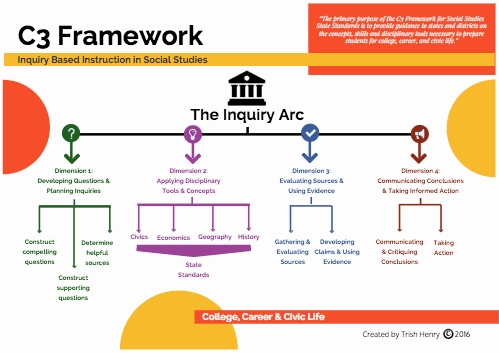
The Inquiry Arc
NCSS Guidance on the C3 Framework and the Four (4) Dimensions of the Inquiry Arc
Dimension 1 : Developing Questions and Planning Inquiries
Dimension 2 : Applying Disciplinary Concepts and Tools
Dimension 3 : Evaluating Sources and Using Evidence
Dimension 4: Communicating Conclusions and Taking Informed Action
Inquiry-Based Learning
One of the latest and most promising instructional shifts in social studies education is towards inquiry-based learning. With its roots found in John Dewey’s, among others, philosophy that students learn best while doing, inquiry-based learning seeks to build on the natural curiosity of students and engage their problem solving skills, while accessing personal experiences to make informed and well-supported opinions about the world in which they live. To quote Brazilian educator, advocate, and philosopher Paulo Freire, an inquiry education “provoke[s] the discovering of need for knowing and never to impose the knowledge whose need was not yet perceived”.* By clicking on the following names of education related groups and organizations, you will be taken to websites that provide inquiry-based and open educational resources.
*Bell, B., Gaventa, J., & Peters, J. (Eds). (1990) We make the road by walking: Conversations on education and social change: Myles Horton and Paulo Freire. Philadelphia, PA: Temple University Press.
Legal Disclaimer:
EIN Presswire provides this news content "as is" without warranty of any kind. We do not accept any responsibility or liability for the accuracy, content, images, videos, licenses, completeness, legality, or reliability of the information contained in this article. If you have any complaints or copyright issues related to this article, kindly contact the author above.
