
When Risk Becomes Uninsurable, Everyone Loses: Building Forensics Turns Insurance Pain Points Into Control Solution
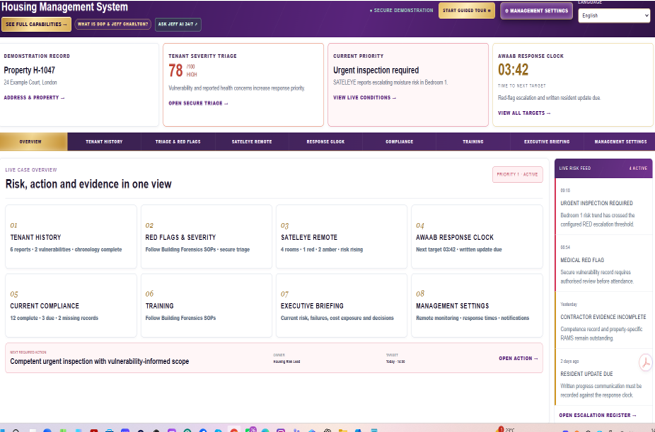
Pre-emptive monitoring and risk reduction
35 years of expertise meets AI to turn identified insurance failure points into preventive management, 24/7 monitoring and delegated risk control.
**“Insurance exists because risk exists. Simply withdrawing from risk protects the insurer, but it also removes business. The alternative is to identify the failure points, put controls around them”**”
BECKENHAM, KENT, UNITED KINGDOM, August 26, 2026 /EINPresswire.com/ -- # When Risk Becomes Uninsurable, Everyone Loses: Building Forensics Turns Housing and Insurance Pain Points Into Management and Control Solutions— Jeff Charlton, Lead Author
**Rising housing claims and insurance pressures expose weaknesses in reactive management. Building Forensics has identified recurring failure points and developed systems designed to control risk before it escalates.**
Rising claims, increasing insurance premiums and difficulties obtaining appropriate cover are creating growing problems for housing providers, contractors, directors, brokers and insurers operating in an increasingly demanding Awaab's Law compliance environment.
The warning signs are substantial.
The Housing Ombudsman's evidence to Parliament shows that the maladministration rate in its damp and mould determinations increased from **46% to 81% over four years**.
At the same time, housing-sector insurance research has reported significant premium increases and identified additional damp and mould claims among the factors causing insurers to reassess liability underwriting rates.
The National Housing Federation has separately reported that some housing associations have experienced difficulty obtaining appropriate Directors' and Officers' insurance at the right level and cost.
## Building Forensics Identified the Failure and Pain Points
Building Forensics has identified recurring failure and pain points within the traditional reactive model: fragmented information, delayed intervention, inadequate evidence, missed vulnerability, incomplete actions, repeated professional involvement, inappropriate contractor responses and risks that remain uncontrolled until they become complaints or claims.
The growth of legal action surrounding housing conditions creates another potential exposure. Where a landlord has already failed to investigate, document, communicate, act or verify completion properly, reconstructing the evidence after litigation begins can be considerably more difficult than managing the risk correctly from the outset.
Rather than simply describing these problems, Building Forensics has used more than 35 years of specialist experience, combined with AI-assisted development, to create **management and control systems designed around the identified failure points**.
The principle is straightforward:
**Identify the failure point. Build a control around it. Monitor the risk. Escalate when necessary. Verify completion.**
## From Reactive Response to Preventive Management
The Building Forensics **Housing Management System** has been developed to replace dependence on reactive complaint and claims handling with preventive management, structured controls and, where appropriate, 24/7 environmental monitoring.
The system brings together tenant and property history, vulnerability, severity, response deadlines, inspection, contractor competence, outstanding actions, escalation and evidence of completion.
It is also designed to address a critical problem in damp and mould management: potentially hazardous biological contamination should not simply be passed to an uncontrolled or inadequately competent contractor without appropriate assessment, scope, controls and verification.
The objective is to identify developing problems **before they become serious complaints, regulatory failures or insurance claims**.
## An Opportunity for the Insurance Industry
This creates an important opportunity for insurers and brokers.
When risks become uncontrolled, insurers may increase premiums, restrict terms or decide that an exposure is no longer commercially attractive.
The insured organisation can lose access to affordable protection. But withdrawing from a class of business also means insurers and brokers cannot earn revenue from risks they are unwilling or unable to accept.
Building Forensics has therefore developed a different proposition:
**Instead of simply withdrawing from difficult risk, can that risk first be made measurable, manageable and demonstrably better controlled?**
The Housing Management System addresses the underlying property, tenant, compliance and management risk.
Its claims-management controls address what happens when an incident nevertheless progresses toward a claim.
And remote monitoring can provide continuing oversight rather than waiting for the next complaint to reveal that conditions have deteriorated.
Together, these elements are designed to move organisations from:
**Complaint → reaction → escalation → claim**
towards:
**Identify → assess → control → monitor → intervene → verify.**
## Making Risk More Insurable
Building Forensics does not claim that its systems can guarantee insurance availability, prevent every claim or determine an insurer's underwriting decision.
The proposition is more fundamental.
Insurance exists to accept and price risk. Better information, documented controls, earlier intervention and evidence that corrective actions have actually been completed can potentially provide underwriters with a better-characterised risk than an organisation relying principally upon reactive complaint management.
For housing providers, the potential benefit is better control.
For tenants, it is earlier recognition and intervention.
For directors, it is improved oversight and evidence.
For insurers and brokers, it creates the possibility of examining whether risks that are becoming increasingly difficult to insure can instead become **better-managed risks**.
Jeff Charlton, founder of Building Forensics, said:
**“Insurance exists because risk exists. Simply withdrawing from risk protects the insurer, but it also removes business. The alternative is to identify the failure points, put controls around them and demonstrate that the risk is being managed.”**
Building Forensics has spent more than 35 years examining water damage, mould, biological contamination, remediation and the failures that allow relatively manageable problems to escalate.
AI-assisted development has now enabled that accumulated specialist knowledge to be converted into practical management and control systems.
The result is a change in philosophy:
**Don't wait for the claim to demonstrate that the system failed. Use the system to identify the developing failure before it becomes the claim.**
Further information about the Building Forensics Housing Management System and associated risk-management systems is available at **BuildingForensics.ai**.
Jeff Charlton
Building Forensics
+44 7990500999
email us here
Visit us on social media:
LinkedIn
Instagram
Facebook
YouTube
Legal Disclaimer:
EIN Presswire provides this news content "as is" without warranty of any kind. We do not accept any responsibility or liability for the accuracy, content, images, videos, licenses, completeness, legality, or reliability of the information contained in this article. If you have any complaints or copyright issues related to this article, kindly contact the author above.
