
Boardroom Catalysts: Patterns in Activist Director Selection
Executive Summary
When an activist obtains board representation, the number of seats tells only part of the story. The backgrounds of the directors who enter the boardroom may reveal whether the campaign emphasizes direct investor participation, operating experience, financial capabilities, or industry knowledge.
We examine 1,048 board appointments involving 835 individuals in U.S. activist campaigns since 2015, including directors seated through negotiated settlements and contested elections. We analyze the professional profiles associated with those appointments, how they differ by appointment pathway, how the mix varies over time and across sectors, the expertise directors bring to the board, and differences by gender.
Several findings stand out:
- Activist-selected directors are drawn primarily from two groups: senior operators and finance-oriented professionals. CEOs, presidents, and general managers represented 32 percent of unique directors and 28 percent of appointments. Finance-oriented professionals accounted for 56 percent of appointments, comprising sponsoring-activist principals at 27 percent, other investment professionals at 19 percent, and finance executives at 10 percent.
- Director profiles differ by appointment pathway. Settlements included more CEOs and activist principals, while contested elections included more outside investment and finance professionals. These differences may reflect whom activists nominate, which candidates companies accept in settlements, which campaigns proceed to a vote, or how shareholders assess competing nominees. The data do not distinguish among these mechanisms.
- Appointment profiles also varied by target-company sector. Investment professionals accounted for more than half of appointments in energy and materials, sectors where capital allocation, portfolio strategy, and asset value often feature prominently. Their share was lower in communication services, healthcare, industrials, and consumer staples, where boards may place greater weight on operating or sector-specific expertise.
- Repeat appointments extend beyond activist principals to a small recurring pool of outside directors. Approximately one-third of sponsoring activist principals appointed during the period served on more than one board, compared with roughly one in ten outside directors. Sponsoring activist principals served on an average of 1.7 boards each, and the most frequently appointed principal served on nine boards. Among outside appointees, the most active individual served on six boards, while 12 outside directors served on at least three boards during the study period.
- The expertise mix changed over time, partly reflecting shifts in targeted sectors. Investment management and private equity consistently accounted for roughly one-quarter of expertise tags, while the second-most common field shifted from technology to financial services and, most recently, healthcare and life sciences.
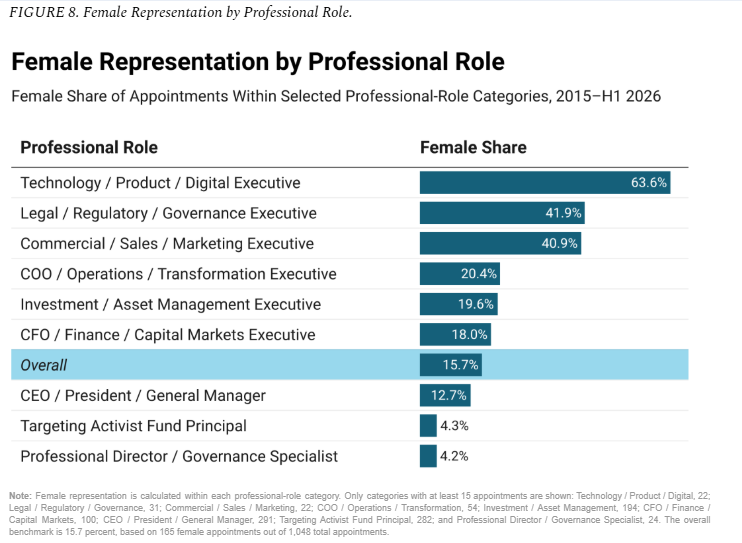
- Female representation varied sharply by professional role. Women accounted for 15.7 percent of appointments overall and were more prevalent in several smaller functional categories, but represented only 12.7 percent of chief executives and 4.3 percent of sponsoring-activist principals.[12]
Senior Operators and Finance Professionals Dominate Activist-Related Appointments
Chief executives, presidents, and general managers account for 28 percent of appointments and 32 percent of unique directors. These individuals typically bring company-wide or divisional profit-and-loss responsibility and often provide operating or industry credibility.[2]
Principals of the sponsoring activist account for 27 percent of appointments but 21 percent of unique directors. The difference reflects repeat service: some activist principals joined multiple boards during the study period, with the most active individuals serving on as many as nine boards. [2] [3]
Investment and asset management professionals not employed by the sponsoring activist represent 19 percent of appointments and 18 percent of unique directors. This category includes principals of other investment firms, portfolio managers, private equity professionals, and other investment executives.[2]
Chief financial officers and other finance professionals account for 10 percent under both measures. Taken together, sponsoring-activist principals, other investment professionals, and finance executives represent 56 percent of all appointments and approximately half of unique directors. This concentration shows that investment- and finance-oriented roles are prominent among activist-related board appointments, although the appointment-weighted result is amplified by repeat service among activist principals. [2] [3]

Viewed over time, chief executives and general managers remain among the leading categories. In 2018-2020, they were tied for first with investment and asset management executives. Sponsoring-activist principals ranked first in 2021-2023, while chief executives returned to first place in 2024-H1 2026.[2]

Finance-Oriented Appointees Are More Common in Contested Elections
The route to the board is associated with differences in the professional composition of seated directors. Those differences may reflect who activists nominate, which candidates companies accept in settlements, how shareholders vote, or the characteristics of campaigns that proceed to a vote. Appointment data alone cannot separate those mechanisms.5 Previous research has treated settlements and proxy contests as distinct pathways to activist board representation, while recent industry analysis has examined the consequences of activist settlements separately from contested outcomes. [7] [10]
Chief executives and sponsoring-activist principals constitute a smaller share of directors seated through contested votes than of directors appointed through settlements. Investment and asset management professionals outside the sponsoring activist constitute a larger share of vote-based appointments.[5]
The clearest difference appears among CFOs and other finance executives, who account for approximately 8 percent of settlement appointments but 17 percent of appointments resulting from shareholder votes. This may reflect differences in whom activists nominate, which candidates advance to a vote, or how shareholders assess finance-oriented profiles in contested elections.

Investment-Professional Appointments Vary Widely by Sector
Investment professionals—combining principals of the sponsoring activist with other investment and asset management executives—account for more than half of appointments in energy and materials. Their combined share is lower in communication services, healthcare, industrials, and consumer staples.[6]
Sponsoring-activist principals represent a comparatively small share of appointments in real estate and financials, while external investment professionals account for a larger portion of appointments in those sectors.[6]
Investment professionals accounted for more than half of appointments in energy and materials. One possible explanation is that campaigns in these sectors more often emphasize capital allocation, portfolio strategy, or asset valuation. Their share was lower in communication services, consumer staples, healthcare, and industrials, where operating or sector-specific expertise may be more prominent.

Repeat Appointments Extend Beyond Activist Principals
When measured relative to the size of each subgroup, repeat appointments are more prevalent among sponsoring-activist principals, although repeat service also extends to a meaningful group of outside appointees. During the study period, 60 of 178 unique activist principals served on multiple boards, compared with 74 of approximately 657 outside directors.

Among sponsoring-activist principals, two individuals at one fund accounted for 15 board appointments during the period studied. The most frequently appointed principal served on nine boards. Among external appointees, one individual served on six boards in connection with activist campaigns during the period.[3]
A group of 12 directors not directly affiliated with the sponsoring activist served on at least three activist-related boards during the study period. These repeat outside appointees skew toward investment and finance backgrounds, with expertise concentrated in technology, private equity, and financial services. Their repeated appointments suggest a small cadre of experienced candidates familiar with recurring activist priorities such as capital allocation, portfolio review, strategic transactions, and operational improvement, although the data do not establish why any individual was selected or whether prior service affected outcomes.[3] [4]

Investment Expertise Remains Dominant as the Aggregate Mix Shifts
Investment management and private equity account for approximately one quarter of identified expertise tags in each period shown. The second-ranked category changes over time. Technology, software, and digital experience ranked second in 2018-2020. Financial services, banking, and insurance moved into second place in 2021-2023. Healthcare and life sciences ranked second in 2024-H1 2026.[4]
The rise in healthcare expertise is consistent with the growing share of U.S. activist campaigns targeting healthcare and life sciences companies. Technology experience declined in relative rank after 2020, while consumer and financial-services expertise remained among the five leading categories throughout the periods displayed.

Female Representation Varies Sharply by Professional Role
Female representation among appointments varied substantially by professional role. It was highest among technology, product, and digital executives at 63.6 percent, followed by legal, regulatory, and governance professionals at 41.9 percent and commercial, sales, and marketing executives at 40.9 percent. Female representation was moderately above the overall average in operations, investment management, and finance roles, but considerably lower among chief executives at 12.7 percent, sponsoring-activist principals at 4.3 percent, and professional directors at 4.2 percent. Overall, women were more prevalent in several smaller functional categories but remained underrepresented in the largest leadership and sponsoring-activist principal groups, limiting their share of appointments overall.[12]
Appointment pathways were nearly identical by gender. Among female appointments, 86.7 percent resulted from negotiated settlements and 13.3 percent from shareholder votes, compared with 86.9 percent and 13.1 percent, respectively, among male appointments. These figures indicate no meaningful difference in appointment pathway by gender within the sample, although they do not address nomination rates or election success.[12]
Conclusion
The directors appointed in connection with activist campaigns differ in affiliation, professional role, sector expertise, gender, and prior activist-related service. Examining those characteristics across appointments provides a broader view of how activist-related board representation has been composed since 2015.
The data point to a director market shaped primarily by senior operators and finance-oriented professionals. Repeat service is concentrated among activist principals, but a smaller group of recurring outside appointees is also evident. The composition of seated directors differs between settlements and contested elections, varies across target sectors, and shows substantial differences in female representation by professional role.[2][3][5][6]
These findings are descriptive. They do not establish that appointed directors act on behalf of the activist, that any one profile is more effective, or that professional background or gender determines post-appointment outcomes. They do, however, show that activist-related directors are not a homogeneous category.
Taken together, the findings provide a systematic account of the professional and demographic composition of activist-related board appointments. They also identify several dimensions—affiliation, role, sector expertise, gender, and prior activist-related service—that may be useful in future research on nomination patterns, board composition, and post-appointment outcomes.
Scope, Definitions, Methodology, and Limitations
In campaigns involving board change, director backgrounds can provide insight into the capabilities activists seek, the experience they view as underrepresented, and the type of intervention they may anticipate. That inference requires caution: appointees may be principals or employees of the sponsoring activist, outside executives or investors, or mutually agreed candidates selected through a settlement process.
This report uses “activist-selected director” as an umbrella term for directors whose appointment was materially connected to an activist campaign, including dissident nominees elected by shareholders and settlement appointees selected with meaningful activist involvement. The term does not imply legal agency, continuing direction, or a uniform relationship with the sponsoring investor. Prior research similarly distinguishes between activist-affiliated and unaffiliated appointees.⁷ Once seated, an activist-related appointee becomes a member of the full board and owes the same fiduciary duties under applicable law as the company’s other directors. The appointment does not, by itself, make the director an agent or representative of the nominating investor.[9]
The dataset covers publicly identified U.S. activist campaigns since 2015 involving approximately 400 investors, including firms that remain active and those that have ceased operations. It includes directors seated through negotiated settlements or contested elections and excludes nominees who were never appointed or elected.[1] The sample comprises 835 unique directors and 1,048 appointments. Appointment-weighted analysis gives greater weight to repeat appointees, while unique-director analysis counts each individual once.[1]
Role categories are mutually exclusive and reflect each director’s principal professional position at the appointment date. Classifications were based primarily on company filings, appointment announcements, activist disclosures, and contemporaneous professional biographies. Categories include chief executives, presidents, and general managers; principals of the sponsoring activist; unaffiliated investment professionals; finance executives; operating or transformation executives; and other roles. Sector expertise may include multiple tags for the same director, so expertise percentages represent the distribution of identified tags rather than the percentage of directors possessing each type of expertise. Expertise tags were assigned using information available at each appointment date; repeat appointees therefore contribute observations to each relevant appointment.
The findings are descriptive and subject to several limitations. Public disclosure may not identify which party first proposed a mutually agreed director. Because unsuccessful nominees fall outside the sample, the analysis does not capture the full candidate pool or measure category-specific election success rates. Role and expertise classifications also require judgment, particularly for individuals with multiple professional backgrounds.[1] In addition, the same director, activist, company, or campaign may contribute multiple observations, so the reported percentages should not be treated as statistically independent.[1]
Time-series analyses begin in 2018 because the number of classified appointments in 2015–2017 was insufficient to support comparably stable period-level rankings. The 2024–H1 2026 period is also not directly comparable with the two preceding three-year periods and may reflect seasonality or reporting lag.[1] The data describe appointments rather than subsequent boardroom conduct, company performance, or causal effects.[1]
Gender classifications were based on publicly available biographical information and self-referential pronouns where available. The analysis is limited to individuals who could be classified from public sources and does not attempt to infer gender identity where the available information was inconclusive.
Building on prior research and industry commentary on activist directors, recruiting, settlements, and universal proxy, this report provides an appointment-level view of professional roles, sector expertise, gender, repeat service, and appointment pathways through H1 2026.[7] [8] [9] [10] [11] [12]
1 DEF 14 Inc., Activist Campaign and Board Appointment Dataset. Topic: campaign coverage, appointment events, unique directors, appointment mechanisms, study-period boundaries, and observation-level limitations. The dataset covers publicly identified activist campaigns beginning in 2015 and includes directors actually seated through settlements or contested elections.(go back)
2 DEF 14 Inc., Executive Roles of Activist-Selected Directors Dataset. Topic: professional-role classifications of seated directors, including appointment-weighted and unique-director distributions and changes in role composition over time.(go back)
3 DEF 14 Inc., Repeat Appointments of Activist-Selected Directors Dataset. Topic: recurring board appointments, including the number of activist-related boards served by sponsoring-activist principals and external appointees.(go back)
4 DEF 14 Inc., Sector Expertise of Activist-Selected Directors Dataset. Topic: sector-expertise tags assigned to seated directors and changes in the relative frequency and ranking of expertise categories over time. Directors may receive more than one expertise tag.(go back)
5 DEF 14 Inc., Appointment Path and Director Roles Dataset. Topic: professional-role composition of directors seated through settlements compared with directors seated through contested shareholder votes.(go back)
6 DEF 14 Inc., Director Roles by Target Sector Dataset. Topic: distribution of sponsoring-activist principals, other investment professionals, and non-investment appointees across target-company sectors.(go back)
7 Ian D. Gow, Sa-Pyung Sean Shin & Suraj Srinivasan, “The Determinants and Consequences of Appointing Activist Directors,” CLS Blue Sky Blog (Feb. 22, 2023). Topic: characteristics of affiliated and unaffiliated activist directors, circumstances surrounding board appointments, and post-appointment outcomes.(go back)
8 John C. Coffee Jr., Robert J. Jackson Jr., Joshua R. Mitts & Robert E. Bishop, “What Happens When an Activist Goes on the Board?” CLS Blue Sky Blog (Jan. 29, 2018). Topic: activist-fund employees on nominee slates, settlement agreements, information sharing, and market responses to activist-director appointments.(go back)
9 Patricia Lenkov, “Activist Investor Board Recruiting De-Mystified” Harvard Law School Forum on Corporate Governance (Jan. 10, 2024). Topic: activist director recruiting, candidate qualifications, board composition, and the role of activist-nominated directors after appointment.(go back)
10 Marco Castellani, Patrick Ryan & Lex Suvanto, “How Does Settling With an Activist Impact Shareholder Returns?” Harvard Law School Forum on Corporate Governance (Apr. 3, 2025). Topic: activist settlements, activist-supported board appointments, and post-settlement company outcomes.(go back)
11 Keir Gumbs, “The Universal Proxy: An Early Look” Harvard Law School Forum on Corporate Governance (Feb. 28, 2023). Topic: the universal-proxy regime and its implications for contested director elections and nominee selection.(go back)
12 DEF 14 Inc., Gender and Professional Roles of Activist-Selected Directors Dataset. Topic: gender classifications, professional-role distributions, and appointment pathways among seated directors.(go back)
Legal Disclaimer:
EIN Presswire provides this news content "as is" without warranty of any kind. We do not accept any responsibility or liability for the accuracy, content, images, videos, licenses, completeness, legality, or reliability of the information contained in this article. If you have any complaints or copyright issues related to this article, kindly contact the author above.
