
When capacitors face the heat, all-organic polymers offer a new design map
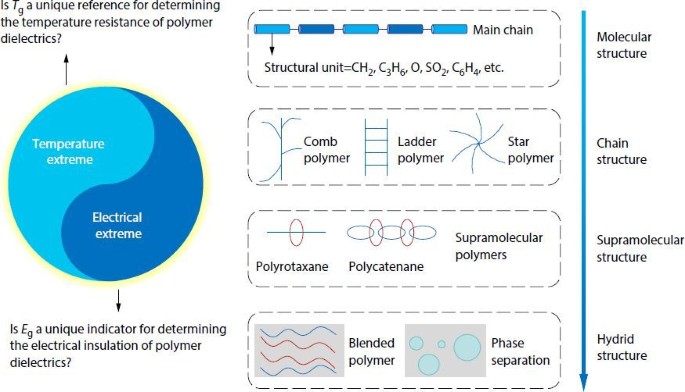
Evaluation criteria and multilevel design of high-temperature polymer dielectrics.
GA, UNITED STATES, July 27, 2026 /EINPresswire.com/ -- Capacitors that power electric vehicles, aircraft, drilling systems and other high-energy equipment must charge in seconds while surviving temperatures that quickly undermine conventional polymer films. A new review maps how all-organic dielectric materials can be redesigned to preserve electrical insulation, release stored energy efficiently and remain manufacturable under extreme heat. It organizes recent advances across four linked scales—from chemical building blocks and chain architecture to supramolecular interactions and polymer blends—and connects each level to charge transport, breakdown and thermal stability. By turning scattered approaches into a unified design framework, the review offers a practical route toward lighter, scalable capacitors for harsh environments, where the commercial benchmark, biaxially oriented polypropylene (BOPP), reaches its limits.
Dielectric capacitors store energy through polarization rather than chemical reactions, enabling rapid charging, high power density and long cycling life. Polymer films are especially attractive because they are lightweight, flexible, inexpensive and resistant to high voltage. Yet rising temperature creates a difficult trade-off: rigid, heat-resistant structures can narrow electronic energy gaps and increase conduction losses, while materials with strong insulation may lack the thermal stability needed for operation above 120 °C. Surface coatings and inorganic fillers can improve performance, but complex processing, cost and uneven interfaces may hinder large-scale film production. Because of these challenges, deeper research is needed into all-organic structural strategies that jointly control heat resistance, charge transport, dielectric response and manufacturability.
Researchers from Tsinghua University, together with the School of Electric Power Engineering at South China University of Technology, published the review online on May 14, 2026, in the Chinese Journal of Polymer Science. The research team assessed recent progress in molecularly designed polymers and all-organic composites for high-temperature capacitive energy storage, linking multiscale structures to electrical conduction, thermal behavior and device-level performance.
Rather than ranking materials by a single metric, the review examines how several structural levels work together. At the primary-structure level, main-chain, side-group and copolymer design can tune glass-transition temperature (Tg), energy bandgap (Eg), dielectric constant and charge-trapping behavior. The authors highlight evidence that a larger Eg is not always decisive once charge transport shifts to hopping pathways; molecular geometry, including the angle between conjugated planes, can become equally important. At the chain level, ladder-shaped polymers, grafting and crosslinking can restrict molecular motion, reduce leakage current and strengthen films. One ladder-shaped system reviewed achieved a thermal conductivity of 1.9 watts per metre-kelvin and delivered 5.34 joules per cubic centimetre at 200 °C with 90% efficiency, showing how dense chain packing can improve both heat flow and insulation. Supramolecular hydrogen bonds and mechanically interlocked structures offer another route to confine charges without heavily altering the polymer backbone. The review also compares all-organic blends and multilayer films, which can create energy barriers or graded interfaces while retaining scalable processing. Finally, it evaluates machine learning (ML) and materials informatics as tools for screening molecular structures, while stressing that small, inconsistent datasets and limited model interpretability still constrain reliable prediction.
The authors said the central lesson is that no single molecular feature can solve the high-temperature capacitor problem. Heat resistance, electrical insulation, dielectric polarization, thermal conductivity, mechanical strength and film processing must be designed as a connected system, they said. In their view, the most promising materials will not post a record energy density in a laboratory test; they must also operate efficiently at practical electric fields, fail safely, withstand repeated thermal and electrical stress, and be manufactured as thin, uniform films. This systems-level perspective turns molecular chemistry into an engineering roadmap rather than a collection of isolated performance gains.
The framework could guide development of compact power electronics for electric vehicles, electrified aircraft, space systems, geothermal equipment and deep oil and gas exploration, where conventional cooling adds weight, cost and complexity. All-organic dielectrics may also fit established polymer-film manufacturing more readily than particle-filled materials, supporting consistent quality and larger production volumes. Before commercialization, however, researchers need better measurements of minimum breakdown strength, long-term aging, mechanical toughness, low-field energy density and heat dissipation. Building shared high-temperature datasets that capture chain relaxation, molecular packing, hydrogen bonding and charge localization could also make ML-guided design more trustworthy. Combining these advances may shorten materials development cycles and help translate promising chemistries into reliable capacitors for extreme environments.
References
DOI
10.1007/s10118-025-3545-x
Original Source URL
https://doi.org/10.1007/s10118-025-3545-x
Funding information
This work was financially supported by the National Natural Science Foundation of China (Nos. 52525303, 92466301 and 52307025).
Lucy Wang
BioDesign Research
email us here
Legal Disclaimer:
EIN Presswire provides this news content "as is" without warranty of any kind. We do not accept any responsibility or liability for the accuracy, content, images, videos, licenses, completeness, legality, or reliability of the information contained in this article. If you have any complaints or copyright issues related to this article, kindly contact the author above.
