
PATRICK MIMRAN BILLBOARD PROJECT
Patrick Mimran Billboard project
Patrick Mimran Billboard project
Billboard project
As the Venice Biennale opens Patrick Mimran introduces a different kind of presence
Art is not where you think you are going to find it”
GENEVA, GE, SWITZERLAND, April 27, 2026 /EINPresswire.com/ -- “Art needs neither masters nor slaves.”— Patrick Mimran
“Art is mute when money talks.”
“A good work of art is one that you still love on the day it is worth nothing.”
This is not an exhibition. It is an interruption.
For two weeks in May, as the Venice Biennale opens and the city once again becomes the epicenter of the global art world, Patrick Mimran introduces a different kind of presence into its fabric: not within institutions, but across the city itself. Forty-two large-scale billboards appear along routes of passage and waiting—Piazzale Roma, the railway station, Rialto, the Giardini, the Zattere, Murano—quietly displacing Venice’s visual order.
Not images, but statements. Not narrative, but friction.
Originally conceived in New York in 2001 and developed across cities worldwide, Mimran’s Billboard Project appropriates the language of advertising only to turn it against itself. The billboard—typically a vehicle for persuasion—is emptied out and reactivated as a site of doubt. Its function shifts: from selling to questioning.
“Art and fashion are a mismatched couple.”
“There are two universal languages: art and stupidity.”
“Artists who talk too much about their art only create art that has nothing to say.”
These phrases are short, blunt, and disarming. They do not clarify; they interrupt. They cut into the visual field with the same immediacy as commercial messaging, yet refuse its logic. Encountered in transit, they produce a brief but persistent disorientation—a pause within the flow of the city.
In Venice, this operation takes on particular resonance. At a moment when the Biennale structures meaning, frames discourse, and concentrates attention, Mimran’s intervention unfolds elsewhere: along peripheral routes, within everyday crossings, in places not designed for contemplation.
“Art is not where you think you are going to find it.”
The work does not ask to be seen; it intercepts the gaze. It does not gather an audience; it meets passersby. In doing so, it restores a degree of instability to the act of viewing—an encounter that is neither framed nor anticipated.
Mimran’s statements do not form a coherent argument. Rather, they operate as a dispersed constellation of positions—at times ironic, at times incisive—addressing the structures and contradictions of the art system itself:
“Artists and art dealers are just an unfaithful couple.”
“Art is nothing more than a commodity for collectors and a pastime for the people.”
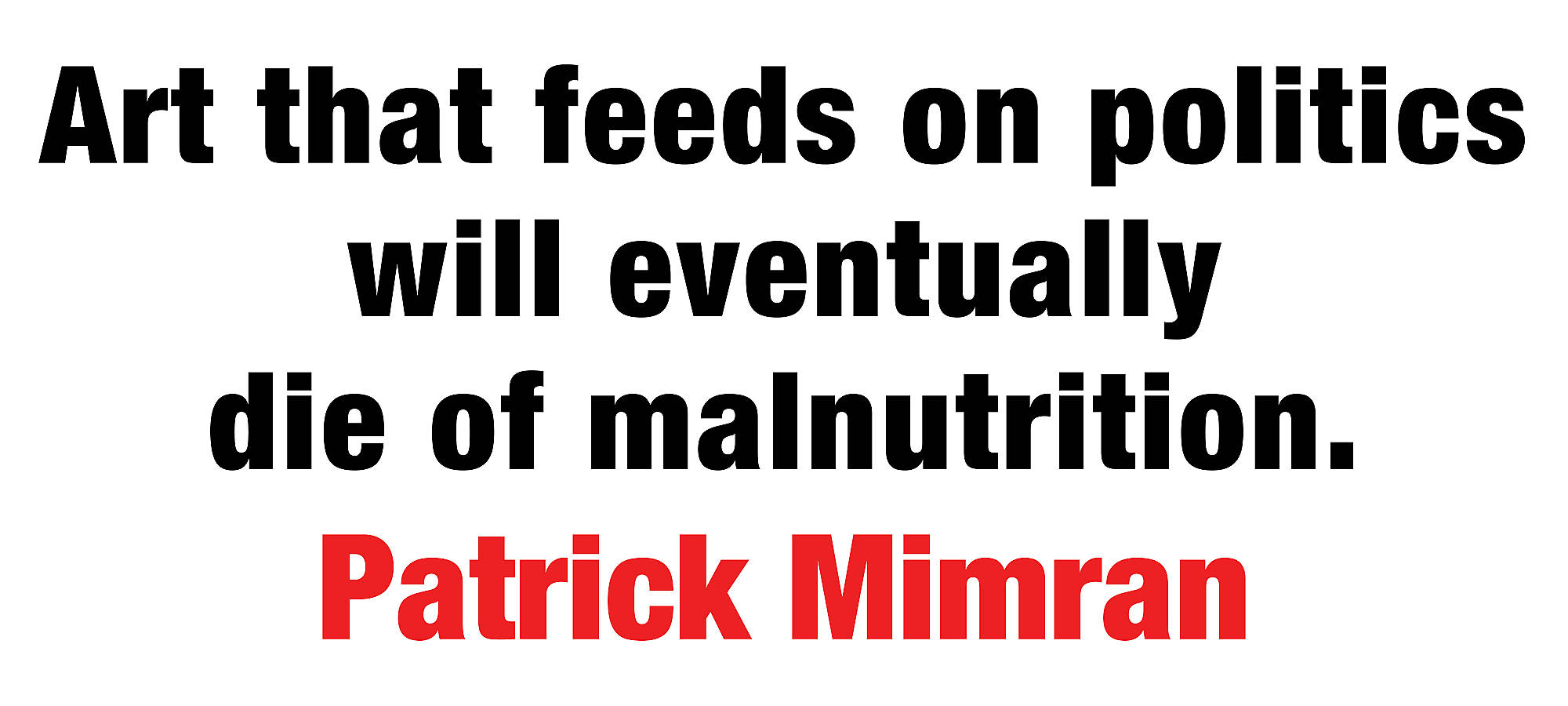
“Art that feeds on politics will eventually die of malnutrition.”
What emerges is not a thesis, but a field of tensions: a language reduced to its bare essentials, yet capable of expanding meaning precisely through its refusal to stabilize it.
Within the context of Venice, the gesture becomes almost paradoxical: while the city hosts one of the most elaborate displays of contemporary art, these interventions strip the medium down to its most elementary form—words on a surface—reclaiming immediacy against spectacle.
“Contemporary art is a discourse always explained but never understood.”
Here, the work does not coincide with the object, but with the encounter. Not the image, but the disturbance it generates.
“If art is useful, what is it good for?”
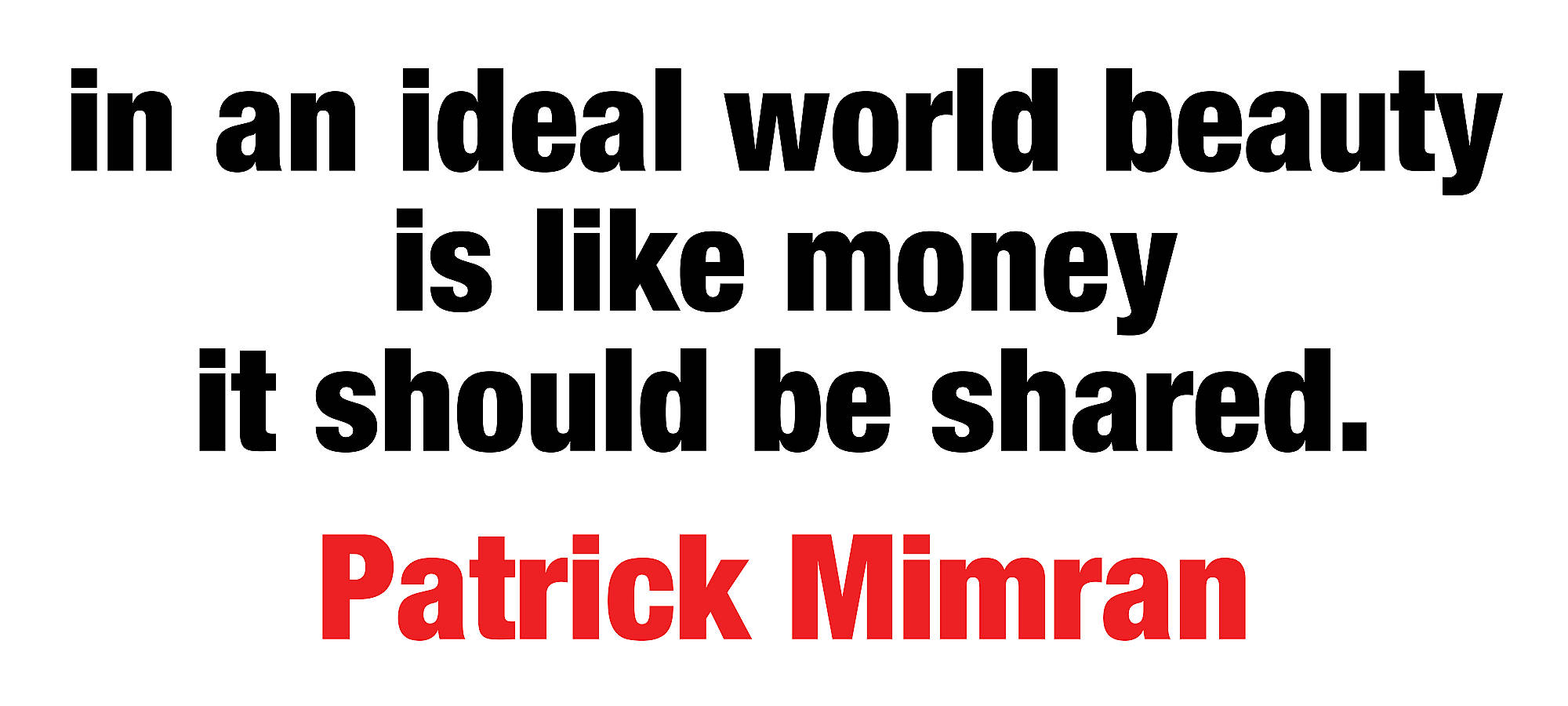
“In an ideal world, beauty is like money: it should be shared.”
On the occasion of the project’s 25th anniversary, a volume published by Marsilio (April 30, 2026), featuring texts by Mimran and Denis Curti, retraces its international trajectory. Moving between documentation and reflection, the book situates the project within a broader lineage of conceptual and public art practices, while reaffirming its core premise: that art can still operate as a direct, unmediated act within the space of everyday life.
Distribution
Disseminated across the urban landscape, the billboards trace Venice’s main routes of access and circulation: from the city’s primary gateways—Piazzale Roma, Santa Lucia railway station, Tronchetto—along the Cannaregio axis through Lista di Spagna to Rialto, the city’s commercial and symbolic core.
From there, the intervention radiates toward the monumental system of San Marco and the Biennale area—San Zaccaria, Giardini, Celestia—before extending south across Dorsoduro and the Zattere, reaching the Salute and Spirito Santo, and crossing the lagoon toward the Giudecca and San Giorgio.
The dissemination also expands northward—to Fondamente Nove, Madonna dell’Orto, Sant’Alvise, Tre Archi—reaching Murano and the Cemetery Island, and including Sant’Elena, a threshold between city and sea.
A diffuse, non-hierarchical geography that engages points of transit and marginal spaces, everyday trajectories and symbolic sites, turning the entire city into a field of appearance and friction.
Patrick Mimran
Patrick Mimran (Paris, 1956) lives and works in Switzerland. A multidisciplinary artist, his practice spans painting, photography, music, and installation, and has been presented in institutions and contexts across Europe and the United States.
Lara Facco
Lara Facco P&C
+39 02 3656 5133
press@larafacco.com
Legal Disclaimer:
EIN Presswire provides this news content "as is" without warranty of any kind. We do not accept any responsibility or liability for the accuracy, content, images, videos, licenses, completeness, legality, or reliability of the information contained in this article. If you have any complaints or copyright issues related to this article, kindly contact the author above.
