
RNA ‘Quality Control’ System Breaks Down in ALS

A Northwestern Medicine study has shed light on a critical molecular mechanism underlying amyotrophic lateral sclerosis (ALS), according to findings published in the journal Neuron.
The research points to a failure in the cell’s RNA “quality control” system, which normally keeps genetic messages clean and functional.
Every cell uses RNA as a messenger to carry instructions from DNA to make proteins, but these messages can sometimes be faulty or incomplete in ALS patients, said Evangelos Kiskinis, PhD, associate professor in the Ken and Ruth Davee Department of Neurology‘s Division of Neuromuscular Disease and of Neuroscience, who was senior author of the study.
“In most ALS patients, we know that a predominantly nuclear RNA-binding protein known as TDP-43 leaves the nucleus and forms cytoplasmic aggregates,” Kiskinis said. “This misslocalization of TDP-43 underlies the pathophysiology of the disease. In this study, we focused on understanding how loss-of-function of TDP-43 in human motor neurons affects RNA metabolism.”
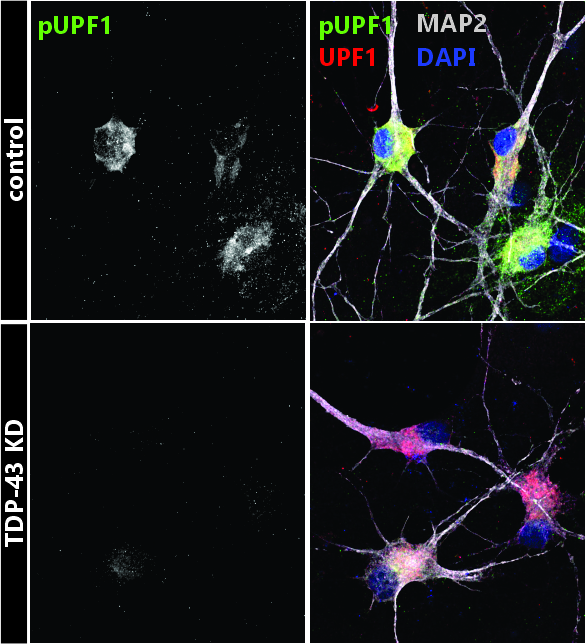
In the study, Kiskinis and collaborators examined motor neurons derived from induced pluripotent stem cells. They focused on UPF1, a protein that acts like a proofreader, scanning RNA and destroying defective copies before they cause trouble. This process, called mRNA decay, is essential for healthy cells.
The team discovered that UPF1 and TDP-43 normally work together to control the length of RNA messages — especially at their tail ends. These regions help regulate how long an RNA message lasts and where it goes in the cell. In ALS, these processes go haywire, leading to unstable RNA and stressed neurons.
Additionally, UPF1 activity was found to be significantly diminished in motor neurons from ALS patients and in cells depleted of TDP-43 — a hallmark protein of ALS pathology. The study demonstrated that TDP-43 depletion disrupts UPF1 activity, and the two proteins interact in an RNA-dependent manner, clumping together in ALS neuronal tissue.

“The reduction in UPF1 activity we uncovered allows faulty RNAs that arise downstream of TDP-43 dysfunction to escape the normal degradation and build up in disease neurons,” said Francesco Alessandrini, PhD, a postdoctoral scholar in the Kiskinis laboratory and first author of the study. “It’s like a double hit, TDP-43 and UPF1 both not working well enough.”
These findings highlight a previously unknown link between RNA decay, TDP-43 dysfunction, and neurodegeneration.
“Now that we’ve identified these aberrant RNAs, our goal is to understand their role in the breakdown of motor neurons,” said Matthew Wright, a research data analyst in the Kiskinis laboratory and co-author of the study.

The study not only maps out this broken RNA surveillance system but also suggests new treatment strategies: if scientists can restore UPF1’s “proofreading” power, they might slow or stop the damage in ALS.
“This discovery that we made has important implications for the pathophysiology of the disease,” Kiskinis said. “If indeed these RNAs are toxic and they become unbearable for cells, then the therapeutic implication is that if we figure out a way to reactivate the pathway, that would obviously be beneficial.”
The study was funded by the U.S. National Institutes of Health, National Institute on Neurological Disorders and Stroke, the National Institute on Aging, the Les Turner ALS Foundation and the New York Stem Cell Foundation. Additional support was provided by the AFM Telethon Postdoctoral Fellowship, National Institutes of Health grants R01GM059614, R35GM149268, R21GM147719 and R01NS127187; and the Target ALS Foundation.
Legal Disclaimer:
EIN Presswire provides this news content "as is" without warranty of any kind. We do not accept any responsibility or liability for the accuracy, content, images, videos, licenses, completeness, legality, or reliability of the information contained in this article. If you have any complaints or copyright issues related to this article, kindly contact the author above.
