
Radiologists at the Imapôle Lyon-Villeurbanne group benefit from the support of contextflow AI to detect lung anomalies
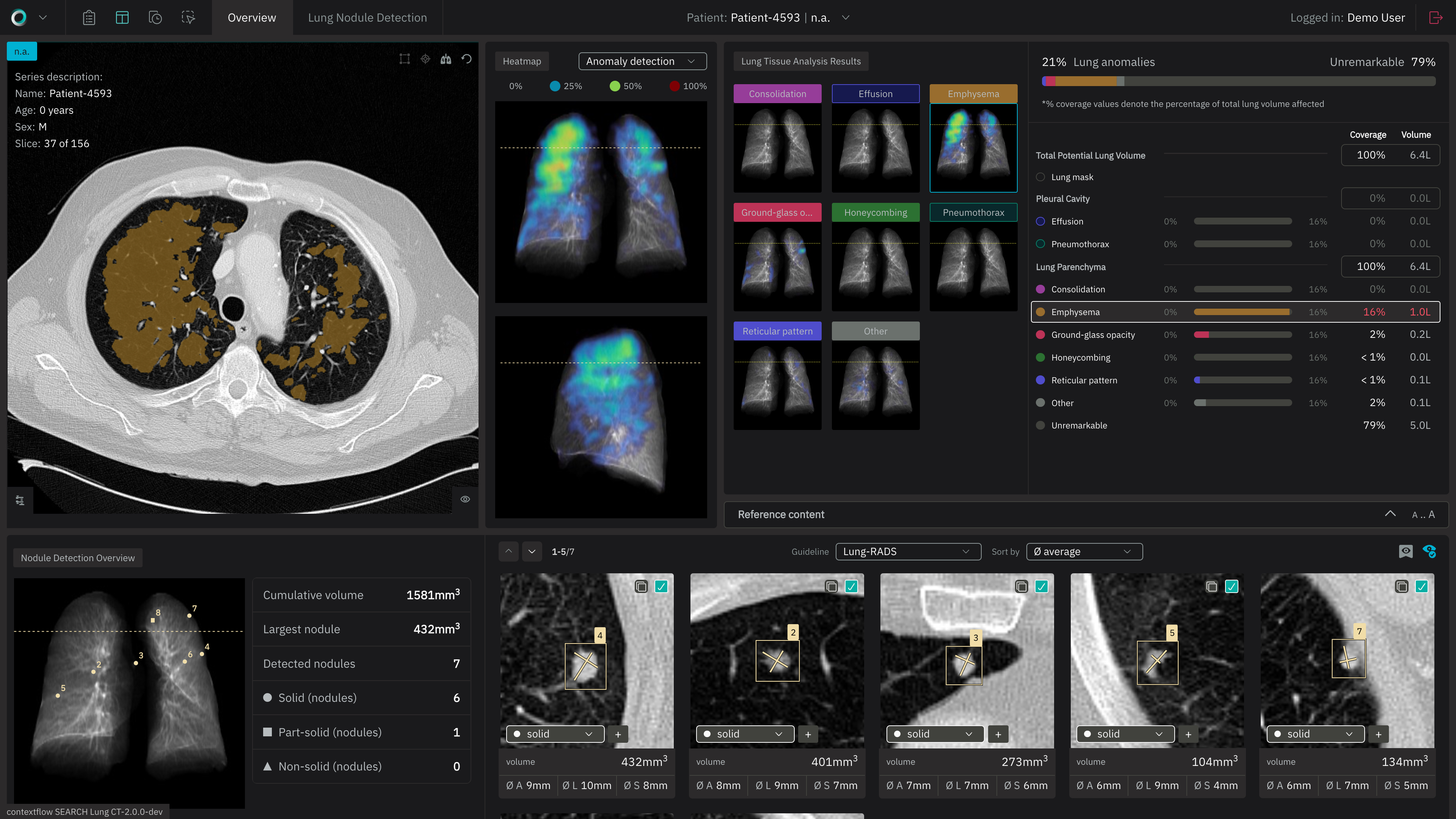
contextflow ADVANCE Chest CT provides computer-aided detection support for lung cancer, ILD, COPD, and now IPE.

contextflow logo
Imapôle Lyon-Villeurbanne is the medical imaging department of the largest private healthcare establishment in the Lyon region.
Imapôle Lyon-Villeurbanne is fully committed to this belief and has thus integrated contextflow ADVANCE Chest CT into its clinical routine.
Hello Mr. Lounis, could you tell us about Imapôle Lyon-Villeurbanne?
The Imapôle group consists of 10 radiologists responsible for reporting the medical images from two sites: Médipôle Lyon Villeurbanne, Europe's largest private hospital with over 850 beds, and the Pôle Médical d'OL Vallée in Décines. These two sites carry out more than 800 examinations a day and around 170,000 examinations a year.
What were the motivations and determining factors that led your radiology department to consider adopting contextflow in your clinical practice at Imapôle Lyon-Villeurbanne?
At Imapôle, a significant proportion of our work (∼1/3) is in oncology. This means that we have to interpret a large number of images to monitor or detect pathologies in our patients. In this context, we had been looking for a solution that could help us detect nodules and monitor their evolution in terms of size, particularly in terms of growth or shrinkage.
We are also involved in a lung cancer screening program at Médipôle - in France, studies are currently being carried out in this field. At Imapôle Lyon Villeurbanne, we have a large pneumology department, and we wanted to offer a solution that was reproducible, efficient and independent of the operator behind the screen.
Of the various solutions we had identified, contextflow was one of the three finalists, and appeared to be the most efficient and comprehensive, meeting our needs.
What were the selection criteria and what preliminary evaluations were carried out before choosing contextflow’s software for your radiology department?
We explored the market to find solutions suited to our mission, which is to detect and monitor lung nodules over time. We also took into account other criteria such as the time taken to return results. It was essential that the analysis could be carried out quickly, with a return to the PACS and the doctor in around five minutes, in order to maintain our patient management flow. After a comparison of contextflow to other vendors, we chose contextflow because it offers more than just nodule detection and integrates very well into our PACS.
The other point that was a "game changer" in our choice was contextflow's ability to look ahead and offer incidental pulmonary embolism detection in the near future. This gives us a tool capable of responding to several of our problems, particularly in oncology, for long-term monitoring, analysis and reproducibility of measurements, as well as analysis and quantification of other pulmonary pathologies like emphysema.
Can you retrace the history of the integration of contextflow’s software in your radiology department, from its implementation to the present day?
contextflow’s technical teams have been extremely responsive. We were able to put them in touch with our IT and PACS teams, and all three teams quickly managed to install the virtual machine to carry out all the tests. We had a fairly tight deadline to achieve a level of integration that would enable us to use the system seamlessly without the doctor having to leave his environment. This was a key factor.
contextflow’s solution is fully integrated into our workflow. Sending is automatic from the modality to the AI solution, and the results are sent back to PACS. So when the doctor reads the examination, they have the contextflow results at their fingertips. The technical support provided by the teams during the start-up phase was extremely responsive, which is very positive for contextflow. The level of integration with PACS is very high.
What performance indicators and evaluation criteria are used to measure the effectiveness and clinical impact of contextflow’s software in your radiology department?
In terms of our prescribing physicians, we have a large number of pulmonologists and pulmonary oncologists in our department. So we have a team of doctors who specialize in lung diseases. They have been very satisfied with the contextflow software at an advanced level of pulmonary analysis, especially here in Lyon. They have particularly appreciated the ability to detect and track lung nodules over time and to compare results.
When a patient is sent for assessment after three or six months of chemotherapy, it is extremely valuable to have a tool like contextflow to ensure reproducibility of analysis and measurements. This has really been a major asset for our prescribing physicians.
Today, the use of the tool is practically demanded by prescribers, as they have become accustomed to its use. They therefore refer their patients to our center so that their scans can benefit from this additional in-house analysis. As far as our own doctors are concerned, as I mentioned earlier, the more transparent the interface in the workflow, the more it is used. As a result, 100% of lung scans now go through contextflow, benefiting from both medical and AI-assisted dual analysis.
How would you like to see the contextflow solution evolve in the future?
I would love to see contextflow provide a solution for the detection of pulmonary embolism, as this is a real need for all emergency medical imaging departments. This will be of considerable help to emergency physicians and doctors, speeding up patient management and reducing the time lost in analysis. The contextflow team took our feedback seriously and is working towards this.
Still, we are very satisfied with the current solution. contextflow is continuously improving the specificity and sensitivity of the nodule detection algorithm. Next, they plan to extend the possibilities of thoracic pathology analysis, not only for the lungs, but also for the vessels and heart, as well as for all organs located in the thoracic region. If contextflow could also provide analysis for these elements in the future, that would be a real asset.
Julie Sufana
contextflow GmbH
+43 676 9201032
jsufana@contextflow.com
What makes contextflow unique?
Legal Disclaimer:
EIN Presswire provides this news content "as is" without warranty of any kind. We do not accept any responsibility or liability for the accuracy, content, images, videos, licenses, completeness, legality, or reliability of the information contained in this article. If you have any complaints or copyright issues related to this article, kindly contact the author above.
