
RUSSIA, July 24 - The Prime Minister spoke at the forum’s plenary session, visited the exhibits and talked with participants in the Architektory.rf programme.
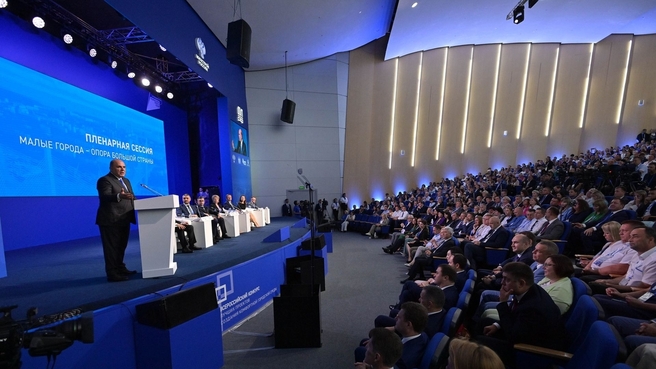
Mikhail Mishustin speaks at the plenary session of the forum, Development of Small Cities and Historical Settlements
24 July 2023

Mikhail Mishustin visits an exhibit at the forum Development of Small Cities and Historical Settlements. Left, Minister of Construction, Housing and Utilities Irek Faizullin with Primorye Territory Governor Oleg Kozhemyako
24 July 2023

Mikhail Mishustin visits an exhibit at the forum Development of Small Cities and Historical Settlements
24 July 2023

Mikhail Mishustin visits an exhibit at the forum Development of Small Cities and Historical Settlements
24 July 2023

Mikhail Mishustin visits an exhibit at the forum, Development of Small Cities and Historical Settlements. From left, Primorye Territory Governor Oleg Kozhemyako; Minister of Construction, Housing and Utilities Irek Faizullin; and Deputy Prime Minister and Presidential Plenipotentiary Envoy to the Far Eastern Federal District Yury Trutnev
24 July 2023

Mikhail Mishustin visits an exhibit at the forum, Development of Small Cities and Historical Settlements. From left, Minister for the Development of the Far East and Arctic Alexei Chekunkov; Minister of Construction, Housing and Utilities Irek Faizullin; Rector of the Far Eastern Federal University (FEFU) Oleg Korobets; Primorye Territory Governor Oleg Kozhemyako; and Deputy Prime Minister and Presidential Plenipotentiary Envoy to the Far Eastern Federal District Yury Trutnev
24 July 2023

Mikhail Mishustin visits an exhibit at the forum, Development of Small Cities and Historical Settlements. From left, Primorye Territory Governor Oleg Kozhemyako; Minister of Construction, Housing and Utilities Irek Faizullin; and Deputy Prime Minister and Presidential Plenipotentiary Envoy to the Far Eastern Federal District Yury Trutnev
24 July 2023

Mikhail Mishustin visits an exhibit at the forum Development of Small Cities and Historical Settlements
24 July 2023

Mikhail Mishustin at an exhibit for the forum, Development of Small Cities and Historical Settlements. Minister of Construction, Housing and Utilities Irek Faizullin, left, with Acting Omsk Region Governor Vitaly Khotsenko
24 July 2023
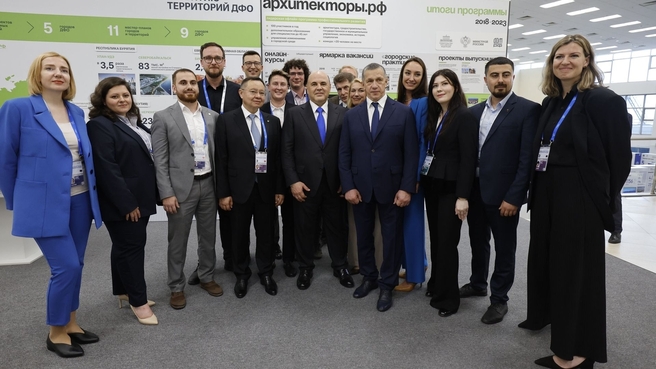
Mikhail Mishustin after visiting an exhibit at the forum, Development of Small Cities and Historical Settlements, with representatives of the Architektory.rf (Architects) programme
24 July 2023

Mikhail Mishustin speaks at the plenary session of the forum, Development of Small Cities and Historical Settlements
24 July 2023

Mikhail Mishustin speaks at the plenary session of the forum, Development of Small Cities and Historical Settlements
24 July 2023
Mikhail Mishustin speaks at the plenary session of the forum, Development of Small Cities and Historical Settlements
The Development of Small Cities and Historical Settlements forum is a key event in developing Russian regions and creating a comfortable urban environment.
The first forum took place in Kolomna in 2018. It launched the national competition for the best projects for creating a comfortable urban environment. The forum has also been held in Krasnogorsk, twice in Nizhny Novgorod and in Tyumen and Tambov.
This year, the forum is taking place for the eighth time. Its participants reviewed the best projects on creating a comfortable urban environment and the second contest for the regions in the Far Eastern Federal District.
The forum’s exhibits presented products of organisations involved in improving cities and villages. The underlying idea was a modern park-like setting in a city. The exhibit shows sports and children’s playgrounds, outdoor fitness equipment, surfaces for playgrounds and sports grounds, and urban territories and small architectural forms.
Companies demonstrated their greening and landscaping projects. Some sections were devoted to smart city infrastructure involving radio electronics, street lightning and eco-friendly street furniture and equipment.
The exhibit also featured the most effective tools and practices in forming and developing urban environments over the past few years.
The regions’ stands contain information about the participants in the national contest on the best projects devoted to creating a comfortable urban environment. In particular, they showcase the new regions of Russia, which are taking part in this year’s contest for the first time.
Архитекторы.рф is a leading professional development programme. It is designed to reveal the potential of Russian architects, urban planners, and state and municipal management experts. The programme was drafted by ДОМ.РФ to upgrade the skills of Russian architects, urban planners and city and municipal employees. Starting in 2023, the programme also includes geographers, environmentalists, economists, political scientists, culture experts and sociologists that have professional experience in urban development. The main goal is to create a venue for exchanging experience and expanding professional ties, upgrading urban and architectural solutions and promoting a dialogue between urban residents, experts and officials.

Mikhail Mishustin speaks at the plenary session of the forum, Development of Small Cities and Historical Settlements
Mikhail Mishustin’s remarks:
Good afternoon, friends,
I am delighted to welcome all of you to Vladivostok, a wonderful city, at the Development of Small Cities and Historical Settlements forum. It traditionally gathers hundreds of professionals – architects, urbanists, experts and representatives of regional and municipal authorities. These are people that are taking an active part in the life of their cities and communities and are doing much to improve them. It offers a very good opportunity to hold a frank discussion on issues related to improving the quality of life in each corner – in the literal sense of this word – of our vast country.
Today, the main theme is as follows: “Small towns are a support of a big country.” This is true. They are in a substantial majority and reflect Russia’s diversity, preserving its culture, history and traditions and making a tangible contribution to the national economy. These include famous tourist attractions like Plyos, Pereslavl-Zalessky, Sergiyev Posad and Bolgar; industrial cities like Cherepovets, Gubkin and Kirovsk, ports like Nakhodka, Vyborg and Magadan and, of course, academic centres like Michurinsk, Koltsovo and Obninsk. These are the cities that form the backbone of our country from Anadyr to Baltiysk and from Pevek to Derbent.
They frequently need government support more than others. The smaller a town, the more difficult it is to find funds for its renovation and improvement, for creating modern, comfortable living conditions that would motivate people not to leave their hometowns but to stay there, to work and start a family. This is why improving living conditions in small towns is the state’s strategic priority. Without it, it is impossible to reach national development goals set to us by the President.
For many people, comfortable conditions are linked with the housing issue. Some people move from a flat into a house; others go from renting to owning their home, and still others change their small flats for bigger properties. Any of these options should be available and the state’s goal is to ensure their implementation. System-wide work is underway to allow the majority of people to acquire their own housing.
The construction of over 52 million square metres of housing was completed in the past six months. People are using large-scale mortgage programmes, including preferential lending and family mortgages, to name a few. Last year, we decided to extend them until the middle of next year on the President’s instructions. About 300,000 loans were already granted under these programmes in the first six months of this year.
Today, every other flat is bought under the Far Eastern mortgage programme in the regions of the Far Eastern Federal District. Over 73,000 families have used it during its operation. Last year, it included teachers and medical workers and it was extended for another six years.
People in small communities have the opportunity to take out rural mortgages; over the past three and a half years, about 120,000 loans have been issued. Recently, we have made the mortgage terms more attractive by doubling the maximum size of a loan with an interest rate of up to 3 percent, which is now 6 million roubles.
Of course, in the majority of regions there are mostly private houses in rural areas and small communities. Therefore, we are also giving a lot of attention to the development of individual housing. Today, any mortgage programme allows individuals to obtain loans if they want to buy or build housing. In the first six months of this year, 120,000 mortgage loans have been issued for this purpose for a total amount of about 450 billion roubles.
Of course, while we are building new housing, it is important to waste no time demolishing buildings that are unfit to live in – and we must do it across the whole country. These are blocks of flats in a very poor condition, of which many are located in small towns and villages.
The objective set forth in the Housing and Urban Environment national project is to ensure that not a single house which was put down as being in a state of disrepair before 1 January 2017 remains in the country within the next two years. Forty Russian constituent entities will complete this phase of the programme as early as this year. Another 14 constituent entities have already achieved this result ahead of time and are now handling the issue of demolishing buildings that were deemed unfit for habitation after 1 January 2017.
We need to continue doing whatever is necessary to bring life in small towns and settlements up to a modern standard. Incidentally, we talked this over in detail earlier today as we visited an exhibition and met with Архитекторы.рф school graduates.
This means that along with residential housing in a region, the necessary infrastructure has to be well developed, so that childcare centres and schools are conveniently located within walking distance and it does not take people hours to make multiple connections to get to the nearest hospital.
These are very important issues that can be resolved through, among other things, considerable funding. On instructions from the President, we have developed several instruments for the regions, so they can use them to accomplish these very important and vital tasks, which is what we discussed in detail with the heads of regions earlier today.
One of the most needed instruments is government loans to develop infrastructure. Last year, we distributed 1 trillion roubles among our constituent entities obliging them to use these funds to carry out about 1,000 projects to develop their engineering and utility, social, road, tourist and other types of infrastructure.
This year, we have added another 190 billion roubles in special treasury loans for this particular purpose, including 30 billion roubles allocated to Russian Far Eastern regions; 50 billion roubles were allocated to upgrade public transport, mostly in small towns and rural areas and 10 billion roubles to modernise boiler houses. It is also a very important issue.
Infrastructural bonds will also come in useful. This is an off-budget long-term financing instrument, which helps attract investment, including private investment, to the construction sector. The President has instructed us to increase the amount of these bonds to 300 billion roubles this year to facilitate the implementation of more socially important projects in the Russian regions.
Another mechanism is the utilities infrastructure modernisation programme. Thanks to this programme, 12,000 km of networks and 100 facilities will be built in the majority of the regions within the next two years, improving the quality of life for almost 3 million people.
At the President’s initiative, additional funding in the amount of 30 billion roubles will be allocated from the federal budget for these regional projects.
Bureaucratic barriers have been removed from all stages of construction to ensure that our cities can be improved faster. A major part of requirements has been made voluntary. But I want to stress that compliance with the provisions concerning safety of structures remains mandatory.
We have simplified procedures for priority infrastructure upgrade projects with respect to urban planning and land use approvals. Excessive procedures have been removed. As a result, expedited construction and maintenance of roads, schools, hospitals and other important facilities have become possible, with completion dates moving six to eight months ahead of schedule.
Around 40 million people currently live in small towns. Another 30 million live in rural areas, with the closest towns being the centres of their social, cultural and economic life.
Of course, they all need well-maintained parks, promenades, stadiums, parks; clean and well-lit streets and places for enjoyable leisure.
The Comfortable City Environment federal project was launched six years ago, resulting in more than 103,000 improved public spaces all over the country. Almost 290 billion roubles have been spent on the project, federal funds accounting for just over half.
I want to specifically note that heads of regions and municipalities have changed their attitude to this work significantly. Many more of them now go beyond the formal approach because they realise that a fountain on the main square, however beautiful, may not make people happy if what they need is a park, pretty courtyards, children’s playgrounds or sports grounds close to home. These changes bring meaningful benefits only when they meet the public’s expectations.
We have spoken about this extensively today, during the exhibition tour, with the heads of regions, but I want to reiterate how important it is to engage people, our citizens, in these processes. They should be able to choose what facilities they need, what is more important and where they should be located. It is this kind of dialogue that can produce most positive results.
More to be posted soon...
