
RUSSIA, June 1 - The Prime Minister took part in the plenary session, Digital Independence of Industrial Russia, and visited an exhibition of the latest developments by Russian companies.
Excerpts from the transcript:
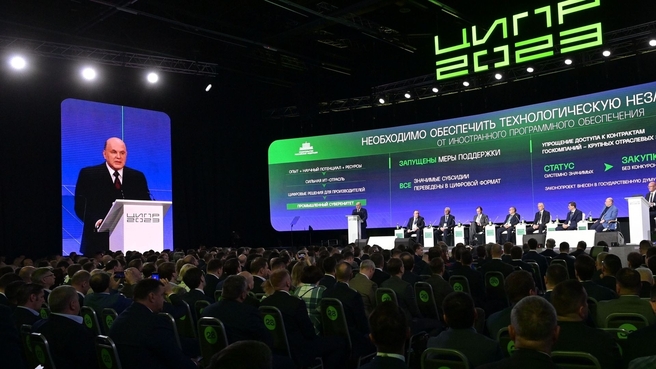
Mikhail Mushustin attends the 8thI Digital Industry of Industrial Russia conference
Mikhail Mushustin: Good afternoon, friends and colleagues,
I am delighted to be here in Nizhny Novgorod, the home place of major enterprises and a developed IT industry.
We have come here for an important industry event. The role of digital solutions has become invaluable in the world. They have become an integral part of all spheres of human endeavour and are playing a vital role in the industrial sector.
Ideas can only take the form of highly competitive products through powerful platform solutions ranging from computer-assisted design to robot software. There is no future without our own software.
This has been proved by the sanctions, when large international companies left the Russian market after promoting their technological solutions here for years, and our enterprises lost access to foreign solutions overnight, solutions they had come to rely on.
There is relentless competition for high technology in the world. In fact, it is a matter of national security.
Our President has tasked us with attaining technological independence from foreign software, which calls for creating a strong IT sector capable of creating top-tier digital solutions customised for our producers. This will create the basis for our industrial sovereignty. We have the necessary experience, research potential and resources, which we must use more energetically.
A number of special instruments such as the tax manoeuvre, targeted support packages, low-interest loan programmes and special grants have been created to stimulate the creation and manufacturing of novel products. They are provided on instructions from the President. To date, the provision of substantial subsidies has been digitised and has become more accessible for businesses.
We intend to simplify our designers’ access to contracts with state-run companies that are major industrial contractors. This involves receiving the system-relevant status, which will help such designers receive contracts without a tender. A draft law to this effect has been submitted to the State Duma.
We are also considering the idea of obligatory deductions for the use of foreign software to be made until a given company transitions to national solutions. Half of the funds could be used to issue grants to Russian IT companies. The other half will be used as collateral for the issuance of low-interest loans to them.
Our industry is well on the path towards using Russian software. According to experts, the demand for individual Russian software products increased by 10 to 12 times last year. There is no doubt that it will continue to grow.
This is a serious challenge for software designers. Over 22,000 of them have been accredited in Russia, and they are actively revising their operations with due regard for the current realities.
As for programmers, their number has increased by 13 percent compared to last year. There are over 740,000 of them now.
A good example of the situation in the industry is the sale of their own solutions and services, which has increased by nearly 25 percent to approximately 2.2 trillion roubles. It is a very positive trend.
When we met here last year, we held in-depth discussions on the industry’s requirements for innovations and end-to-end technologies, including in artificial intelligence and big data cybersecurity.
I would like to note that we have managed to launch and streamline the operation of industrial competence centres (ICC), a new mechanism of interaction between sectors and companies in the IT sphere. It comes down to joining the efforts of large clients and experienced designers. It was the first and, so far, the largest example of public-private partnership.
Overall, there are 33 such consortiums comprising over 300 industry leaders and 700 experts. They have been created in all the main sectors, such as automobile, aircraft and rolling stock manufacturing, metallurgy, oil and gas sector, and petrochemistry. Their main task is to identify sectors with critical dependence on foreign digital products and to formulate clear priorities for creating and implementing Russian software.
Overall, we have identified over a thousand foreign solutions which have a direct bearing on the manufacturing processes in terms of their sustainability. However, only one in six of them lacked a Russian equivalent. Of course, it is essential that we come up with an adequate replacement without delay. We launched the effort to develop universal software solutions in the key technological sectors, primarily in product life cycle management, digital design and virtual testing. By the way, we have seen quite a few great examples of these solutions at the exhibition stands. These are all serious end-to-end solutions that are just as good as similar Western products. If we are to succeed in putting manufacturers across the country on a sustainable development path, we must ensure that this system-wide approach is effective. Tangible results have already started to materialise.
Over 160 projects of this kind worth over 210 billion roubles in total received the green light, with only 10 percent of this amount coming from federal grants. Companies took care of the rest, making a meaningful contribution to laying the groundwork for and facilitating industrial development in Russia.
I want to extend my special gratitude to the senior executives in these companies for serving as role models in terms of their corporate technological responsibility. Many of them are here in this room. I am certain that together we will deliver on the objectives the President has set for us and make our economy even stronger.
Let me note that since the creation of the competence centres, some of them, as well as their customers have already emerged as the frontrunners. There are also those falling behind. What sectors am I referring to? Pharmaceuticals, trade, food and processing, and crop farming. We supported their projects back in 2022, but have yet to see them implemented. In fact, they never got off the ground. Moreover, the agreements to award grants to these organisations have not been signed.
Some major manufacturers adopted a passive attitude, which is utterly puzzling. Maybe they believe that the foreign solutions will last them many years.
Colleagues, let’s do away with illusions: waiting it out is not an option. We need to shape an up-to-date IT product landscape, and start ranking projects and companies in terms of their readiness and the results they achieve.
In December, the Government signed several agreements with state corporations to develop high-technology sectors as part of an effort to promote import substitution in the software industry. We also drafted roadmaps for each of these documents, covering all the initiatives whose implementation will enable us to increase the share of homegrown solutions and reach an import substitutions rate of 90 percent by the end of the decade while reducing the number of foreign solutions in the key sectors of the economy.
The transition to Russian hardware will be the next major milestone, and a very challenging one at that. It is obvious that this kind of hardware will not work unless we have Russian software to run it.
More to be posterd soon...
