
Old Jeans Could Help Power the Next Generation of Batteries
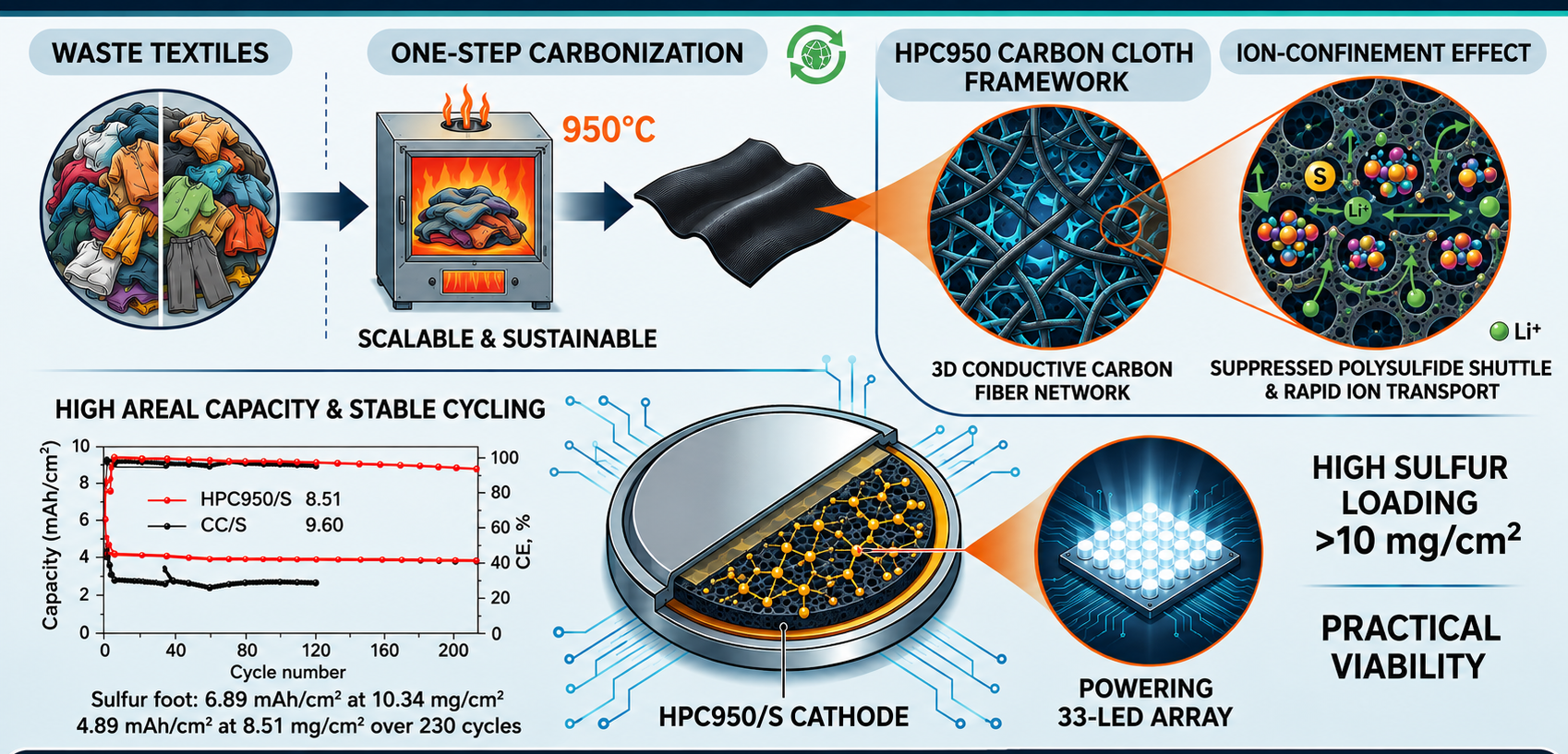
Fig.1. Waste textiles are carbonized into HPC950 carbon cloth, enabling high sulfur loading, stable cycling, and high areal capacity in lithium-sulfur batteries.
Scientists turn discarded denim into a high-performance material for lithium-sulfur batteries
Li-S batteries are considered promising for next-generation energy storage owing to the low cost and exceptional energy density of sulfur. But their development has been challenged by sulfur's poor electrical conductivity and the movement of sulfur compounds within the battery, known as the shuttle effect.
The researchers addressed these problems by heating waste denim at 950°C, turning its cotton fibres into a porous carbon cloth. The material's structure helps hold sulfur in place and control ion movement inside the battery.
The resulting battery maintained stable performance over 230 charge-discharge cycles, even with high sulfur loading. In a demonstration, it powered 33 LED lights for 40 minutes without a noticeable drop in performance.
The approach could offer a double benefit: reducing textile waste while creating a low-cost material for advanced energy storage. Because the process is relatively simple, the researchers believe it could potentially be scaled for future battery applications. Further research will focus on testing the material in battery systems designed for practical, everyday use.
About Green Chemical Engineering:
Green Chemical Engineering is an international, peer-reviewed journal covering sustainable chemistry and chemical engineering. It is indexed in ESCI, EI, Scopus, and CSCD and has an Impact Factor of 11.9 (JCR Q1) and a CiteScore of 18.5.
Read the full article here: https://doi.org/10.1016/j.gce.2026.06.003
Andrew Smith
Charlesworth Yansci
+44 7478 953600
marketing@charlesworth-group.com
Visit us on social media:
Bluesky
X
Other
Legal Disclaimer:
EIN Presswire provides this news content "as is" without warranty of any kind. We do not accept any responsibility or liability for the accuracy, content, images, videos, licenses, completeness, legality, or reliability of the information contained in this article. If you have any complaints or copyright issues related to this article, kindly contact the author above.
