
Polarization metrology for linear birefringence
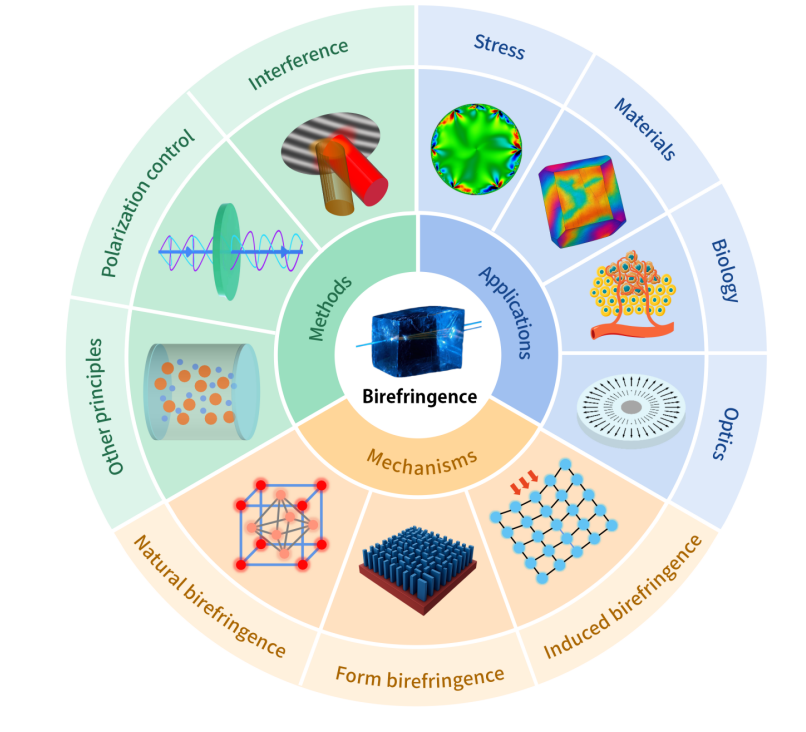
Overview of mechanisms, measurement methods, and applications of linear birefringence in transparent anisotropic media.

Mechanisms of birefringence.

Typical polarimetric modulation analysis technologies.
GA, UNITED STATES, August 24, 2026 /EINPresswire.com/ -- Birefringence provides a powerful optical window into hidden anisotropic features, stress states, and microscopic structures in transparent media. In a new review in Light: Advanced Manufacturing, scientists in China systematically summarize polarization optical metrology for linear birefringence, covering physical mechanisms, measurement models, polarimetric modulation, interferometric techniques, and key applications in stress analysis, advanced materials, biomedicine, and optical device characterization.
Transparent media such as glass, crystals, polymer films, optical components, and biological tissues are widely used in advanced manufacturing, photonic systems, precision instruments, and biomedical imaging. Although they may appear uniform, they often contain hidden anisotropy, residual stress, molecular orientation, or field-induced structural changes, which can affect optical performance and device reliability.
Birefringence is a sensitive optical signature of such anisotropic behavior. It occurs when different polarization components of light experience different refractive indices in a medium, leading to light splitting or phase retardance. By measuring phase retardance and retardance-axis orientation, researchers can reveal material information that is difficult to detect using conventional methods.
In a new review(doi: https://doi.org/10.37188/lam.2026.078) published in Light: Advanced Manufacturing, a team led by Professor Yidong Tan from Tsinghua University and Professor Hua Shen from Nanjing University of Science and Technology presents a systematic overview of polarization optical metrology for linear birefringence in transparent anisotropic media.
The review summarizes the physical origins of birefringence, including natural, engineered, and induced mechanisms, and classifies birefringent samples as static, dynamic, spatial, and spatiotemporal according to their measurement characteristics. It also establishes a unified framework based on Jones and Mueller matrix formalisms, helping clarify the intrinsic connections among different measurement methods.
The authors further discuss three main technical categories: polarimetric modulation analysis, interferometric measurement, and other optical approaches. Polarimetric methods use polarization modulation and analysis to retrieve birefringence parameters. Interferometric methods provide high sensitivity to phase changes and are suitable for precision measurement and spatial mapping. Other emerging approaches, including spectral methods, polarization cameras, metasurfaces, and integrated polarimetric devices, are pushing birefringence measurement toward compact, real-time, and multifunctional systems.
Birefringence measurement has broad applications in residual stress analysis, advanced material characterization, biomedical imaging, and optical device evaluation. It enables non-destructive visualization of stress in transparent components, reveals anisotropic responses in functional materials, provides label-free contrast for biological tissues, and supports the calibration of waveplates, liquid crystal devices, spatial light modulators, vortex waveplates, and metasurface-based polarization components.
Looking forward, birefringence metrology is expected to advance toward higher precision, faster speed, larger field of view, greater integration, and intelligent analysis, driven by the needs of precision manufacturing, advanced materials, biomedical imaging, and modern photonics.
DOI
10.37188/lam.2026.078
Original Source URL
https://doi.org/10.37188/lam.2026.078
Funding information
This work was supported by the National Natural Science Foundation of China under Grant Nos. 62405292 and 62405135; the Fundamental Research Program of Shanxi Province under Grant No. 202403021222184; the Postdoctoral Fellowship Program of CPSF under Grant Nos. GZC20240802 and GZC20242242; and the Jiangsu Funding Program for Excellent Postdoctoral Talent under Grant No. 2024ZB744.
Lucy Wang
BioDesign Research
email us here
Legal Disclaimer:
EIN Presswire provides this news content "as is" without warranty of any kind. We do not accept any responsibility or liability for the accuracy, content, images, videos, licenses, completeness, legality, or reliability of the information contained in this article. If you have any complaints or copyright issues related to this article, kindly contact the author above.
