
Smart Speakers Market Poised for Sustained Expansion with 17.1% CAGR Until 2035
Smart Speakers Market
Smart Speakers Market Size, Share and Research Report By Voice Assistant Platform (Amazon Alexa, Google Assistant, Apple Siri (HomePod), Baidu / Alibaba /
Smart Speakers Market: Expanding rapidly as voice assistants, smart home integration, and connected audio technologies reshape everyday consumer experiences.”
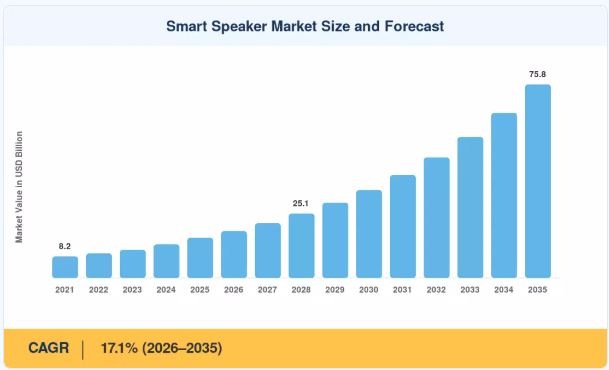
BERLIN, BERLIN, GERMANY, August 14, 2026 /EINPresswire.com/ -- The Global smart speakers market reached an estimated USD 15.6 billion in 2025 and is projected to grow from USD 18.3 billion in 2026 to USD 75.8 billion by 2035, registering a CAGR of 17.1% during the forecast period. Two major catalysts are accelerating this trajectory: the deepening integration of large language model (LLM)-powered voice assistants into everyday consumer and enterprise workflows, and the explosive proliferation of smart home ecosystems across North America, Europe, and Asia-Pacific. With over 600 million smart speaker units anticipated to be in active use globally by 2027, device manufacturers, platform operators, and third-party skill developers face mounting pressure to differentiate on voice intelligence and ecosystem interoperability or risk rapid commoditization.— Market Research Future (MRFR)
First-generation smart speakers many constrained by cloud-dependent latency, limited multilingual support, and single-ecosystem lock-in are rapidly giving way to on-device AI-enabled platforms that integrate neural processing units (NPUs), spatial audio arrays, and cross-platform Matter/Thread smart home protocols. A recent Juniper Research analysis estimated that top-quartile smart speaker deployments incorporating proactive contextual recommendations and personalized voice profiles generated 31–37% higher user engagement and monetizable interaction rates than generic, assistant-light counterparts. This technology shift is not incremental it represents a structural re-platforming of how ambient computing enters the home and workplace.
Get Full PDF Sample Copy of Report: (Including Full TOC, List of Tables & Figures, Chart) @
https://www.marketresearchfuture.com/sample_request/2286
➤ How Significant Is the Smart Speakers Market’s Growth?
The smart speakers market has demonstrated exceptional and accelerating expansion, rising from approximately USD 9.87 billion in 2021 to an estimated USD 15.6 billion in 2025, representing a dynamic historical growth trajectory. The market is expected to more than triple over the next decade, driven by surging adoption of AI voice assistants, escalating smart home device penetration, and the integration of smart speakers as central hubs within connected living environments.
Rising consumer appetite for hands-free convenience, accessibility-driven use cases across aging populations, and the rapid expansion of voice commerce with global voice shopping projected to exceed USD 80 billion annually by 2030 have created acute demand for increasingly intelligent, privacy-conscious speaker platforms. Retail brands, media companies, financial services providers, and healthcare organizations are all investing in smart speaker skills and integrations to capture emerging voice-first consumer touchpoints.
➤ What Does the Future Hold for the Smart Speakers Market?
On-device AI and generative voice intelligence stand at the forefront of the market’s next growth phase. Next-generation smart speakers are evolving from reactive command-response devices into proactive ambient computing companions. Embedded NPUs capable of running lightweight LLMs locally are enabling sub-100ms response latency, offline functionality, and on-device voice biometric authentication addressing longstanding consumer concerns around privacy, reliability, and responsiveness.
The growing emphasis on whole-home audio and multi-room synchronization is another defining force shaping the market’s future. Platforms supporting spatial audio rendering, adaptive room correction, and seamless multi-speaker synchronization via Wi-Fi 6/6E and Thread are displacing traditional standalone Bluetooth speakers in premium home audio segments. Partnerships between smart speaker OEMs and music streaming services, podcast platforms, and spatial audio content creators are further expanding the value proposition beyond voice control.
The Matter smart home interoperability standard now supported by Amazon, Apple, Google, and Samsung is fundamentally reshaping the ecosystem dynamics of smart speaker adoption. As cross-platform device control becomes table-stakes, vendors are competing on AI intelligence quality, audio fidelity, and privacy architecture rather than proprietary ecosystem lock-in. This shift is expected to accelerate smart speaker penetration into previously resistant consumer segments.
Buy this Premium Research Report at:
https://www.marketresearchfuture.com/checkout?currency=one_user-USD&report_id=2286
➤ Who Are the Key Players in the Smart Speakers Market?
The smart speakers landscape is characterized by a mix of dominant consumer technology platforms, diversified CE manufacturers, and emerging AI-native voice computing startups. Key participants shaping the competitive dynamics include:
★Amazon
★Apple
★Samsung Electronics
★Sonos
★Baidu
★Alibaba (AliGenie / Tmall Genie)
★Xiaomi
★Lenovo
★Harman International (Samsung subsidiary)
Competition in the market is intensifying as vendors race to embed generative AI and LLM-powered conversational capabilities, expand multilingual and multi-dialect voice recognition accuracy, and develop differentiated premium audio hardware. Strategic partnerships with music labels, streaming platforms, smart home device makers, and healthcare providers are increasingly reshaping the competitive landscape.
➤ What Are the Emerging Trends in the Smart Speakers Market?
Several transformational trends are redefining how the smart speakers market evolves through 2035:
Generative AI & LLM Voice Integration: Next-generation voice assistants powered by large language models are transforming smart speakers from keyword-command devices into conversational AI companions capable of multi-turn dialogue, creative generation, and complex task execution.
On-Device AI & Edge Processing: Embedded NPUs enabling on-device inference are reducing cloud dependency, delivering faster response times, offline functionality, and stronger privacy guarantees addressing key barriers to adoption in privacy-sensitive households and enterprise environments.
Matter & Cross-Platform Interoperability: The Matter smart home protocol is enabling smart speakers to serve as universal hubs controlling heterogeneous device ecosystems, reducing friction for consumers navigating multi-brand smart home environments.
Spatial Audio & Premium Sound Differentiation: Dolby Atmos support, beamforming microphone arrays, and adaptive room correction are becoming key competitive differentiators in the mid-to-premium smart speaker segment, attracting audiophile and home cinema users.
Voice Commerce & Financial Services Integration: Seamless voice-activated shopping, bill payment, banking inquiries, and loyalty redemption capabilities are driving strong engagement and monetization for platform operators, with voice commerce expected to generate over USD 80 billion globally by 2030.
Healthcare & Eldercare Applications: Smart speakers are increasingly deployed as ambient care companions for aging-in-place populations, supporting medication reminders, telehealth connectivity, emergency detection, and cognitive engagement applications a rapidly expanding vertical with strong institutional procurement momentum.
Get access to the full description of the report @
https://www.marketresearchfuture.com/reports/smart-speaker-market-2286
➤ How Is the Smart Speakers Market Segmented?
The smart speakers market report provides a comprehensive segmentation framework:
1 By Product Type: Smart Speakers, Smart Displays, Smart Soundbars
2 By Voice Assistant Platform: Amazon Alexa, Google Assistant / Gemini, Apple Siri, Proprietary AI Assistants
3 By Connectivity: Wi-Fi, Bluetooth, Wi-Fi + Bluetooth, Zigbee/Thread/Matter
4 By End-Use: Residential, Commercial & Enterprise, Hospitality, Healthcare, Education
5 By Distribution Channel: Online Retail, Consumer Electronics Stores, Operator & Carrier Channels, B2B Direct Sales
➤ What Are the Regional Insights from the Smart Speakers Market?
North America commands approximately 38% of global smart speakers market share, underpinned by the region’s high smartphone and broadband penetration, mature smart home adoption rates, and the dominant market presence of Amazon Echo and Google Nest device families. The U.S. alone accounts for the largest installed base of voice assistant-enabled devices globally, with smart speaker household penetration exceeding 40% in 2025.
Europe holds the second-largest share at approximately 24%, with the United Kingdom, Germany, and France representing the primary markets. Growing demand for privacy-compliant, GDPR-aligned voice AI platforms is shaping vendor product roadmaps and data architecture decisions across the region. Smart speaker adoption in European enterprise environments particularly in hospitality, facility management, and healthcare is an emerging growth vertical.
Asia-Pacific represents the fastest-growing major region and is expected to account for over 30% of global smart speaker unit shipments by 2035. China’s domestic smart speaker ecosystem dominated by Baidu, Alibaba, and Xiaomi forms the world’s second-largest market by volume. India represents the most dynamic emerging market, with rapid affordable-tier adoption driven by Hindi and regional language voice assistant improvements alongside affordable 4G/5G connectivity expansion.
Latin America is projected to register a CAGR of approximately 14.1% through 2035, driven by Brazil’s rapidly expanding middle-class consumer electronics market, increasing Portuguese and Spanish language support in major voice assistant platforms, and growing e-commerce adoption that is fueling voice commerce interest.
Middle East & Africa rounds out the global picture, with the UAE, Saudi Arabia, and South Africa representing the most active markets for premium smart speaker procurement. Government smart city initiatives, luxury hospitality sector deployments, and expanding 5G connectivity are key drivers of regional adoption.
➤➤➤ Industry Analysis Reports by Market Research Future:
Hi-Fi Speaker System Market
https://www.marketresearchfuture.com/reports/hi-fi-speaker-system-market-4598
Autonomous Mobile Manipulator Robots Market
https://www.marketresearchfuture.com/reports/autonomous-mobile-manipulator-robots-ammr-market-10809
Smart Cameras Market
https://www.marketresearchfuture.com/reports/smart-cameras-market-1326
Smart Indoor Lighting Market
https://www.marketresearchfuture.com/reports/smart-indoor-lighting-market-3780
Digital Process Automation Market
https://www.marketresearchfuture.com/reports/digital-process-automation-market-6651
Android Stb And Tv Market
https://www.marketresearchfuture.com/reports/android-stb-tv-market-10332
Europe Advanced Co2 Sensor Market
https://www.marketresearchfuture.com/reports/europe-advanced-co2-sensor-market-2574
Collision Avoidance Sensors Market
https://www.marketresearchfuture.com/reports/collision-avoidance-sensors-market-8167
Serdes Market
https://www.marketresearchfuture.com/reports/serdes-market-7428
Power Amplifier Market
https://www.marketresearchfuture.com/reports/power-amplifier-market-1705
Equipment Monitoring Market
https://www.marketresearchfuture.com/reports/equipment-monitoring-market-7477
Fiber Management Systems Market
https://www.marketresearchfuture.com/reports/fiber-management-systems-market-11929
Sagar Kadam
Market Research Future
+ +1 628-258-0071
email us here
Legal Disclaimer:
EIN Presswire provides this news content "as is" without warranty of any kind. We do not accept any responsibility or liability for the accuracy, content, images, videos, licenses, completeness, legality, or reliability of the information contained in this article. If you have any complaints or copyright issues related to this article, kindly contact the author above.
