
Human Memories may be Stored within Billions of Tiny 'Quantum Computers' in the Brain

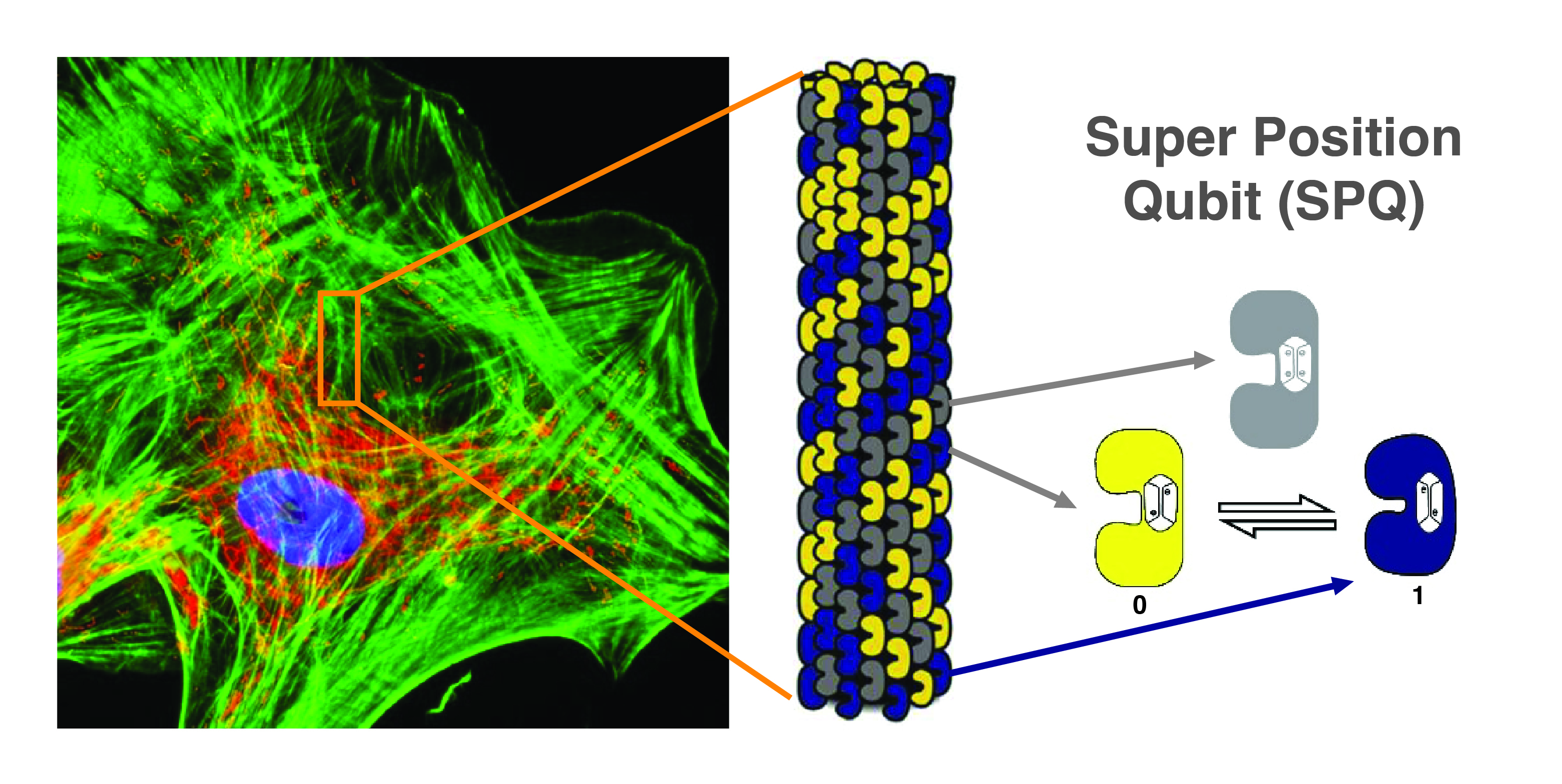
Figure 1. A human neuron showing its microtubules (green fluorescent fibers). A single microtubule is separated out to show its component tubulins. Each tubulin can be in one of two classical states (0 or 1) or in a quantum “Super Position Qubit" state (gray).
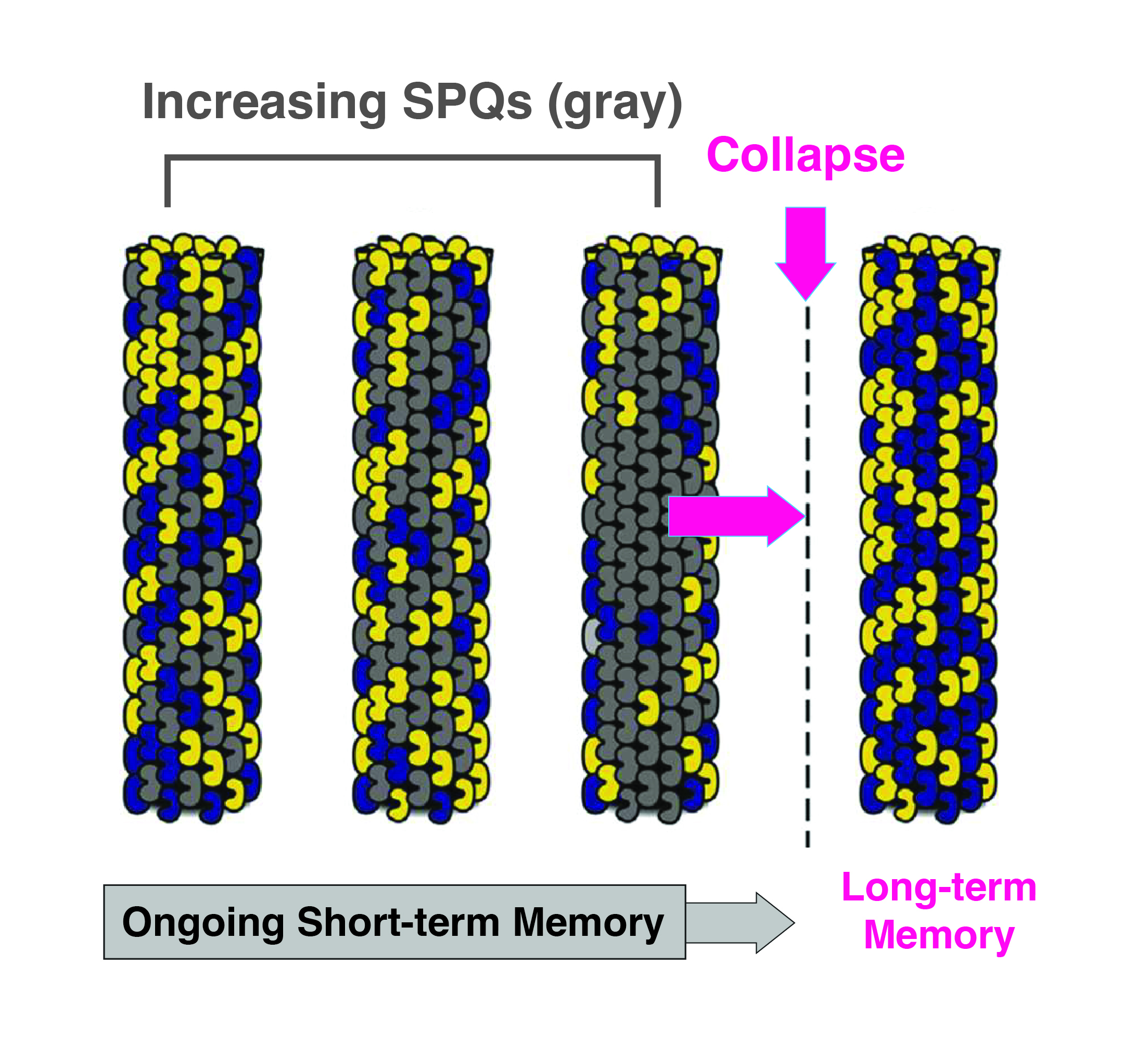
Figure 2. Human Quantum-Based Processing for Short-term Memory and its conversion into Long-Term memory within neurons.
The paper’s author, Dr. Gary Arendash of the Dept. of Molecular Biosciences at the University of South Florida and RF Longevity (RFL) says that the human brain has billions of minicomputers called “microtubules” located within its neurons - many thousands in a single neuron. These small hollow tubules appear to be crucial for normal memory and become damaged in neurologic diseases such as Alzheimer’s Disease.
In the paper, Dr. Arendash states that any therapeutic hoping to stop and reverse Alzheimer’s memory loss will likely need to address the microtubule damage caused by the disease. Such a microtubule-targeting therapeutic appears to be the Transcranial Radiofrequency Wave Treatment (TRFT) that Dr. Arendash and his USF colleagues developed and successfully tested in Alzheimer’s patients.
By targeting the dysfunctional microtubules in Alzheimer’s Disease patients, they reported in several clinical studies that TRFT can stop and reverse Alzheimer’s memory impairment - the first and only Alzheimer’s therapeutic intervention to do so. As documented in the present paper, re-vitalizing and rescuing microtubules appears to be key to these memory benefits.
Microtubules are very numerous within the large pyramidal neurons of the cerebral cortex, with 10,000 or more microtubules in each neuron. These small hollow tubules are made up of protein units called tubulin, each of which can exist in either one of two classical states (0 and 1) or in both states simultaneously as quantum “superposition qubits” (SPQs) (Figure 1).
In the paper, Dr. Arendash describes how quantum mechanisms may well be involved in memory processing and storage within neuronal microtubules. For memory processing, he describes the human brain as operating as a hybrid computer - one that involves both quantum and classical computing.
New memories are first encoded as “short-term memory” (which last a few seconds to minutes) in brain areas such as the hippocampus and pre-frontal cortex. During a short-term memory event, Dr. Arendash proposes that microtubules of neurons in these brain areas change more and more of their tubulins into the quantum superposition (SPQ) state to register that event as short-term memory.
If this short-term memory event is to be quickly forgotten, the tubulins in an SPQ state within neurons would dissipate into a random pattern of the three states on microtubules. However, if the short-term memory event is to be processed/stored into long-term memory, it would be sent to neurons in the cerebral cortex. Within these neurons, all of the created SPQs for the event would undergo collapse into one of the two classical states forming a record of the event (Figure 2).
It is in this totally collapsed state of tubulins that long-term memories are proposed to be stored in cortical neurons as a memory trace or “engram”. In essence, Dr. Arendash says that long-term memories are likely stored in a classical computer binomial state of 0’s and 1’s within microtubules for later retrieval from the memory engram of the event.
Such long-term memory storage would be very stable within microtubules and last for years or even a lifetime since most adult brain neurons survive until death.
In the extensive IJMS paper, Dr Arendash advocates that a “vibrational fabric” exists in memory neurons. This fabric consists of: 1) microtubules, 2) the radiofrequency (1 GHz) vibrations they produce, 3) the resulting photons produced by these vibrations, and 4) the ensuing creation of new quantum SPQs.
He reasoned that, if this is the case, then administration of radiofrequency waves at 1 GHz should synergize with the 1 GHz vibrations being produced by microtubules and thus enhance photon production and creation of new memory SPQs. The result would be an increase in memory processing by microtubules.
This may indeed be the case since Dr. Arendash’s pre-clinical studies showed that 1 GHz radiofrequency wave treatment to normal mice enhanced their memory. This same radiofrequency wave treatment (1 GHz) to transgenic Alzheimer’s mice either protected them against memory impairment with treatment in adulthood or reversed their memory impairment with treatment in old age.
However, the most impressive effects were seen in AD patients wherein daily “in home” TRFT treatments to the entire brain at 1 GHz reversed their memory impairment or stopped it from progressing for at least 2½ years (when the study was concluded). It is this later support in clinical studies that is unique to this quantum basis of memory and provides for its credibility.
In view of the safety and clinical efficacy of TRFT (a.k.a. TEMT) in Alzheimer’s patients, FDA in the U.S. gave this new biotechnology its first “Breakthrough” device designation against Alzheimer’s Disease several years ago.
Most of the mechanisms responsible for the striking memory benefits of TRFT against Alzheimer’s Disease appear to involve beneficial actions on neuronal microtubules. These “microtubule-targeting” actions include removal of toxic brain oligomers from microtubules, increasing microtubule vibrations, and repair of microtubules.
Dr. Arendash has thus proposed TRFT as the first “microtubule stabilizer/enhancer” for the human brain, especially one that appears to treat the microtubule dysfunction that is central to Alzheimer’s Disease.
Neuroscientists have known for many years that memory and cognition in general are centered in neuronal networks and synaptic communication of neurons within these networks. Indeed, nearly all theories of memory focus on this “neuronal network” level and most neuroscientists continue to believe that long-term memories are maintained at a neuronal network level.
However, Dr. Arendash says that there is a deeper and more basic level involved in memory - the “quantum underground” as first referred to by Dr. Travis Craddock. That deepest, intraneuronal level is likely the four-component “microtubule vibrational fabric” he has proposed, as indicated earlier in this article.
This microtubule vibrational fabric in human brains – composed of a quantum underground of microtubules and their vibrations – has lead Dr. Arendash to conclude in his paper that “this quantum-based fabric in the human brain would be extraordinarily difficult (conceivably impossible) for Artificial Intelligence to duplicate in any human synthetic brain”. This probably would bring a sigh of relief to most people.
“TRFT appears to have established itself as the best way to safely enhance or repair mechanisms of memory involving the human brain’s microtubules” Dr. Arendash said. “This is particularly important for Alzheimer’s Disease, wherein no drug has been able to stop or reverse the disease’s progressive memory loss.” He concluded that “current Alzheimer’s drugs simply don’t target microtubules or their quantum processes within the human brain - but there is now evidence that TRFT does both.”
RF Longevity, SE (RFL) is a non-profit organization based in Phoenix, AZ that is committed to advancing bioengineered devices to prevent and/or treat diseases of aging. These diseases include Alzheimer’s Disease, Parkinson’s Disease, and brain cancers. RFL’s primary goals are to identify funding sources for clinical trials involving Transcranial Radiofrequency Treatment (TRFT) and to make both the scientific community and public aware of TRFT’s effects on age-related diseases and extension of human “healthy longevity”.
Gary W Arendash
RF Longevity, SE
email us here
Legal Disclaimer:
EIN Presswire provides this news content "as is" without warranty of any kind. We do not accept any responsibility or liability for the accuracy, content, images, videos, licenses, completeness, legality, or reliability of the information contained in this article. If you have any complaints or copyright issues related to this article, kindly contact the author above.
