
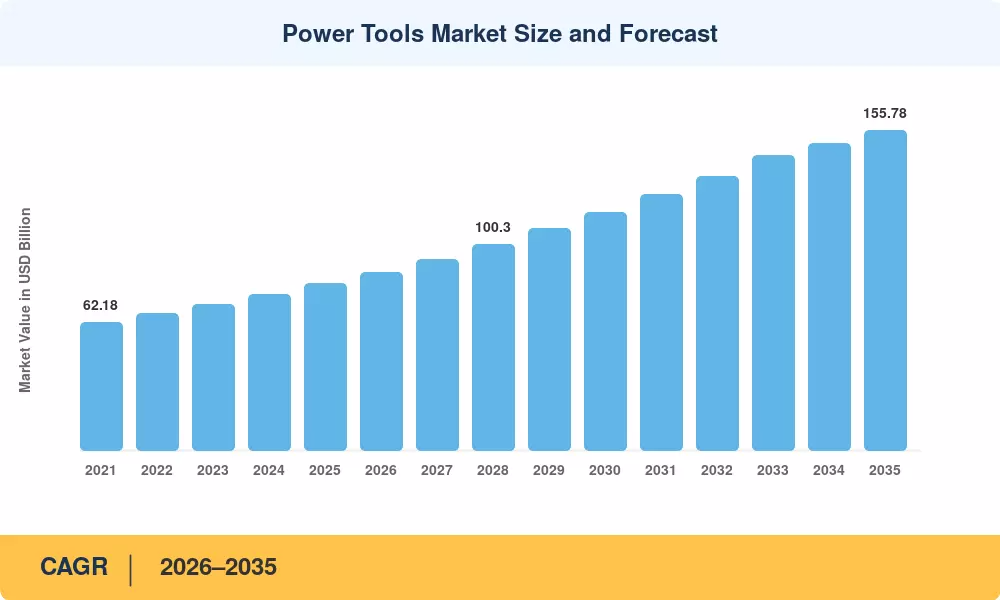
Power Tools Market to Reach USD 155.78 Billion by 2035 at 7.38% CAGR
Power Tools Market1
The Power Tools Market stood at USD 81.42 billion in 2025 and is projected to reach USD 86.47 billion by 2026
The Power Tools Market stood at USD 81.42 billion in 2025 and is projected to reach USD 86.47 billion by 2026 before climbing to USD 155.78 billion by 2035”
NEW YORK, NY, UNITED STATES, July 29, 2026 /EINPresswire.com/ -- The Power Tools Market stood at USD 81.42 billion in 2025 and is projected to reach USD 86.47 billion by 2026 before climbing to USD 155.78 billion by 2035, expanding at a CAGR of 7.38% during 2026–2035.— Arti Dhapte
Market Overview
Power tools are electrically, pneumatically, or hydraulically driven devices that significantly enhance efficiency and precision across various applications, making them essential for professionals and DIY users alike. These tools, including drills, saws, grinders, sanders, and impact wrenches, are fundamental to the global manufacturing ecosystem, enabling production across multiple sectors such as construction, automotive, electronics, and infrastructure .
The market's robust growth trajectory is underpinned by several powerful catalysts. Rising demand from the construction, automotive, manufacturing, and home improvement sectors is driving global market expansion . Rapid urbanization and infrastructure development across emerging economies, particularly in Asia-Pacific, Latin America, and the Middle East, are fueling demand for power tools in residential and commercial projects . Additionally, the proliferation of DIY trends and home renovation activities continues to boost consumer-level demand .
A fundamental technology shift is reshaping the Power Tools Market. The market is moving decisively from corded and pneumatic tools toward cordless, battery-powered solutions that offer greater mobility, convenience, and reduced reliance on traditional power sources . Advancements in lithium-ion battery technology and brushless motors are making cordless tools more powerful, efficient, and reliable. According to industry analysis, electric formats captured 63.02% of 2025 revenue, with cordless sub-segments expanding at a significant CAGR as lithium-ion packs approach corded performance parity . This shift is redefining job-site productivity, and stricter emissions rules in major cities are accelerating the replacement of pneumatic and gas-powered units with battery platforms .
Technological developments are rapidly expanding the market's capabilities and appeal. Smart power tools equipped with Bluetooth connectivity, IoT-enabled tracking, and digital controls are gaining traction, allowing users to monitor performance, track usage, and adjust settings via mobile apps . AI-powered sensors are enabling real-time tool health monitoring, reducing wear and tear, and optimizing performance through predictive maintenance features . The integration of brushless motor technology is enhancing efficiency, durability, and power output while extending tool lifespan. Ergonomics, user safety features, and dust protection are increasingly prioritized in product design .
Policy and regulatory influence on the market is growing. Government initiatives promoting smart manufacturing, such as the EU's IPCEI stimulus and India's "Make in India" incentives, are stimulating factory-floor investments in high-precision, connected tool systems . Stricter safety regulations are driving the integration of advanced safety features such as auto-shutoff mechanisms, vibration control, and enhanced grip designs . Regulations targeting Hand-Arm Vibration Syndrome (HAVS) are prompting redesigns in demolition hammers to mitigate vibration exposure . On the trade front, tariffs on Chinese lithium-ion batteries have impacted manufacturing costs and pricing .
The demand outlook remains exceptionally strong, with the market poised for sustained double-digit growth. Asia-Pacific is the dominant and fastest-growing region, holding nearly 40% of global revenue, anchored by China's industrial expansion and India's manufacturing sector growth . The region's booming construction sectors, rapid urbanization, and increasing consumer spending are fueling demand . North America represents a technologically advanced market, driven by significant equipment rental revenue and a strong professional user base . Europe shows divergent trajectories: Western markets face rental channel saturation, while Eastern Europe benefits from EU funding and new manufacturing capacity .
📍 Get Free Sample Report for Detailed Market Insights:
https://www.marketresearchfuture.com/sample_request/3571
Market Segmentation
By Mode of Operation
The market is segmented by mode of operation into Electric (Corded + Cordless), Pneumatic, Hydraulic, and ICE (Gasoline/Diesel). Electric tools dominate the market, with cordless tools experiencing rapid growth as lithium-ion battery technology advances . Cordless tools are particularly popular due to their mobility, convenience, and decreasing performance gap compared to corded alternatives. Pneumatic tools retain their foothold in industrial settings where compressed-air systems already exist, while hydraulic devices serve ultra-high-torque niches such as bridge tensioning. Engine-driven equipment is increasingly relegated to off-grid construction and forestry operations due to urban noise and emissions limits .
By Product
Product segmentation covers Drilling & Fastening Tools, Impact Drivers & Wrenches, Cutting & Grinding Tools, Demolition & Concrete Tools, Sanding & Finishing Tools, and Oscillating & Multi-Function Tools. Drilling and fastening tools accounted for a significant share of 2025 revenue, reflecting their ubiquity across construction sites and assembly lines . Impact drivers and wrenches are registering high growth thanks to automotive and aerospace tightening specifications that require exact torque and data capture for traceability . Cutting and grinding tools remain resilient, with innovations such as carbide-tipped blades offering extended life compared to bi-metal alternatives. Demolition tools are seeing regulatory-driven design changes to reduce vibration exposure .
By End User
End-user segmentation includes Construction & Infrastructure, Industrial & Manufacturing, Residential & DIY, Automotive, and Aerospace & Defense. The construction segment is the largest end-user, driven by ongoing urbanization, large-scale infrastructure development, and residential housing demand . Power tools such as saws, drills, grinders, and nailers are essential for framing, installation, and finishing work across commercial and residential projects. The industrial and manufacturing sector drives demand for high-precision tools in assembly lines and repair facilities. The residential and DIY segment is expanding rapidly, fueled by home renovation trends and the increasing availability of easy-to-use, affordable tools .
By Sales Channel
Sales channel segmentation covers Offline (Retail + Distribution) and Online (E-commerce + DTC). Offline channels remain dominant, particularly through professional distributors and retail chains. However, online sales are growing rapidly, driven by e-commerce penetration, price comparison capabilities, and the convenience of direct-to-consumer (DTC) purchasing. In emerging economies, e-commerce access is widening the consumer base for power tools .
By Region
Regional segmentation includes North America, Europe, Asia Pacific, South America, and the Middle East and Africa. Asia-Pacific leads with nearly 40% of global revenue, while also posting the highest growth rate. North America and Europe are mature markets with significant technology adoption and replacement demand.
🛒 You can buy this market report at:
https://www.marketresearchfuture.com/checkout?currency=one_user-USD&report_id=3571
Regional Analysis
Asia-Pacific
Asia-Pacific held approximately 39.55% of global revenue in 2025 and is poised for significant growth, anchored by China's industrial expansion and India's manufacturing sector growth . China's 25% capital-investment hike under its upgrading plan is driving demand for power tools across construction and manufacturing. India's "Make in India" incentives are drawing both domestic and foreign OEMs, with the country's power tools export sector projected to reach USD 12 billion by 2035 . Localized battery pack production and rising disposable incomes are spurring cordless adoption . Japan's mature but innovation-centric market relies on premium brushless models. Southeast Asian countries are experiencing rapid construction activity and urbanization, fueling demand for power tools in residential and commercial projects . The region's aggressive pricing strategies, localized branding, and after-sales support are helping brands build long-term market presence .
North America
North America represents a technologically advanced market with a significant equipment rental revenue base . The United States drives regional demand, supported by high labor charges and a well-developed distribution network . The region benefits from a strong professional user base in construction, automotive, and manufacturing sectors. The shift toward cordless technologies and smart tools is prominent, with contractors demanding improved runtime, power, and connectivity. However, tariffs on Chinese batteries have inflated procurement costs, motivating near-shoring in Mexico, where tool imports have surged . The American Rental Association expects equipment rental revenue to continue climbing, reinforcing a substantial recurring demand base .
Europe
Europe shows divergent trajectories: Western markets face rental channel saturation and strict HAVS regulation, whereas Eastern Europe benefits from EU funding and new manufacturing capacity . The EU's EUR 8.1 billion IPCEI initiative stimulates smart-factory investments, generating demand for connected precision tools. Environmental compliance pressure favors electric models, and leading OEMs differentiate through low-vibration certifications and recyclable packaging . Germany is a key market, home to major manufacturers such as Bosch and Festool. The region's focus on sustainability and energy efficiency is driving innovation in eco-friendly, low-emission tools .
South America
South America is an emerging market for power tools, driven by construction activity and infrastructure development in countries such as Brazil and Argentina. The region's growth is supported by urbanization and the expansion of the manufacturing sector.
Middle East and Africa
The Middle East and Africa region is experiencing growing demand for power tools, fueled by infrastructure projects, construction booms, and industrial development. Saudi Arabia's Vision 2030 and various smart city initiatives are creating significant opportunities for power tool manufacturers.
Competitive Landscape / Key Players
The power tools market is highly competitive and fragmented, with the presence of several well-established global players and emerging regional manufacturers. The top five players hold a significant, yet not dominant, share of the market . Key companies operating in this market include Stanley Black & Decker, Robert Bosch, Techtronic Industries (TTI), Makita Corporation, Hilti Corporation, Atlas Copco, Ingersoll Rand, Snap-on, Apex Tool Group, Emerson Electric, Husqvarna, Festool, and Hitachi Koki (HiKOKI) .
Strategic developments in the market include significant investments in R&D, production expansion, M&A activities, and technology partnerships. For instance, Bosch Power Tools India's Chennai plant crossed the one-crore unit production milestone, demonstrating the scale of operations . Companies are focusing on differentiating through battery ecosystems, smart features, app integration, and IoT capabilities .
Competitive differentiation increasingly hinges on innovation in battery technology, cordless platforms, smart connectivity, and sustainability. Leading brands such as Bosch and Makita leverage ecosystem consistency to lock in customer loyalty . New Chinese entrants leverage localized production and aggressive pricing to compete . Companies are also investing in ergonomic designs, durability, and enhanced user safety features to meet evolving end-user expectations .
Latest Industry News & Developments
Recent industry developments highlight the ongoing transformation of the power tools market toward cordless technology, digital integration, and sustainability. In April 2025, NITI Aayog released a report laying out a roadmap to scale up India's exports from $1 billion to over $25 billion by 2035, targeting 10% of the global power tools market share . This reflects the growing importance of emerging manufacturing hubs.
The industry is witnessing notable advancements in battery technology, automation, and sustainability. Lithium-ion battery improvements are enabling longer run times, faster charging, and higher power output, making cordless tools more efficient and reliable . Smart power tools equipped with Bluetooth connectivity and digital controls are gaining traction, allowing users to monitor performance via mobile apps . The development of energy-efficient tools with lower carbon footprints is appealing to environmentally conscious consumers .
However, rising raw material costs and supply chain disruptions, particularly for semiconductors and battery components, are posing challenges for manufacturers, impacting production timelines and pricing .
Market Challenges & Opportunities
Key restraints facing the power tools market include fluctuating raw material costs and supply chain disruptions for critical components such as semiconductors, lithium-ion batteries, and metal components . Price volatility and demand-supply gaps in raw materials such as steel and aluminum, essential for manufacturing, create significant challenges . High tariffs on Chinese lithium-ion batteries have inflated procurement costs . The saturation of mature rental channels in Western Europe and the shortage of skilled labor for installation and maintenance in certain regions further constrain growth.
Emerging opportunities in the market are substantial and diverse. The rise of cordless and battery-powered tools presents the most significant opportunity, with advancements in lithium-ion batteries and brushless motors making cordless tools more powerful and versatile . The integration of smart and connected power tools, including IoT-enabled tracking and performance monitoring, is improving efficiency and user convenience . The growing demand for eco-friendly and low-emission tools is driving innovation in sustainable manufacturing . The expansion of automation and robotics in industrial applications is creating demand for robotic and automated power tools that enhance precision and reduce labor dependency . The increase in DIY and home improvement trends, particularly in emerging economies, is expanding the consumer base .
Future potential lies in AI-powered tools with predictive maintenance features, lightweight high-power cordless tools, and 3D-printed modular tool designs that allow for customizable attachments . The expansion of robotic power tools in construction and industrial applications will enhance precision and labor efficiency . Stricter safety regulations will drive the integration of advanced safety features, creating a premium segment for compliant products .
To explore more market insights, visit us at:
https://www.marketresearchfuture.com/reports/power-tools-market-3571
Final Market Summary
The power tools market is positioned for exceptional growth through 2035, driven by rising global construction activity, industrial expansion, the proliferation of DIY trends, and technological advancements in cordless and smart tools. The projected valuation of USD 155.78 billion reflects rapidly expanding adoption across professional, industrial, and consumer segments, with the market transitioning from traditional corded and pneumatic tools toward intelligent, battery-powered, and connected solutions.
The medium-term growth outlook remains exceptionally strong, with the market registering a robust CAGR of 7.38% during the forecast period. Asia-Pacific will continue to lead market expansion through China's industrial upgrading and India's manufacturing growth, while North America and Europe maintain significant positions through technology leadership and replacement demand. The ongoing development of advanced battery chemistries, smart connectivity, and AI-driven diagnostics will continue to expand market possibilities and applications.
Long-term industry potential extends significantly beyond the current forecast horizon. The electrification of construction equipment fleets is accelerating, with increasing expectations for fully electric jobsites within the next few years . AI-powered tools with predictive maintenance features will enhance efficiency, reducing downtime and optimizing performance . The rise of 3D printing and modular tool designs will allow for customizable attachments and multifunctional tools .
More Related Reports from MRFR Library:
Cold Storage Agv Market: https://www.marketresearchfuture.com/reports/cold-storage-agv-market-35188
Desalination Technologie Market: https://www.marketresearchfuture.com/reports/desalination-technologie-market-35190
Mobile Water Treatment System Market: https://www.marketresearchfuture.com/reports/mobile-water-treatment-system-market-35191
Residential Water Treatment Market: https://www.marketresearchfuture.com/reports/residential-water-treatment-market-35794
Flake Ice Machine Market: https://www.marketresearchfuture.com/reports/flake-ice-machine-market-35926
Water Treatment As A Service Market: https://www.marketresearchfuture.com/reports/water-treatment-as-a-service-market-36202
Mobile Water Treatment Service Market: https://www.marketresearchfuture.com/reports/mobile-water-treatment-service-market-36807
Cut To Length Line System Market: https://www.marketresearchfuture.com/reports/cut-to-length-line-system-market-37320
Residential Ball Valve Market: https://www.marketresearchfuture.com/reports/residential-ball-valve-market-37475
Process Liquid Analyzer Market: https://www.marketresearchfuture.com/reports/process-liquid-analyzer-market-37728
Larry Wilson
WantStats Research And Media Pvt. Ltd.
+1 855-661-4441
email us here
Legal Disclaimer:
EIN Presswire provides this news content "as is" without warranty of any kind. We do not accept any responsibility or liability for the accuracy, content, images, videos, licenses, completeness, legality, or reliability of the information contained in this article. If you have any complaints or copyright issues related to this article, kindly contact the author above.
