
Caviar Market Poised for Growth as Premium Demand, Aquaculture and Luxury Gifting Drive Expansion to USD 1.01B by 2035
Caviar Market
Premium caviar demand is accelerating as sustainable aquaculture and luxury gifting trends propel the market toward USD 1.01 billion by 2035.
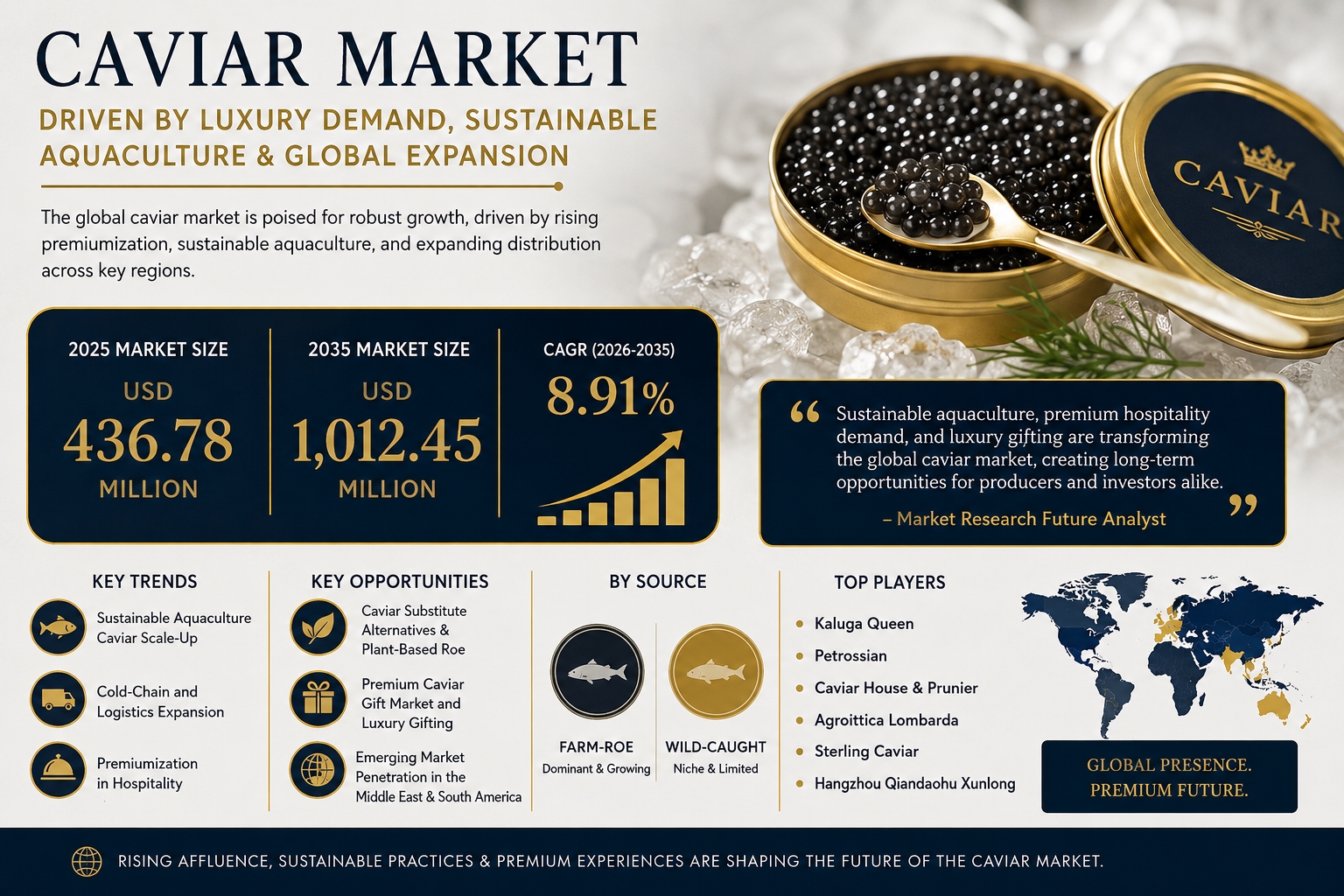
Sustainable aquaculture, premium hospitality demand, and luxury gifting are transforming the global caviar market, creating long-term opportunities for producers and investors alike.”
NEW YORK, NY, UNITED STATES, July 15, 2026 /EINPresswire.com/ -- The global caviar market is entering a new phase of growth, supported by the rise of sustainable aquaculture, the expansion of cold-chain logistics, and sustained demand from luxury hospitality, gifting, and premium food retail. According to the report, the caviar market was valued at USD 436.78 million in 2025 and is projected to reach USD 1,012.45 million by 2035, expanding at a CAGR of 10.5% from 2026 to 2035.— Market Research Future (MRFR)
Market Overview
As consumers continue to seek high-value culinary experiences and premium seafood products with clear provenance, producers are responding with improved farming techniques, greater traceability, and broader distribution strategies. While caviar has long been associated with exclusivity and fine dining, the market is now becoming more diverse, more geographically distributed, and increasingly shaped by innovation in aquaculture and logistics.
The market is being influenced by a combination of supply-side modernization and demand-side premiumization. On the supply side, farmed sturgeon roe continues to gain importance as wild-caught sourcing remains constrained by conservation concerns, trade regulations, and limited availability. On the demand side, luxury consumers, hotels, restaurants, specialty retailers, and online premium food channels are all contributing to stronger interest in high-quality caviar across multiple species and product forms.
Industry observers note that the caviar market is evolving beyond a narrow luxury niche into a more structured global specialty food category. Sustainable aquaculture is making production more scalable, while improved packaging and refrigerated shipping systems are enabling producers to maintain freshness across longer distances. These changes are helping premium caviar reach not only traditional markets in Europe and North America, but also faster-growing markets in Asia-Pacific, the Middle East, and parts of South America.
Get Full PDF Sample Copy of Report: (Including Full TOC, List of Tables & Figures, Chart) @ https://www.marketresearchfuture.com/sample_request/2707
Growth Drivers
One of the most significant market trends is the scale-up of sustainable aquaculture caviar production. Producers are increasingly investing in controlled farming systems that support more predictable yields, stronger biosecurity, and improved product quality. These methods are especially valuable in an environment where environmental stewardship and supply continuity matter as much as taste and prestige. As a result, farm-roe is expected to remain the dominant source category in the global market.
Another major development is the expansion of cold-chain and logistics infrastructure. Because caviar is highly perishable and sensitive to temperature changes, distribution capabilities play a decisive role in market growth. Better refrigerated transport, modern packing standards, and direct-to-consumer fulfillment systems are making it easier for producers to serve distant buyers without compromising quality. This trend is helping premium caviar brands grow both domestic and international sales while maintaining the freshness expectations of discerning consumers.
Premiumization in hospitality is also supporting market momentum. Fine dining restaurants, luxury resorts, cruise lines, private aviation, and high-end event catering are all using caviar to elevate the guest experience. In this environment, caviar is not only a product but also a symbol of refinement, celebration, and exclusivity. Menu innovation and experiential dining are encouraging chefs and hospitality brands to feature caviar in more versatile ways, including tasting menus, amuse-bouches, pairing experiences, and signature dishes.
The market is also being shaped by changing consumer behavior in gifting and personal indulgence. Premium caviar gift boxes and luxury gifting packs are becoming increasingly popular for holidays, corporate gifts, anniversaries, weddings, and milestone celebrations. This shift is broadening the market beyond traditional restaurant use and creating higher-value opportunities for packaging, branding, and direct-to-consumer sales. For many buyers, caviar is now viewed not only as a culinary delicacy but also as a distinctive luxury gift with strong emotional appeal.
Segment Outlook
The market covers several product categories, including Beluga, Osetra, Sevruga, Sterlet, and other species, along with different forms such as fresh, frozen, dried, pressed, and pasteurized products. It also spans farm-raised roe and wild-caught sources, distributed through off-trade and on-trade channels. This diversity is creating opportunities for companies to target distinct consumer segments, from luxury restaurants and boutique hotels to online shoppers seeking curated gourmet gifts.
Within the species segment, Beluga, Osetra, Sevruga, and Sterlet each hold distinct market positions based on taste, texture, rarity, and pricing. Beluga remains synonymous with ultra-premium prestige, while Osetra and Sevruga continue to attract interest among buyers seeking high quality with somewhat broader accessibility. Sterlet and other varieties are helping diversify the market and extend product offerings across different price bands and culinary uses. This species segmentation gives producers room to tailor their portfolios to very specific market expectations.
The form segment is equally important. Fresh caviar is often associated with the highest-end experience and immediate consumption, while frozen and pasteurized forms support broader distribution and longer shelf life. Dried and pressed formats appeal to niche culinary applications and specialized foodservice use. As product handling techniques improve, these format categories are likely to gain further relevance, especially in markets where export logistics and shelf stability are key purchasing considerations.
From a source perspective, farm-raised production is increasingly central to the long-term outlook of the industry. Aquaculture offers traceability, production discipline, and a more reliable supply base than wild-caught systems, which are constrained by ecological and regulatory factors. While some wild-caught caviar remains available in select markets, the structural direction of the industry points toward farm-roe as the dominant supply model for future growth. This shift is also aligned with growing consumer interest in sustainability and responsible sourcing.
The distribution landscape is also changing. Off-trade channels, including specialty retailers, gourmet outlets, e-commerce platforms, and premium food merchants, are becoming more important as consumers purchase caviar for home dining and gifting. On-trade channels, including restaurants, luxury hotels, and event venues, remain essential for building brand prestige and showcasing product quality. Together, these channels are helping the market move toward a more balanced structure in which both experiential dining and retail purchase behavior support growth.
Regional Outlook
Regional growth patterns are also becoming more pronounced. Asia-Pacific remains a major demand center, supported by rising affluence, expanding luxury hospitality, and growing interest in imported gourmet foods. Europe continues to serve as a leading consumption and production region, with deep culinary traditions and a strong presence of established caviar brands. North America remains a key market for premium retail, specialty e-commerce, and fine dining applications. Meanwhile, the Middle East and South America are emerging as attractive expansion regions due to increasing luxury consumption and the growing popularity of premium food experiences.
These regional dynamics are encouraging producers to adapt their strategies to local preferences, regulatory environments, and distribution realities. In mature markets, consumers often place a premium on heritage, authenticity, and brand reputation. In emerging markets, demand is increasingly shaped by luxury lifestyle trends, gifting culture, and the desire for distinctive imported products. As a result, companies that can combine premium positioning with flexible market entry strategies are likely to gain a stronger foothold across multiple geographies.
The report also highlights opportunities in emerging market penetration in the Middle East and South America. These regions are becoming more relevant as luxury dining expands and affluent consumers seek premium products that signal status and sophistication. For caviar brands, this creates room for targeted partnerships with high-end retailers, hospitality groups, and gourmet distributors that can introduce the category to new audiences.
Competitive Landscape
Leading players in the market include Kaluga Queen, Petrossian, Caviar House & Prunier, Agroittica Lombarda, Sterling Caviar, and Hangzhou Qiandaohu Xunlong. These companies are positioned across different parts of the value chain and represent a mix of long-established luxury brands and high-capacity aquaculture producers. Competitive advantage in this market is increasingly tied to product consistency, traceability, brand reputation, international distribution, and the ability to serve both traditional and emerging demand centers.
Market participants are also expected to invest more heavily in product education and brand storytelling. Because caviar remains a premium purchase for many consumers, trust, provenance, and culinary guidance can make a decisive difference in conversion. Producers and distributors that clearly communicate species origin, harvest methods, storage requirements, and serving suggestions are likely to strengthen consumer confidence and improve repeat sales. In a category where quality perception matters greatly, transparency can be a powerful differentiator.
At the same time, alternative products are creating new competitive dynamics. Caviar substitute products and plant-based roe alternatives are gaining attention from consumers who want the visual appeal and serving experience of caviar in a more accessible, sustainable, or vegetarian format. While these substitutes are not expected to replace premium sturgeon caviar, they are expanding the broader market conversation around luxury seafood alternatives and opening a path for new product innovation. Brands that can successfully combine authenticity, affordability, and sustainability may find additional growth opportunities in this emerging segment.
Emerging Opportunities
The report identifies several opportunities that could shape the next phase of market development. One of the most notable is the premium caviar gift market and luxury gifting segment. As consumers increasingly purchase caviar for celebrations, corporate gifting, and special occasions, packaging and presentation are becoming as important as product quality. This is creating room for curated assortments, limited-edition gift sets, and premium branding strategies that elevate the consumer experience.
Another opportunity lies in the continued expansion of sustainable aquaculture caviar scale-up. Producers that can demonstrate responsible farming practices, strong traceability, and consistent quality are likely to appeal to both premium buyers and environmentally conscious consumers. This is especially important as sustainability becomes a more visible purchasing criterion in luxury food categories.
The report also points to caviar substitute alternatives and plant-based roe as an emerging niche. Although these products serve a different consumer base than traditional caviar, they are helping broaden category awareness and introduce new audiences to the visual and culinary appeal of roe-based products. For some brands, this may create a pathway into adjacent premium seafood and gourmet snack segments.
Future Outlook
Looking ahead, the caviar market is likely to benefit from a combination of long-term premium demand and structural supply improvements. The expansion of aquaculture, the efficiency gains of modern logistics, the growth of luxury gifting, and the opening of new regional markets all point toward sustained development through 2035. Although the category remains highly specialized, its commercial foundation is becoming broader, more resilient, and better aligned with contemporary consumer expectations.
As culinary culture continues to value exclusivity, craftsmanship, and distinctive sensory experiences, caviar is expected to remain one of the most recognizable symbols of premium food. The category’s future will depend on balancing tradition with innovation, protecting quality while expanding access, and meeting the rising demand for products that are both indulgent and responsibly sourced. For brands that can navigate these dynamics effectively, the caviar market presents a promising runway for growth over the next decade.
Discover Related Research Reports By Market Research Future:
Vegan Caviar Market
https://www.marketresearchfuture.com/reports/vegan-caviar-market-22643
Seafood Processing Market
https://www.marketresearchfuture.com/reports/seafood-processing-market-8612
Processed Seafood and Seafood Processing Equipment Market
https://www.marketresearchfuture.com/reports/processed-seafood-and-seafood-processing-equipment-market-24020
Sagar Kadam
Market Research Future
+1 628-258-0071
email us here
Legal Disclaimer:
EIN Presswire provides this news content "as is" without warranty of any kind. We do not accept any responsibility or liability for the accuracy, content, images, videos, licenses, completeness, legality, or reliability of the information contained in this article. If you have any complaints or copyright issues related to this article, kindly contact the author above.
