
Manual Wafer Aligner Market to Reach US$1,576.2 Million by 2033, Growing at an 8.8% CAGR from 2026
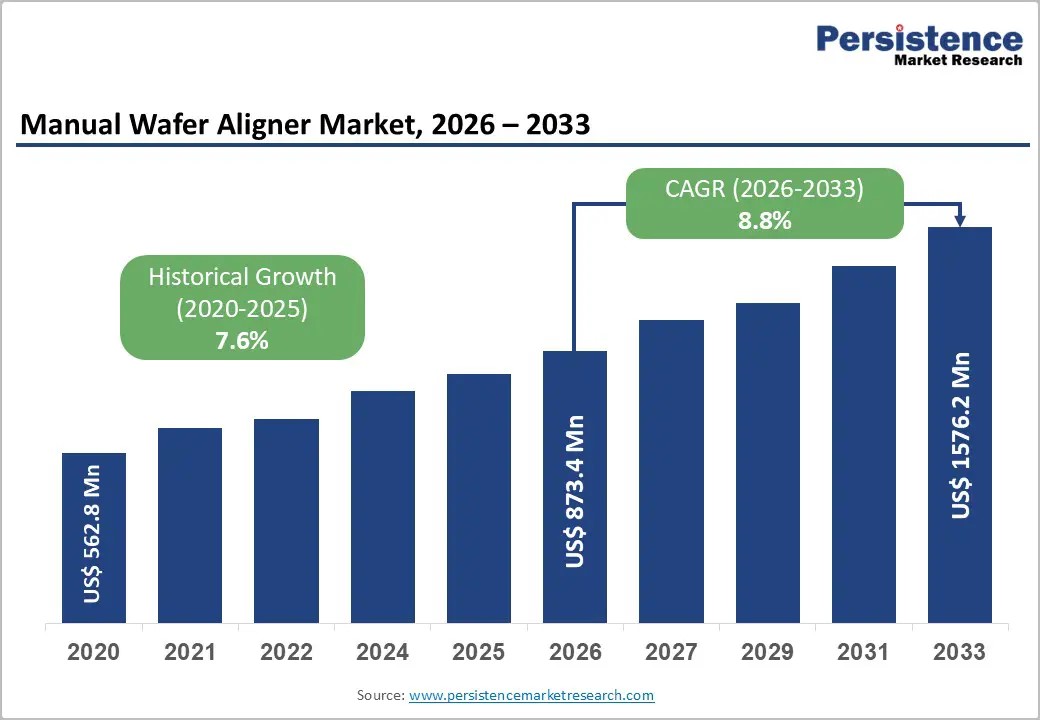
The manual wafer aligner market is valued at US$873.4 Mn in 2026 and projected to reach US$1,576.2 Mn by 2033, expanding at an 8.8% CAGR
BRENTFORD, ENGLAND, UNITED KINGDOM, June 15, 2026 /EINPresswire.com/ -- The global manual wafer aligner market is experiencing steady growth due to increasing demand for cost-effective and flexible wafer positioning solutions in specialty semiconductor manufacturing, MEMS production, research laboratories, and mature-node fabrication facilities. These systems play a vital role in ensuring accurate wafer alignment during semiconductor processing while offering greater operational flexibility than fully automated alternatives.
The market is projected to grow from US$ 873.4 million in 2026 to US$ 1,576.2 million by 2033, registering a CAGR of 8.8%. Growth is driven by rising demand for MEMS devices, automotive electronics, and continued investments in semiconductor manufacturing, particularly across Asia-Pacific. Standard manual wafer aligners lead the market with a 58% share due to their reliability and affordability, while North America remains the dominant regional market, accounting for approximately 40% of global revenue owing to its strong semiconductor R&D ecosystem and advanced manufacturing capabilities.
𝐆𝐞𝐭 𝐚 𝐒𝐚𝐦𝐩𝐥𝐞 𝐏𝐃𝐅 𝐁𝐫𝐨𝐜𝐡𝐮𝐫𝐞 𝐨𝐟 𝐭𝐡𝐞 𝐑𝐞𝐩𝐨𝐫𝐭: https://www.persistencemarketresearch.com/samples/36134
Key Market Growth Drivers
One of the most significant factors driving market expansion is the affordability of manual wafer aligners compared to fully automated alignment systems. Manual systems can cost up to 70% less while still providing alignment accuracy within ±0.5 to 1.0 micrometers, making them highly attractive for specialty semiconductor applications. Manufacturers producing MEMS sensors, power semiconductors, compound semiconductors, and analog devices benefit from lower capital expenditures without compromising operational precision.
Another major growth driver is the sustained demand for mature-node semiconductor production. Contrary to earlier expectations, 200mm wafer fabs continue operating at high utilization rates due to rising demand from automotive, industrial automation, telecommunications, and consumer electronics industries. These applications rely on mature-node chips known for long-term reliability, cost-effectiveness, and proven performance characteristics. As a result, manual wafer aligners remain essential equipment in many fabrication facilities worldwide.
Market Segmentation Analysis
The manual wafer aligner market is segmented by product type, wafer size, application, and end-user industry. Standard manual wafer aligners lead the market with a 58% share, driven by their reliability, affordability, and compatibility with wafer sizes ranging from 75mm to 200mm. Their broad application across semiconductor manufacturing and research environments continues to support strong demand.
By wafer size, the 101mm–200mm segment accounts for approximately 42.1% of market revenue, supported by the widespread use of 200mm wafers in automotive electronics, MEMS devices, power semiconductors, and analog IC production. These wafers offer a balance between manufacturing flexibility and cost efficiency.
Based on application, front-end wafer fabrication dominates the market with around 64% share, as manual wafer aligners are essential for lithography, deposition, and etching processes requiring accurate wafer orientation. Back-end packaging and research & development activities also contribute significantly to market demand.
From an end-user perspective, semiconductor manufacturers account for approximately 76% of total demand, followed by MEMS manufacturers, optoelectronics companies, LED producers, and research institutions. These sectors favor manual wafer aligners for their flexibility, ease of operation, and cost-effectiveness.
𝐃𝐨 𝐘𝐨𝐮 𝐇𝐚𝐯𝐞 𝐀𝐧𝐲 𝐐𝐮𝐞𝐫𝐲 𝐎𝐫 𝐒𝐩𝐞𝐜𝐢𝐟𝐢𝐜 𝐑𝐞𝐪𝐮𝐢𝐫𝐞𝐦𝐞𝐧𝐭? 𝐑𝐞𝐪𝐮𝐞𝐬𝐭 𝐂𝐮𝐬𝐭𝐨𝐦𝐢𝐳𝐚𝐭𝐢𝐨𝐧 𝐨𝐟 𝐑𝐞𝐩𝐨𝐫𝐭: https://www.persistencemarketresearch.com/request-customization/36134
Market Drivers
Manual wafer aligners are gaining demand due to their cost-effectiveness, flexibility, and ability to handle various wafer materials such as SiC, GaN, GaAs, and InP. Rising production of automotive electronics, MEMS sensors, and mature-node semiconductors, along with growing investments in semiconductor research and education, continues to support market growth.
Market Restraints
The increasing adoption of automated wafer alignment systems in advanced semiconductor fabs is limiting the use of manual aligners. Lower throughput, operator-dependent accuracy, and limited compatibility with Industry 4.0 smart manufacturing environments further restrict their adoption in high-volume and advanced-node production.
Market Opportunities
Rapid semiconductor localization across Asia-Pacific, particularly in China, India, and ASEAN countries, is creating significant growth opportunities for manual wafer aligners. Expanding MEMS, optoelectronics, photonics, and solar cell manufacturing applications are also driving demand for flexible and affordable wafer alignment solutions.
Regional Insights
North America remains the largest market for manual wafer aligners, accounting for approximately 40% of global market share. The region benefits from strong semiconductor research infrastructure, advanced manufacturing capabilities, and continuous investment in specialty semiconductor production. Universities, government laboratories, and research institutions contribute significantly to equipment demand. Equipment manufacturers are increasingly integrating digital features such as process monitoring and data logging to improve system capabilities.
Europe holds approximately 28% of the global market and is supported by strong precision-engineering expertise and semiconductor equipment manufacturing capabilities. Germany leads regional demand, benefiting from its advanced industrial base and strong presence in automotive, MEMS, and specialty semiconductor applications. European manufacturers continue focusing on regulatory compliance, customization, and Industry 4.0 compatibility.
Asia-Pacific is the fastest-growing regional market, expanding at nearly 10% CAGR. China, India, Japan, and ASEAN countries are driving growth through semiconductor localization strategies, foreign direct investment, and government incentives. The region is expected to contribute approximately 65% of incremental market growth through 2033, making it a key target for equipment manufacturers.
𝐁𝐮𝐲 𝐍𝐨𝐰 𝐭𝐡𝐞 𝐃𝐞𝐭𝐚𝐢𝐥𝐞𝐝 𝐑𝐞𝐩𝐨𝐫𝐭: https://www.persistencemarketresearch.com/checkout/36134
Competitive Landscape
The global manual wafer aligner market is moderately fragmented, with competition divided between established manufacturers and emerging regional suppliers. Leading companies focus on product customization, enhanced precision, improved digital monitoring capabilities, and strong after-sales support services.
Key market participants include:
• Emu Technologies
• SPS-International
• GL Automation
• H-Square
• G2 Automated Technologies
• Chung King Enterprise
• Dou Yee Enterprises
• Honwe Precision
• Shen-Yueh Technology
• Standard Technology
• Chain-Logic International
• Suzhou SOSCH Microelectronics
• JEL Corporation
• Logosol, Inc
• TB-Ploner GmbH
• MGI AUTOMATION
• UST Co., Ltd
• Hon We Precision Co. Ltd
• RECIF Technologies
Conclusion
The manual wafer aligner market is expected to experience steady growth through 2033, driven by rising demand for cost-effective semiconductor manufacturing solutions, expanding MEMS applications, and continued use of mature-node fabrication facilities. Growth opportunities will be supported by semiconductor localization initiatives in Asia-Pacific and increasing investments in automotive electronics and specialty semiconductors. Despite growing automation, manual wafer aligners will remain essential for research institutions, specialty fabs, and low- to medium-volume production environments.
Related Reports:
Pooja Gawai
Persistence Market Research
+1 646-878-6329
email us here
Visit us on social media:
LinkedIn
Instagram
Facebook
YouTube
X
Legal Disclaimer:
EIN Presswire provides this news content "as is" without warranty of any kind. We do not accept any responsibility or liability for the accuracy, content, images, videos, licenses, completeness, legality, or reliability of the information contained in this article. If you have any complaints or copyright issues related to this article, kindly contact the author above.
