
Speech-to-Text API Market Growth Driven by AI and Voice Recognition Technologies
AI-powered speech-to-text APIs are transforming digital accessibility, education, healthcare, and fintech globally.
Global Speech-to-Text API Market Expected to Reach $21 Billion by 2034 Driven by AI and Digital Inclusion”
WILMINGTON, DE, UNITED STATES, May 25, 2026 /EINPresswire.com/ -- — Allied Market Research
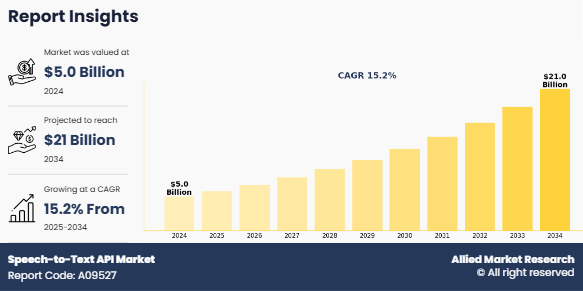
According to a new report published by Allied Market Research, the global speech-to-text API market size was valued at $5 billion in 2024 and is projected to reach $21 billion by 2034, growing at a CAGR of 15.2% from 2025 to 2034. The rapid adoption of artificial intelligence technologies, increasing demand for voice-enabled applications, and rising digital transformation initiatives are significantly contributing to the expansion of the speech-to-text API market worldwide.
Download PDF Brochure: https://www.alliedmarketresearch.com/request-sample/A09527
Introduction to the Speech-to-Text API Market
The speech-to-text API market has emerged as one of the fastest-growing segments within the artificial intelligence and cloud computing ecosystem. Speech-to-text APIs are software interfaces that convert spoken language into written text using advanced machine learning algorithms, neural networks, and natural language processing technologies. These APIs allow developers and enterprises to integrate voice recognition capabilities into websites, mobile applications, enterprise systems, customer service platforms, and smart devices.
The growing popularity of voice-based interactions is transforming the way users communicate with digital systems. Businesses across industries are increasingly integrating speech-to-text API solutions to improve accessibility, enhance customer engagement, automate workflows, and support multilingual communication. These technologies are becoming essential tools for education, healthcare, banking, retail, and government sectors seeking more inclusive and efficient digital services.
The speech-to-text API market is also benefiting from the widespread availability of smartphones, affordable internet connectivity, and cloud-based infrastructure. Voice recognition technologies are helping organizations reach underserved communities by overcoming literacy barriers and simplifying access to digital platforms.
Artificial Intelligence Driving the Speech-to-Text API Market
Artificial intelligence is playing a critical role in accelerating the growth of the speech-to-text API market. Recent advancements in deep learning models and neural networks have significantly improved speech recognition accuracy across different languages, accents, and audio environments.
Modern speech-to-text API platforms can process complex voice inputs with greater precision than traditional systems. AI-powered voice recognition solutions can identify context, recognize speech patterns, and adapt to regional pronunciations. This capability has enhanced the usability of speech-based applications in multilingual and multicultural environments.
Machine learning algorithms continuously improve performance by analyzing large datasets and learning from user interactions. These intelligent systems can filter background noise, interpret conversational speech, and deliver real-time transcription services with minimal latency.
The integration of AI technologies into speech-to-text APIs is helping businesses automate customer support, improve workplace productivity, and create seamless voice-driven experiences. As artificial intelligence continues evolving, the speech-to-text API market is expected to witness substantial innovation and expansion.
Growing Smartphone Penetration Supporting Market Growth
The rapid increase in smartphone usage globally is significantly contributing to the expansion of the speech-to-text API market. Smartphones have become the primary gateway to digital services for billions of users worldwide, especially in emerging economies.
Consumers increasingly rely on voice commands, virtual assistants, and voice-enabled search functions for daily activities. Speech-to-text APIs enable mobile applications to support voice messaging, voice search, real-time transcription, and accessibility features for users with disabilities.
Affordable Android devices and declining mobile data costs are further increasing the adoption of voice technologies across developing regions. Businesses are leveraging speech-to-text APIs to build user-friendly applications that cater to local languages and dialects.
The growing use of smartphones for education, banking, healthcare, and e-commerce is expected to create significant growth opportunities for the speech-to-text API market during the forecast period.
Digital Inclusion Initiatives Accelerating Adoption
The speech-to-text API market is experiencing strong momentum due to rising government-led digital inclusion programs across the globe. Governments and development organizations are promoting accessible digital services that can support low-literacy populations and underserved communities.
Speech-to-text APIs help bridge communication gaps by allowing users to interact with digital platforms through voice instead of text-based interfaces. These technologies are particularly beneficial in regions where literacy rates are lower or where local language support is limited.
Public sector organizations are increasingly implementing voice recognition systems for citizen services, healthcare outreach, education programs, and financial inclusion initiatives. Voice-enabled platforms are improving accessibility and enabling broader participation in digital economies.
The growing emphasis on inclusive technology solutions is expected to continue driving the growth of the speech-to-text API market globally.
Education Sector Leading the Speech-to-Text API Market
The education sector currently represents one of the largest application areas within the speech-to-text API market. Educational institutions and e-learning providers are integrating speech recognition technologies into digital learning platforms to improve accessibility and engagement.
Speech-to-text APIs support real-time transcription of lectures, language learning tools, online assessments, and accessibility services for students with hearing impairments. These technologies also assist teachers by automating note-taking and simplifying content creation processes.
Multilingual classrooms are increasingly benefiting from voice recognition tools capable of translating and transcribing multiple languages simultaneously. AI-powered educational applications are helping students improve pronunciation, reading skills, and communication abilities.
The increasing adoption of remote learning platforms and digital classrooms is expected to strengthen demand for speech-to-text API solutions across the global education sector.
Healthcare Industry Emerging as a High-Growth Segment
The healthcare sector is projected to witness significant growth within the speech-to-text API market during the forecast period. Healthcare providers are increasingly adopting voice recognition technologies to improve clinical documentation, telemedicine services, and patient communication.
Speech-to-text APIs enable doctors and healthcare professionals to record patient notes more efficiently through voice dictation. These systems help reduce administrative workloads, improve accuracy, and enhance operational efficiency within healthcare facilities.
Voice-enabled healthcare applications are also supporting remote consultations and public health communication programs, especially in rural and underserved regions. AI-powered transcription tools are improving accessibility for patients while enabling faster medical record management.
As digital healthcare transformation continues accelerating worldwide, the demand for advanced speech-to-text API solutions is expected to rise substantially.
Financial Services Adopting Voice Technologies
Financial institutions are increasingly implementing speech-to-text API solutions to improve customer accessibility and streamline banking operations. Voice-based banking services are becoming highly popular among users seeking convenient and secure digital experiences.
Speech recognition technologies enable customers to perform banking transactions, access account information, and receive customer support through voice commands. These solutions are especially beneficial for low-literacy populations and first-time digital banking users.
Banks and fintech companies are integrating AI-driven voice interfaces into mobile applications and customer service platforms to improve engagement and reduce operational costs. Voice authentication systems are also enhancing security and fraud prevention measures.
The growing adoption of digital banking and financial inclusion initiatives is expected to drive substantial growth in the speech-to-text API market.
Rise of Offline-Capable Speech Recognition Solutions
One of the most important technological advancements in the speech-to-text API market is the development of offline-capable voice recognition systems. Traditional cloud-based speech recognition solutions require continuous internet connectivity, which can be challenging in remote or low-bandwidth regions.
Modern speech-to-text APIs are increasingly incorporating edge computing capabilities that allow voice processing directly on devices without relying entirely on cloud infrastructure. These offline solutions improve speed, reduce latency, and enhance user privacy.
Offline-capable APIs are particularly valuable in education, agriculture, healthcare, and emergency response applications where internet connectivity may be limited. These technologies are helping expand the reach of voice-enabled services across rural and underserved communities.
The growing demand for reliable and accessible voice technologies is encouraging companies to invest heavily in edge AI and hybrid speech recognition architectures.
Procure This Report (422 Pages PDF with Insights, Charts, Tables, and Figures): https://www.alliedmarketresearch.com/speech-to-text-api-market/purchase-options
Market Segmentation Analysis
The speech-to-text API market is segmented based on component, enterprise size, application, industry vertical, and region.
Software Segment Dominates the Market
By component, the software segment held the largest speech-to-text API market share in 2024. Businesses are increasingly investing in AI-powered speech recognition software to automate communication processes and improve operational efficiency.
Speech-to-text software solutions are widely used across industries for transcription, voice search, virtual assistants, customer service automation, and content generation.
Large Enterprises Leading Adoption
By enterprise size, the large enterprise segment accounted for the highest market share in 2024. Large organizations manage massive amounts of customer interactions and operational data, creating strong demand for advanced voice recognition technologies.
These enterprises are leveraging speech-to-text APIs to improve customer experiences, automate workflows, and gain valuable insights from voice data analytics.
Content Transcription Segment Holds Major Share
By application, the content transcription segment dominated the speech-to-text API market in 2024. Businesses, media companies, educational institutions, and healthcare providers are increasingly relying on automated transcription services to improve productivity and accessibility.
Real-time transcription technologies are becoming essential tools for virtual meetings, podcasts, webinars, online education, and legal documentation.
Retail and E-Commerce Sector Driving Growth
By industry vertical, the retail and e-commerce segment accounted for the largest share of the speech-to-text API market in 2024. Retailers are integrating voice-enabled search functions, virtual shopping assistants, and customer service bots into digital commerce platforms.
Voice commerce is becoming increasingly popular as consumers seek faster and more personalized shopping experiences. AI-powered voice technologies are helping businesses improve customer engagement and streamline purchasing processes.
Asia-Pacific Dominates the Speech-to-Text API Market
Region-wise, Asia-Pacific held the largest speech-to-text API market share in 2024. The region benefits from rapid smartphone adoption, expanding internet connectivity, government digitalization initiatives, and a thriving startup ecosystem focused on AI technologies.
Countries such as India, China, Japan, and Southeast Asian nations are witnessing strong demand for localized voice recognition solutions that support multiple languages and dialects.
Government-backed digital identity programs, voice-enabled financial services, and AI innovation initiatives are accelerating the adoption of speech-to-text APIs across the region.
LAMEA Emerging as a High-Growth Region
LAMEA is expected to witness the highest CAGR during the forecast period. The region is experiencing increasing adoption of mobile banking, telemedicine, digital education, and agricultural advisory services powered by voice technologies.
Governments and private organizations across Latin America, the Middle East, and Africa are investing in inclusive digital infrastructure to improve accessibility and expand digital participation.
The growing need for multilingual voice solutions and affordable digital services is creating lucrative opportunities for speech-to-text API providers in the LAMEA region.
Competitive Landscape of the Speech-to-Text API Market
The global speech-to-text API market is highly competitive, with major technology companies focusing on innovation, AI development, and strategic partnerships to strengthen their market presence.
Key players operating in the market include Amazon Web Services, Inc., IBM Corporation, Google LLC, Microsoft, Apple Inc., Twilio Inc., Deepgram Inc., AssemblyAI, Inc., Sonix.ai, Speechmatics, Verbit.ai, Rev.com, and Otter.ai.
These companies are investing heavily in multilingual speech recognition capabilities, real-time transcription technologies, edge AI, and cloud infrastructure to improve accuracy and scalability.
Strategic collaborations with telecom operators, educational organizations, healthcare providers, and fintech companies are helping market players expand their customer base and global reach.
Get a Customized Research Report: https://www.alliedmarketresearch.com/request-for-customization/A09527
Future Outlook of the Speech-to-Text API Market
The future of the speech-to-text API market appears highly promising as voice technologies become increasingly integrated into everyday digital experiences. Advances in artificial intelligence, edge computing, and natural language processing will continue improving the performance and accessibility of speech recognition systems.
Businesses and governments are expected to increasingly rely on speech-to-text APIs to deliver inclusive, efficient, and scalable digital services. The growing demand for multilingual communication, touchless interfaces, and remote collaboration tools will further accelerate market expansion.
As voice becomes one of the most natural methods of human-computer interaction, the speech-to-text API market is expected to play a transformative role in shaping the future of digital accessibility, automation, and global communication.
Trending Reports in Energy and Power Industry:
Speech-to-Text API Market
https://www.alliedmarketresearch.com/speech-to-text-api-market-A09527
IoT Device Management Market
https://www.alliedmarketresearch.com/iot-device-management-market-A13166
AI in Cybersecurity Market
https://www.alliedmarketresearch.com/ai-in-cybersecurity-market-A185408
Free-to-air (FTA) Service Market
https://www.alliedmarketresearch.com/free-to-air-service-market-A07913
Storage Management Software Market
https://www.alliedmarketresearch.com/storage-management-software-market-A115204
Artificial Intelligence in Education Market
https://www.alliedmarketresearch.com/artificial-intelligence-in-education-sector-market
Voice Cloning Market
https://www.alliedmarketresearch.com/voice-cloning-market
Voice Communication Equipment Market
https://www.alliedmarketresearch.com/voice-communication-equipment-market-A14977
Adaptive Security Market
https://www.alliedmarketresearch.com/adaptive-security-market-A107607
AI in IoT Market
https://www.alliedmarketresearch.com/ai-in-iot-market-A12590
AI Text Generator Market
https://www.alliedmarketresearch.com/ai-text-generator-market-A84406
About Us
Allied Market Research (AMR) is a full-service market research and business-consulting wing of Allied Analytics LLP based in Portland, Oregon. Allied Market Research provides global enterprises as well as medium and small businesses with unmatched quality of "Market Research Reports" and "Business Intelligence Solutions." AMR has a targeted view to provide business insights and consulting to assist its clients to make strategic business decisions and achieve sustainable growth in their respective market domain.
Pawan Kumar, the CEO of Allied Market Research, is leading the organization toward providing high-quality data and insights. We are in professional corporate relations with various companies and this helps us in digging out market data that helps us generate accurate research data tables and confirms utmost accuracy in our market forecasting. Each and every data presented in the reports published by us is extracted through primary interviews with top officials from leading companies of domain concerned. Our secondary data procurement methodology includes deep online and offline research and discussion with knowledgeable professionals and analysts in the industry.
David Correa
Allied Market Research
+ + + + + + + + + + + + +1 800-792-5285
email us here
Visit us on social media:
LinkedIn
Facebook
YouTube
X
Legal Disclaimer:
EIN Presswire provides this news content "as is" without warranty of any kind. We do not accept any responsibility or liability for the accuracy, content, images, videos, licenses, completeness, legality, or reliability of the information contained in this article. If you have any complaints or copyright issues related to this article, kindly contact the author above.
