
Turning Unused Devices Into a Global Compute Layer: A Web3 Breakthrough
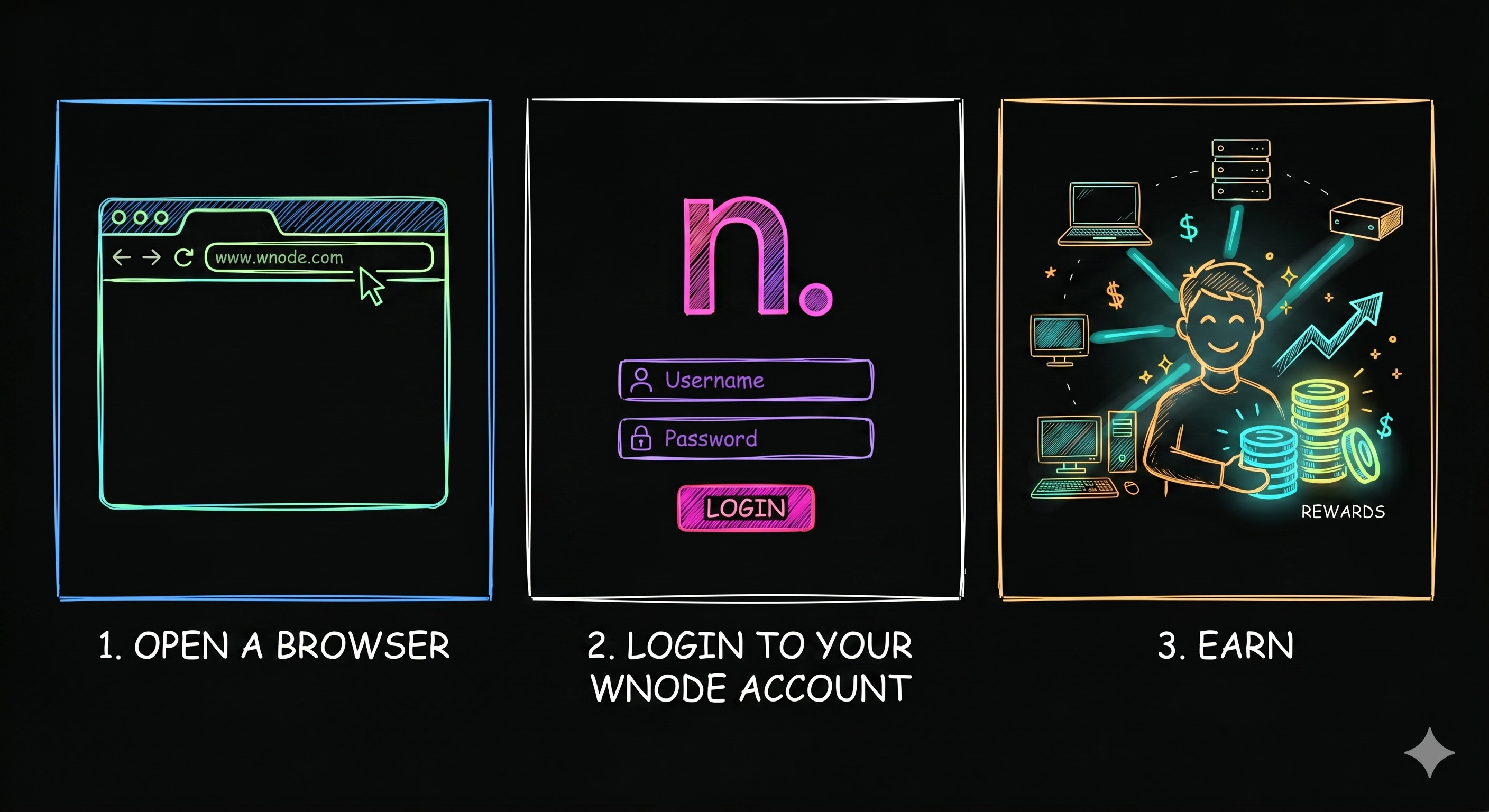
3 clicks to connect mnost devices
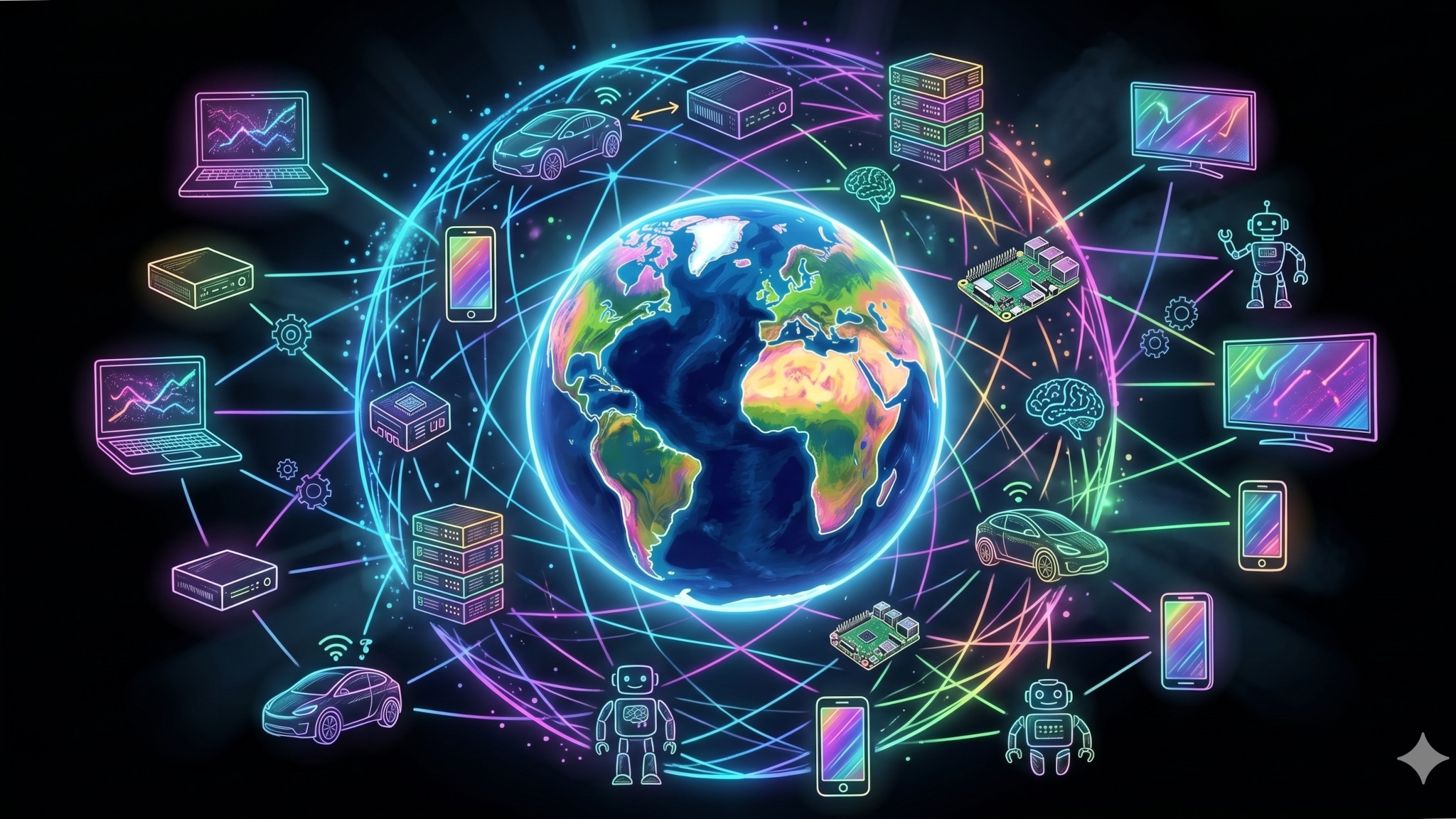
a planetary compute mesh connecting billions of devices and AI systems.
A distributed compute model that connects idle hardware in three clicks, reducing environmental impact and expanding access to the Web3 compute economy
Across the technology sector, large data centres continue to operate with substantial under‑utilisation, often consuming significant energy while running far below peak capacity. At the same time, millions of capable devices, from desktops to small servers, sit idle on shelves, in cupboards, or in storage rooms. Wnode’s system connects this dormant capacity into a unified compute layer, allowing anyone to participate without technical expertise. The onboarding process is designed to be “granny‑proof,” requiring no configuration, no specialist equipment, and no infrastructure changes.
The model operates without the environmental footprint associated with conventional compute facilities. It requires no new data centres, no cooling systems, and no additional load on power grids, relying instead on hardware that is already manufactured and powered. By redirecting unused capacity, the system reduces electronic landfill waste, extends device lifecycles, and avoids the land, water, and energy demands of industrial‑scale compute operations.
This planetary compute mesh is coordinated by AI and structured around a local‑currency‑first economic model, ensuring accessibility for individuals and communities while supporting regional digital participation. Each connected device becomes part of a wider compute layer capable of supporting AI workloads, automation, and next‑generation digital services.
This initiative positions distributed compute as a practical alternative to centralised infrastructure, demonstrating how Web3 principles can be applied to real‑world resource efficiency. With a global surplus of under‑used hardware already in circulation, the opportunity to build a planetary‑scale compute layer without new construction is now technically viable.
Key facts and context
Global data‑centre electricity use is already material: estimated at 240–340 TWh in 2022, roughly 1–1.3% of global final electricity demand. This baseline underscores the sectoral impact Wenode seeks to address. .
Data‑centre demand is expected to grow as AI and digital services expand, creating pressure for new capacity and local grid connections. Wenode positions distributed utilisation of existing devices as a complementary path to meet some incremental demand. .
The installed base of connected devices is already in the tens of billions, with recent industry tracking estimating ~21 billion connected IoT devices by end‑2025 and forecasts that the pool will continue to expand. Wenode’s mesh is designed to overlay this existing base rather than require new hardware. .
Frictionless Fiat Integration and Compliant Governance
To bridge the gap between traditional enterprise needs and decentralized architecture, Wenode utilizes a hybrid financial and tokenomic model designed for broad accessibility and institutional compliance:
• Fiat-to-Fiat Settlement Engine: Customers can purchase computational power using traditional currencies via standard credit cards, bank transfers, and mainstream payment processors, eliminating any cryptocurrency onboarding friction.
• Local Fiat Payouts: To lower the barrier to entry for everyday operators, Wenode processes node rewards directly into operators' local fiat currencies using integrated local payment rails.
• The WEX token is a fixed‑supply utility asset with a hard cap of 10,000,000 tokens.The token is decoupled from governance to prevent whale dominance, ensuring the network remains in the hands of human operators.
• Anti-Centralization Tokenomics: To ensure long-term network stability, the ecosystem features the strictly capped token supply features a predictable issuance schedule. Allocations for founders and early partners are legally time-locked to prevent rapid asset centralization, while all distributions are ledgered transparently on-chain.
• Institutional Safeguards: All operations within the ecosystem are bound by standard regulatory compliance frameworks and built-in anti-abuse controls to protect network integrity.
"The traditional cloud model is facing unprecedented structural limits, from grid capacity failures to year-long hardware backlogs," said Founder and architect, Stephen Soos. "Wenode shifts the paradigm from centralized capital expenditure to decentralized efficiency. By combining traditional fiat currency payment rails with institutional-grade compliant governance, we are making decentralized compute viable, safe, and accessible for enterprise buyers and everyday node operators alike."
Rethinking Global Compute Infrastructure
Wenode addresses market bottlenecks by treating hardware redundancy as an asset. Rather than constructing resource-heavy physical data centers, the platform introduces a distributed network architecture that overlays existing, globally distributed hardware.
Key operational features of the network include:
• High-Fidelity Accessibility: Everyday users can convert idle hardware assets into active infrastructure nodes creating an instant immutable asset and income stream that they can scale to suit their own goals
• Anti-Centralization Governance: Unlike corporate-controlled cloud networks, Wenode is structured as a community-owned mesh where node operators maintain sovereign control over their hardware and the Mesh DAO (Decentralised Autonomous Organisation).
• Built-in Scalability: The platform leverages a decentralized referral (Affiliate) protocol to organically scale its node density, ensuring immediate availability for high-compute workloads such as AI training and data processing, coupled with a meaningful gold standard reward system.
Stephen Soos
Wnode Ltd
+44 7458 197900
stephen@wnode.one
Visit us on social media:
YouTube
X
Wenode Node Operator Dashboard
Legal Disclaimer:
EIN Presswire provides this news content "as is" without warranty of any kind. We do not accept any responsibility or liability for the accuracy, content, images, videos, licenses, completeness, legality, or reliability of the information contained in this article. If you have any complaints or copyright issues related to this article, kindly contact the author above.
