Rabbit, Close to Home by Sharon Wells
Have you ever thought you could use more rabbits in your yard? Usually, gardeners are to rid their gardens of animals that eat their well-manicured plants. And for that purpose, there are plenty of lists of rabbit-resistant plants that feature strong fragrance, fuzzy or prickly textures, or defense mechanisms involving toxicity or an unpleasant taste.
But for those lovers of lagomorphs, here’s some guidance on building a cozy wild rabbit habitat.
Order Lagomorpha is the group of rabbits and rabbit-like cousins proudly taking its place in the mammalian family tree. Contrary to popular belief, rabbits are NOT rodents! They do share certain characteristics with rodents, like ever-growing teeth and good looks, but quite a few qualities set them apart. Rabbits have four upper incisor teeth with a small pair called “peg teeth” hidden behind the larger pair we’re used to seeing, as exemplified by Bugs Bunny. These peg teeth play a role in slicing up plant material into tiny digestible pieces. Anyone who’s had a pet rabbit knows that they cannot subsist on carrots – in fact, feeding a rabbit anything but a varied and precise diet can cause digestive distress and can be fatal.
Rabbits also engage in a behavior called “coprophagy”– meaning eating their own poop. Sounds gross, but the reingestion of uniquely excreted soft feces pellets, rich in vitamins and nutrients, is physiologically necessary for this species. Despite this less-than-glamorous quality, rabbits are not only cute, but incredibly social and sensitive creatures.
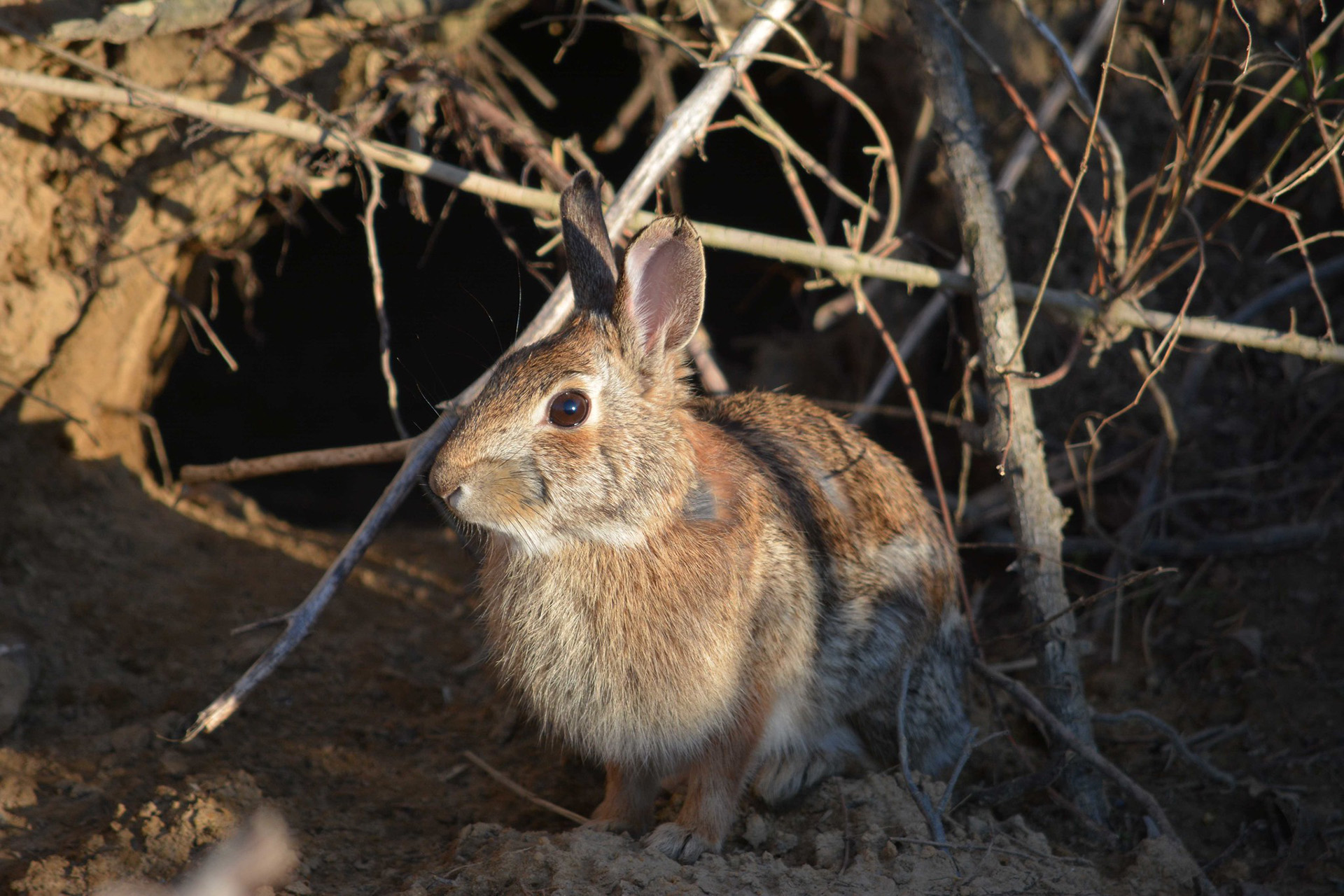
Here in Maryland we have two species of rabbit: the very common Eastern cottontail and the more elusive Appalachian cottontail in Western Maryland. Both play a vital role in a wide variety of Maryland ecosystems, providing seed dispersal, soil aeration, and fertilization, and they provide a readily available meat source for numerous predators. Creating the right habitat for a wild rabbit community, even if that means sacrificing a few plants, can reward you with amazing wildlife viewing opportunities – and who can resist the sight of a baby bunny in the spring?
Creating great rabbit habitat means paying attention to the big three factors – food, water, and shelter – and tailoring them to small mammal preferences. Shelter from those aforementioned predators is important. A great first step is to create a brush pile. Wild Acres has guidance on this if it’s your first time. If this approach doesn’t appeal, encouraging natural cover like multi-stem varieties of dogwood and buttonbush, maintained at chest height and planted close together, can also make ideal woody cover – with the added benefit of providing snacks in the bark. Another option is Rosaceae family shrubs planted together to form patches of cover with thorns that will deter any hostile predator in their right mind. This includes native blackberries, native roses, native plums, hawthorn, etc. Many of these are seasonally available to order from the Department of Natural Resources state nursery. Tall native grasses like bluestems, ryes, and panicgrasses can also provide shelter. More than anything, incorporating a diverse array of cover types helps to ensure continuous shelter throughout the year. Woody structure that is overlooked during the growing season when leafy cover is common can become crucial in winter months after the leaves fall.
Rabbits are not picky eaters but they do prefer native plants. In a 2023 study in New England, scientists analyzed DNA pulled from rabbit pellets to fully understand their diet. The researchers detected 50 different genera of plants in the cottontail pellets collected, and that was during the winter. The conclusions backed up what was found in numerous prior studies: cottontails are true generalists, but prefer the foods their bodies have adapted to over countless generations in North America. There are a few exceptions to this rule, such as the historic tale told in John Mash’s book, The Land of the Living: The Tale of Maryland’s Green Ridge Forest (2003). Some of the land that would become Green Ridge State Forest was denuded around 1900 by an influential family around 1900 looking to plant vast fruit orchards. Their dream was thwarted by rabbits, which became extremely abundant and destructive to the non-native fruit trees. The landowner deployed thousands of steel cages to protect the young trees; and remnant cages can still be found on the Green Ridge property.
Provided you avoid those plants listed as rabbit “resistant,” small native shrubs and herbaceous flowering plants are your best bet for bunny buffets. If you’re more limited in space or what you can plant, avoiding fixation with a mowed lawn is a good place to start, while encouraging growth of other low-growing herbaceous and pollinator-friendly plants. With these tips in mind, if rabbits are anywhere in your area, they’ll eventually find your backyard habitat.
Below is a list of plants noted for rabbit resistance, courtesy the University of Maryland Extension MD Native Plants Program.
|
Actaea pachypoda |
White baneberry, doll’s eyes |
|
Allium canadense |
Wild onion, meadow garlic |
|
Aquilegia canadensis |
Red columbine, wild/eastern columbine |
|
Asarum canadense |
Wild ginger |
|
Baptisia australis |
False blue indigo, blue wild indigo |
|
Clinopodium vulgare |
Wild basil |
|
Desmodium perplexum |
Perplexing tick-trefoil |
|
Eupatorium rotundifolium |
Roundleaf thoroughwort |
|
Monarda didyma |
Scarlet beebalm |
|
Monarda punctata |
Spotted beebalm |
|
Packera anonyma |
Small’s ragwort |
|
Scutellaria elliptica |
Hairy skullcap |
|
Scutellaria incana |
Hoary skullcap |
|
Scutellaria lateriflora |
Mad-dog skullcap |
|
Thalictrum pubescens |
Tall meadow rue |
|
Thalictrum thalictroides |
Rue anemone |
|
Veratrum virginicum |
Virginia bunchflower |
|
Verbesina alternifolia |
Wingstem |
|
Yucca filamentosa |
Adam’s needle |
|
Asplenium platyneuron |
Ebony spleenwort |
|
Athyrium filix-femina var. angustum |
Northern lady fern |
|
Athyrium filix-femina var. asplenioides |
Southern lady fern |
|
Dennstaedtia punctilobula |
Eastern hayscented fern |
|
Dryopteris carthusiana |
Spinulose/toothed wood fern, shield fern |
|
Dryopteris intermedia |
Intermediate wood fern, fancy fern |
|
Lorinseria areolata |
Netted chain fern |
|
Matteuccia struthiopteris |
Ostrich fern |
|
Onoclea sensibilis |
Sensitive fern |
|
Osmundastrum cinnamomeum |
Cinnamon fern |
|
Phegopteris hexagonoptera |
Broad beech fern |
|
Polypodium virginianum |
Common polypody, common rockcap fern |
|
Carex pensylvanica |
Pennsylvania sedge |
|
Dryopteris marginalis |
Marginal wood fern, shield/leatherleaf fern |
**Chart caption: a list of plants
“The truth is a rabbit in a bramble patch. And you can’t lay your hand on it. All you do is circle around and point, and say, ‘It’s in there somewhere.’” ~ Pete Seeger