
Spotted: A Superstar Red-Flanked Bluetail Far from Home
By Barbara Saffir
Photos by Barbara Saffir
Go! Now! HURRY! That’s typically what birders need to do to successfully chase a rare bird visiting from afar or they’ll miss it.
But one American Birding Association Code-4 rarity that had only been seen once before on the East Coast has been dawdling about in the Old Dominion’s Great Falls Park, enjoying its wintercreeper munchies with a jaw-dropping view of the Potomac River since New Year’s Day.
This female red-flanked bluetail (Tarsiger cyanurus) that inhabits the other side of the world was first eyeballed by Fairfax County, Virginia, birder Phil Kenny. Since then, hundreds of birders from Florida to New York and beyond have trekked to this national park nine miles upriver from the nation’s capital, ignoring its Instagramable waterfalls to focus on this itty-bitty bird. I visited seven times.
Even ornithologists don’t know exactly what lured this perky creature to Virginia, its first visit to the state. The red-flanked bluetail typically winters in Japan, Korea, southern China, Thailand, and Myanmar, with breeding grounds spanning Japan, Siberia, and Finland. While sightings have happened in Alaska and western U.S. states, a bluetail has only been documented once before in the Eastern United States—in coastal New Jersey in December 2023. Ornithologists say that maybe they were swept to the East Coast by air currents or perhaps a genetic fluke in their migration makeup contributed.
This particular bird, which resembles a smaller version of our eastern bluebird, certainly discovered enough food in Northern Virginia to nourish it, even during our unusually frigid and snowy winter. She has been noshing on red wintercreeper euonymus seeds, oriental bittersweet berries, and other yummy snacks that are native in China, one of its normal winter destinations. In the United States, the plants are deemed foreign invasives, but the bluetail enjoys them. “It’s like an American tourist going to Paris and eating at McDonalds. It’s something from back home,” I told Washington Post reporter Dana Hedgpeth for her March 8 story on the wayward winter visitor.
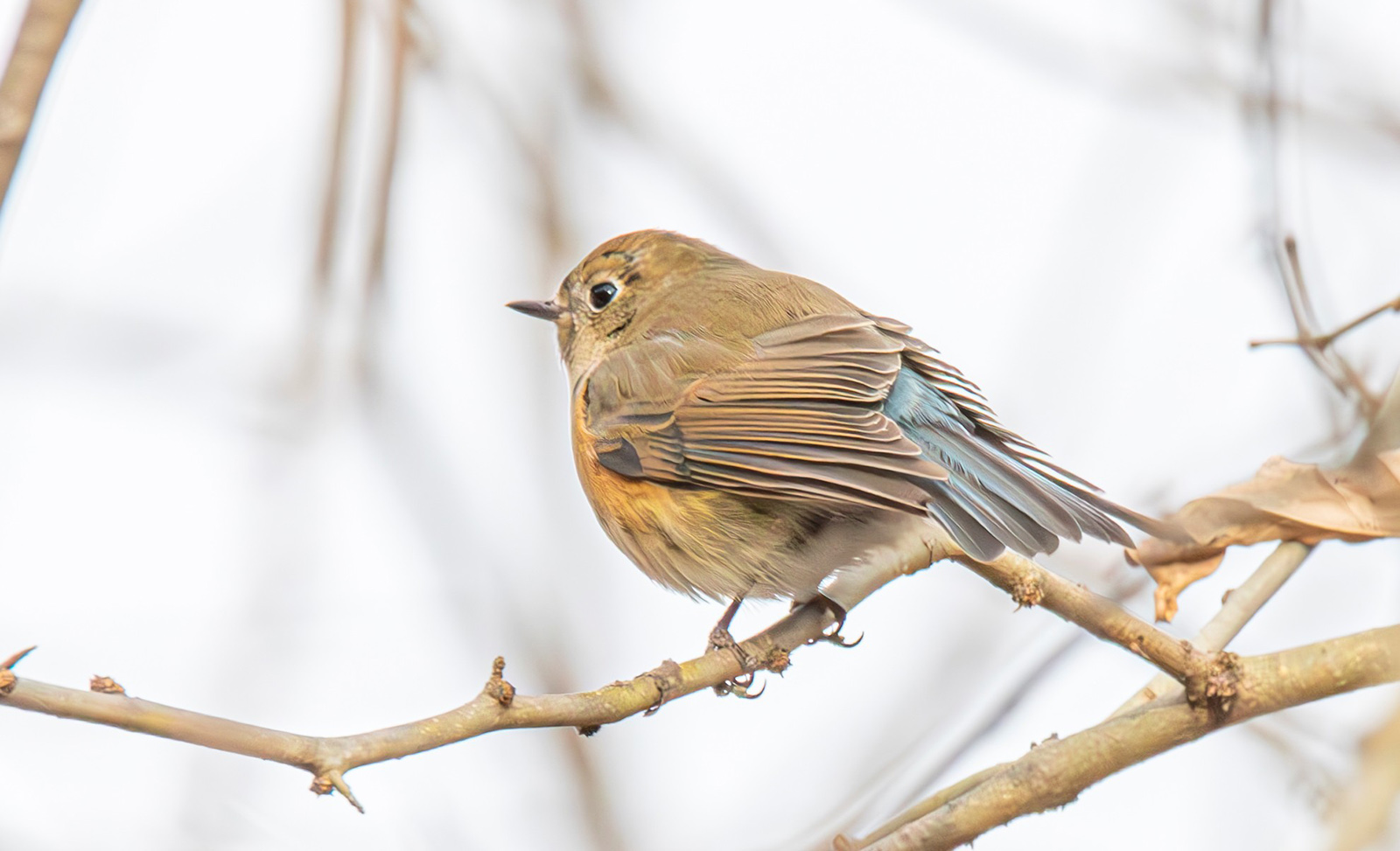
The red-flanked bluetail that attracted so much attention by hanging around at Great Falls Park.
As a former reporter myself and a current Virginia Master Naturalist, I love to educate and entice others to help spread the word about our wonderful wildlife. So even though I’m more of a night owl, I agreed to meet Dana and photographer John McDonnell at the park near daybreak to search for this feathers-in-a-haystack bird. I had spotted it four times already—but usually with the extra eyes of fellow birders who helped track down the 5.5-inch beauty.
This time, I was on my own on a day so thick with fog that you couldn’t even see the river. Pinpointing a tiny, light-brown bird with twin orange sherbet patches on its sides was not going to be easy. Luckily, a very determined birder joined us. We sloshed along the mucky trail together to an area where the bird has been spotted regularly, and bam! Within minutes, his laser-sharp eyes locked onto the bird perched like a hood ornament atop a fat, fallen log in the relatively teensy winter territory that the bluetail appears to have adopted. She usually flits around a roughly 2/10 of a mile narrow strip of land between the river and a granite cliff. Cornell University ornithologist and migration expert Andrew Farnsworth said it’s normal behavior for some birds to favor small areas. But even in that relatively small space, this frequent flyer often disappears in a tangle of vines and moss-green boulders.
So unless she is bobbing her blue tail, it can be a challenge to find her, even for experienced life-listers. She often flitters back and forth (like the flycatcher that she is) from the river to the ridge, with forays to the forest floor to forage under mushy leaves for insects. But on this foggy morning, she sat strangely still for an extra long time, as if she knew that a Washington Post photographer was going to make her famous.
After the newspaper story was published, even more folks traipsed there to see her. Ordinary birders and experts alike sometimes located her right away, while others trolled the trail for hours without a sighting. Some speculated on how long the bluetail might stick around, since March 1 marked the start of meteorological spring and two hot days had already arrived. New Jersey’s bluetail reportedly “flew the coop” around the end of March. Maybe ours will leave when her fellow overwintering BFFs like kinglets, hermit thrushes, and white-throated sparrows depart for their northern breeding territories.
I’m going to miss this celebrity bird. I wish I could implore her: “Don’t hurry home! Back home you’re just an ordinary bird, but in Virginia, you’re a superstar.”
Barbara Saffir is a former journalist turned guidebook author, wildlife photographer, and a certified Virginia Master Naturalist. Her pie-in-the-sky goals are to win the renowned Audubon Bird Photography contest and/or to discover a new species. She realizes that she won’t likely accomplish either–but she’s having a lot of fun trying.
Legal Disclaimer:
EIN Presswire provides this news content "as is" without warranty of any kind. We do not accept any responsibility or liability for the accuracy, content, images, videos, licenses, completeness, legality, or reliability of the information contained in this article. If you have any complaints or copyright issues related to this article, kindly contact the author above.
