
Sentiment Analysis Software Market Set for Rapid Growth Driven by AI-Powered Customer Intelligence
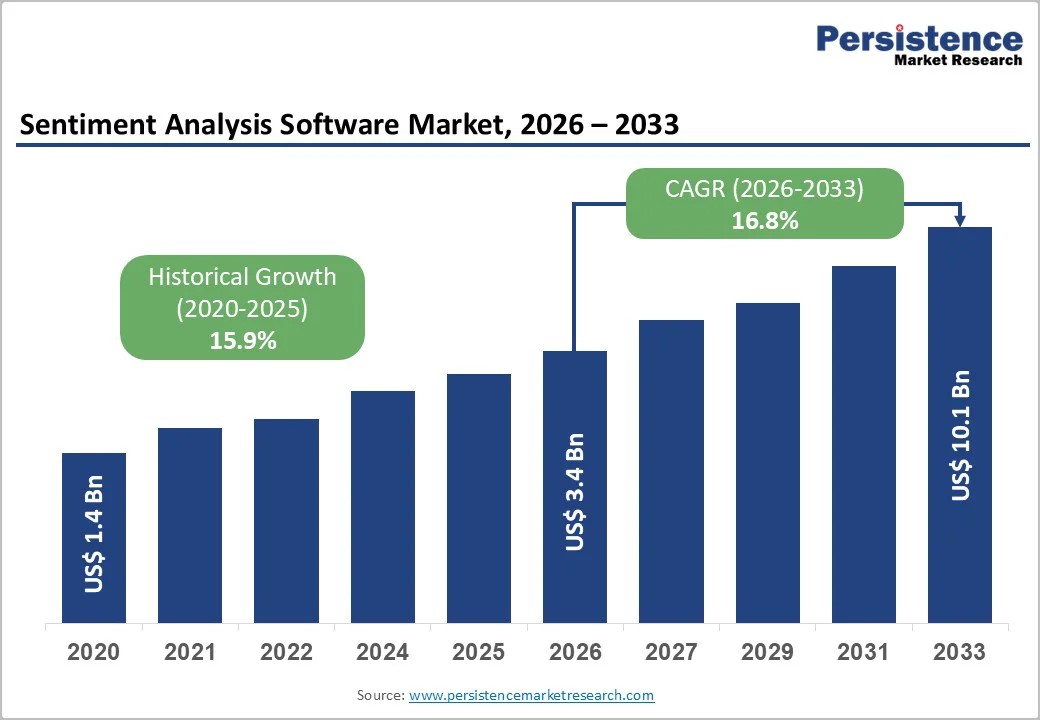
Sentiment analysis software market is set to surge from US$3.4 Bn in 2026 to US$10.1 Bn by 2033, driven by advanced analytics adoption in retail & banking
BRENTFORD, ENGLAND, UNITED KINGDOM, February 9, 2026 /EINPresswire.com/ -- The sentiment analysis software market is emerging as a cornerstone of modern enterprise analytics, helping organizations decode emotions, opinions, and attitudes hidden within vast volumes of unstructured data. As businesses increasingly interact with customers through digital channels, sentiment analysis tools play a vital role in understanding consumer behavior across social media, reviews, emails, chats, and voice interactions. These platforms convert qualitative feedback into actionable insights, enabling organizations to improve customer experience, brand perception, and strategic decision-making.
In 2026, the global sentiment analysis software market is likely to be valued at US$ 3.4 billion and is estimated to reach US$ 10.1 billion by 2033, expanding at a robust CAGR of 16.8% during the forecast period. The market’s growth is fueled by the rapid expansion of digital data, rising adoption of cloud-based analytics, and continuous advancements in AI, machine learning, and natural language processing technologies.
𝐆𝐞𝐭 𝐚 𝐒𝐚𝐦𝐩𝐥𝐞 𝐏𝐃𝐅 𝐁𝐫𝐨𝐜𝐡𝐮𝐫𝐞 𝐨𝐟 𝐭𝐡𝐞 𝐑𝐞𝐩𝐨𝐫𝐭: https://www.persistencemarketresearch.com/samples/18142
Market Statistics, Growth Drivers, and Leading Segments
The accelerating adoption of sentiment analysis software across retail, banking, financial services, media, and e-commerce sectors has significantly strengthened market momentum. Organizations are increasingly deploying sentiment intelligence to monitor brand reputation, assess customer satisfaction, and predict behavioral trends in real time. The integration of AI-powered analytics into customer relationship management (CRM) and business intelligence platforms has further amplified its commercial value.
From a segment perspective, natural language processing (NLP) dominates the technology landscape, accounting for nearly 50% of the market share in 2026, as it enables accurate interpretation of multilingual and context-rich data. Geographically, North America leads the global market with approximately 40% share, supported by high digital maturity, early cloud adoption, and strong presence of leading software vendors. Meanwhile, Asia Pacific is projected to be the fastest-growing region due to rapid digitalization, expanding e-commerce ecosystems, and rising adoption of analytics by SMEs.
Key Highlights from the Report
The global sentiment analysis software market is projected to grow at a CAGR of 16.8% from 2026 to 2033.
Cloud-based deployment models are gaining strong traction due to scalability and cost efficiency.
NLP remains the dominant technology, while AI-driven sentiment tools show the fastest growth.
Retail and BFSI sectors represent major end-users, driven by customer experience optimization.
North America leads the market, while Asia Pacific is expected to register the highest growth rate.
Continuous advancements in AI and multilingual analytics are reshaping competitive dynamics.
Market Segmentation Analysis
The sentiment analysis software market is segmented based on technology, deployment model, end-user industry, and organization size. By technology, the market includes NLP-based, machine learning-based, and hybrid AI-driven sentiment analysis solutions. NLP-based platforms dominate due to their ability to process large volumes of unstructured textual data, while AI-driven solutions are rapidly gaining popularity for their self-learning capabilities and improved contextual accuracy.
Based on end-user industries, the market spans retail and e-commerce, BFSI, healthcare, media and entertainment, IT and telecommunications, and government sectors. Retail and e-commerce lead adoption as businesses increasingly rely on sentiment insights to personalize marketing strategies and improve customer engagement. BFSI organizations use sentiment analysis to monitor customer trust, manage risk, and enhance service quality in an increasingly competitive digital environment.
𝐃𝐨 𝐘𝐨𝐮 𝐇𝐚𝐯𝐞 𝐀𝐧𝐲 𝐐𝐮𝐞𝐫𝐲 𝐎𝐫 𝐒𝐩𝐞𝐜𝐢𝐟𝐢𝐜 𝐑𝐞𝐪𝐮𝐢𝐫𝐞𝐦𝐞𝐧𝐭? 𝐑𝐞𝐪𝐮𝐞𝐬𝐭 𝐂𝐮𝐬𝐭𝐨𝐦𝐢𝐳𝐚𝐭𝐢𝐨𝐧 𝐨𝐟 𝐑𝐞𝐩𝐨𝐫𝐭: https://www.persistencemarketresearch.com/request-customization/18142
Regional Insights
North America remains the largest market for sentiment analysis software, supported by widespread adoption of advanced analytics, strong cloud infrastructure, and early integration of AI technologies. Enterprises in the region heavily invest in customer intelligence platforms to gain competitive differentiation and manage brand reputation in real time.
Asia Pacific is expected to witness the fastest growth during the forecast period, driven by rapid digital transformation, increasing internet penetration, and the expansion of e-commerce platforms. Growing adoption of sentiment analytics by SMEs and startups, particularly in countries such as India, China, and Southeast Asia, further strengthens regional growth prospects.
Market Drivers
The primary driver of the sentiment analysis software market is the exponential growth of digital data generated through social media, online reviews, and customer interactions. Organizations increasingly require real-time insights to understand customer sentiment and respond proactively to changing market dynamics. The rising importance of customer experience management has positioned sentiment analysis as a strategic business tool.
Additionally, advancements in AI, machine learning, and NLP technologies have significantly improved analytical accuracy and scalability. These innovations allow organizations to process multilingual and context-rich data more efficiently, driving broader adoption across industries.
Market Restraints
Despite strong growth prospects, the market faces challenges related to data privacy, security concerns, and regulatory compliance. Handling sensitive customer data requires robust governance frameworks, which can increase implementation costs and complexity for enterprises. In regions with stringent data protection laws, compliance requirements may slow adoption.
Another restraint is the difficulty in accurately interpreting sarcasm, slang, and cultural nuances, which can affect sentiment accuracy. Although AI-driven models are improving rapidly, achieving consistent precision across diverse datasets remains a technical challenge.
Market Opportunities
The growing adoption of AI-driven sentiment analysis across emerging markets presents significant growth opportunities. As digital engagement increases globally, organizations are seeking advanced analytics tools to gain deeper insights into customer behavior and preferences. Integration of sentiment analysis with voice analytics and omnichannel platforms offers new avenues for innovation.
Furthermore, rising demand from SMEs for cloud-based, cost-effective sentiment analysis solutions is expected to create lucrative opportunities for vendors. The expansion of industry-specific applications, such as healthcare patient feedback analysis and financial risk sentiment monitoring, further broadens the market’s potential.
𝐁𝐮𝐲 𝐍𝐨𝐰 𝐭𝐡𝐞 𝐃𝐞𝐭𝐚𝐢𝐥𝐞𝐝 𝐑𝐞𝐩𝐨𝐫𝐭: https://www.persistencemarketresearch.com/checkout/18142
Company Insights
IBM Corporation
Microsoft Corporation
Google LLC
Salesforce, Inc.
Oracle Corporation
SAS Institute Inc.
Qualtrics
Lexalytics
MeaningCloud
Clarabridge
Recent Developments:
In July 2025, GGWP launched Pulse, a real-time sentiment analysis tool that converts anonymized in-game text and voice chats into actionable insights for game developers.
Leading vendors are increasingly integrating generative AI capabilities to enhance contextual understanding and multilingual sentiment accuracy.
Related Reports:
Pooja Gawai
Persistence Market Research
+1 646-878-6329
email us here
Visit us on social media:
LinkedIn
Instagram
Facebook
YouTube
Legal Disclaimer:
EIN Presswire provides this news content "as is" without warranty of any kind. We do not accept any responsibility or liability for the accuracy, content, images, videos, licenses, completeness, legality, or reliability of the information contained in this article. If you have any complaints or copyright issues related to this article, kindly contact the author above.
