
Cells’ Systems Cooperate to Form ‘Scaffolding’ During Egg Development
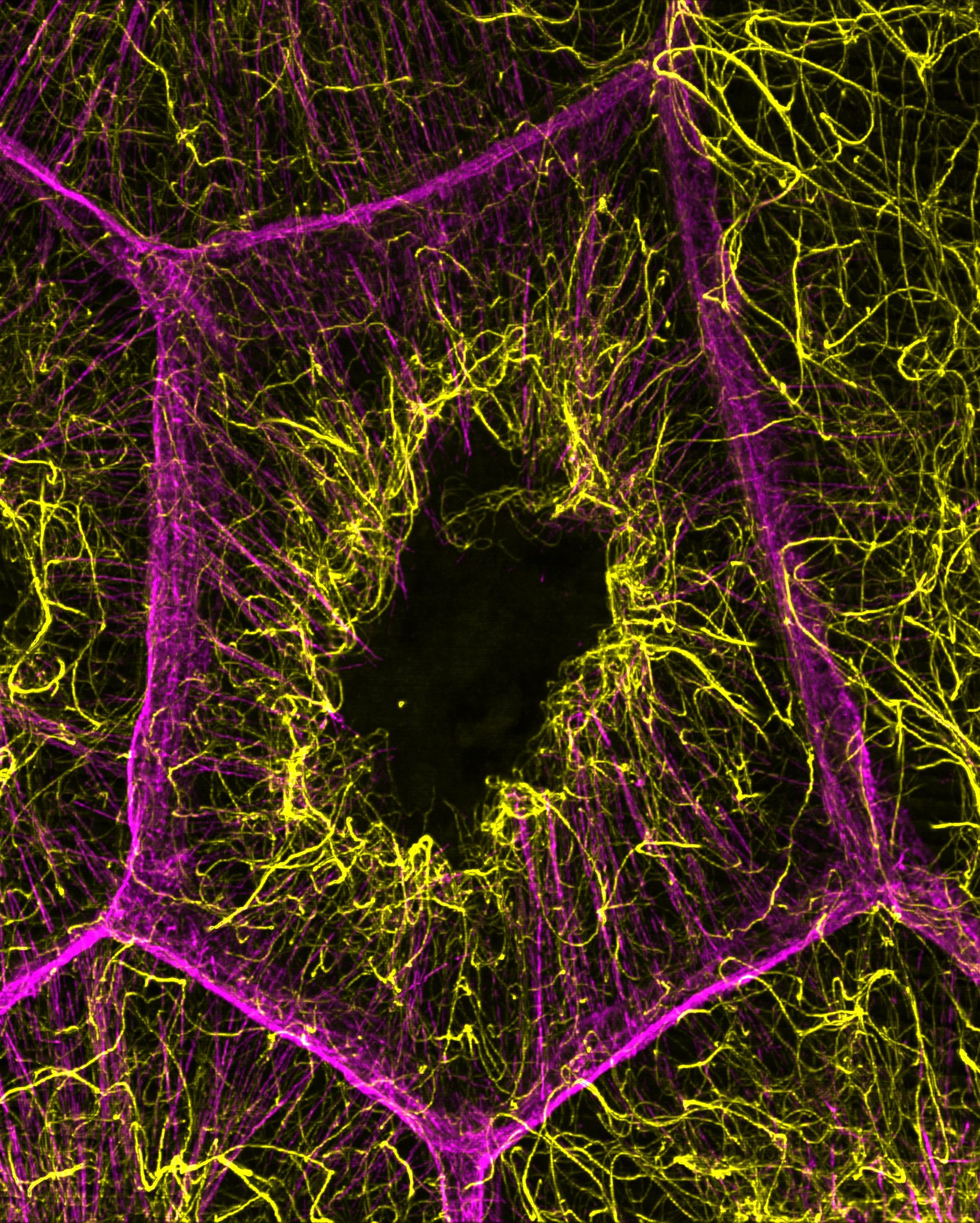
A Northwestern Medicine study has shed light on one of the most intricate construction projects in biology: how cells build and coordinate the internal scaffolding needed to create a healthy egg. The research, published in the Journal of Cell Biology, details how two structural cellular systems work together to form developing egg cells.
“For an egg cell to form, a group of nurse cells all empty their contents into what will become the egg cell. All organelles and proteins, everything, go to the egg cell,” said Wen Lu, PhD, research assistant professor of Cell and Developmental Biology and a co-author of the study. “This is a very dramatic process that is foundational to the development of life, yet exactly how this is accomplished has remained unclear.”

The study, conducted in Drosophila melanogaster (fruit flies), identifies previously unknown collaboration between actin filaments and microtubules — two key components of the cytoskeleton — during egg development.
Inside cells, actin filaments are known for providing flexibility and support, while microtubules serve as more rigid “train tracks” for transport and shape. While the two have long been understood to interact, the mechanisms that guide their coordination during complex developmental stages remain poorly defined, said Vladimir Gelfand, PhD, the Leslie B. Arey Professor of Cell, Molecular, and Anatomical Sciences, who was co-senior author of the study.
Using cutting-edge microscopy techniques, investigators observed that nurse cells, which supply nutrients and materials to the developing egg, build a stable, acetylated microtubule network at the same time that actin cables begin to form. Acetylation, a chemical modification that reinforces microtubules, was shown to be essential for maintaining this network.
Disrupting this microtubule structure prevented both the initiation and elongation of actin cables, revealing that microtubules serve as a foundational scaffold during oogenesis, the process of egg cell development.

The research further showed that the actin cytoskeleton actively supports microtubule organization: Loss of key actin-bundling proteins led to fewer, shorter microtubules. This suggests that bundled actin filaments help regulate microtubule spacing and orientation, maintaining both stability and flexibility within the cell.
Together, these findings reveal a complex “conversation” between actin filaments and microtubules. Each system influences the assembly, positioning and organization of the other, creating the architectural foundation required for transporting materials into the developing egg.
“This is a classic example of what we call ‘crosstalk’ in biology,” Gelfand said. “With this study, we now understand how these structures work together and are essential to oogenesis. Understanding this cytoskeletal coordination is essential, as many aspects of egg development are conserved across species.”
Moving forward, Gelfand, Lu and their collaborators hope to use innovative microscopy techniques to visualize microtubules in greater detail.
“We are very lucky to have access to some of the best equipment in the world to help answer these fundamental scientific questions,” Lu said.
Brooke M. McCartney, PhD, associate professor in the Department of Biological Sciences at Carnegie Mellon University, was the corresponding author of the study.
The study was supported by National Institutes of Health grant R01-GM120378, National Institute of General Medical Sciences grant 2R35GM131752 and the CCBX Research Initiative from the Flatiron Institute/Simons Foundation.
Legal Disclaimer:
EIN Presswire provides this news content "as is" without warranty of any kind. We do not accept any responsibility or liability for the accuracy, content, images, videos, licenses, completeness, legality, or reliability of the information contained in this article. If you have any complaints or copyright issues related to this article, kindly contact the author above.
