
Carbon Removal Technology Market is projected to reach US$ 2,176.82 million by 2034 | DataM Intelligence
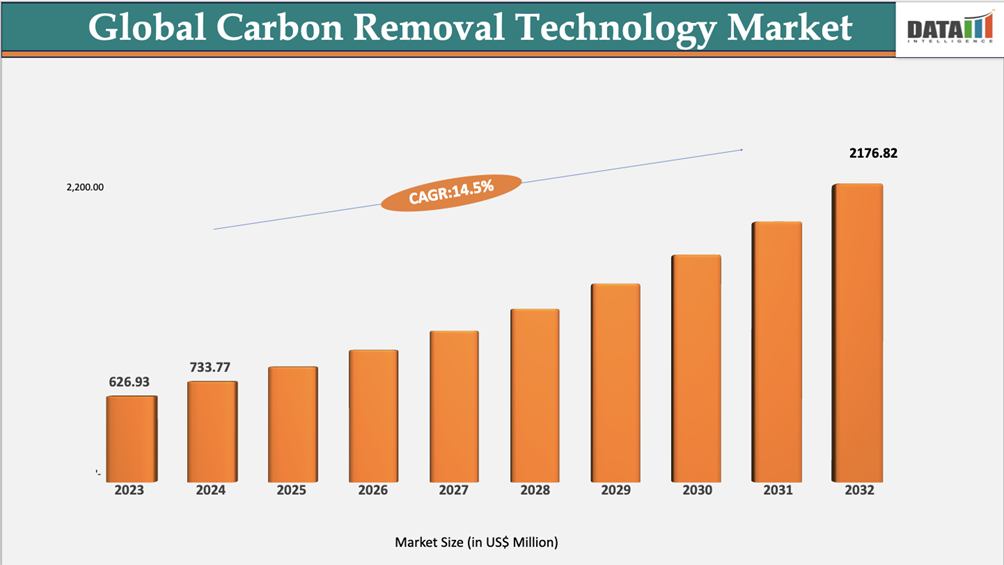
Carbon Removal Technology Market Size
The Global Carbon Removal Technology Market is estimated to reach at a CAGR of 14.59% during the forecast period from 2025-2034.
The Carbon Removal Technology Market is rapidly expanding, driven by climate action, innovation in carbon capture, and global demand for sustainable solutions.”
AUSTIN, TX, UNITED STATES, December 3, 2025 /EINPresswire.com/ -- Overview of the Market:— DataM Intelligence
The Carbon Removal Technology Market encompasses a broad set of solutions designed to extract carbon dioxide (CO₂) and other greenhouse gases from the atmosphere or industrial emissions, and store or repurpose them. This includes engineered approaches like direct air capture (DAC), bioenergy with carbon capture and storage (BECCS), biochar and enhanced mineralization, as well as nature‑based interventions such as afforestation/reforestation, ocean-based removal, and other hybrid methods. These technologies are increasingly critical as global efforts to meet net-zero and climate targets intensify tackling emissions that conventional mitigation alone cannot eliminate. According to a report by DataM Intelligence, The Global Carbon Removal Technology Market was valued at approximately US$ 733.77 million in 2024, and is projected to grow to US$ 2,176.82 million by 2034, reflecting a compound annual growth rate (CAGR) of about 14.59%. The Asia‑Pacific region currently leads the market in 2024, owing to strong industrial growth, rising infrastructure investments, and government-driven decarbonization initiatives across countries such as China, India, Japan, and others. The primary growth drivers include increasing global CO₂ emissions, rising corporate and governmental commitments to net-zero goals, and growing willingness to invest in carbon removal as part of broader sustainability strategies.
To Download Sample Report Here: https://www.datamintelligence.com/download-sample/global-carbon-removal-technology-market
Given rapidly escalating climate concerns, the demand for carbon removal solutions is accelerating. Industries such as power generation, cement and steel production, agriculture, petrochemicals, and land use are increasingly adopting removal technologies to offset emissions they cannot eliminate otherwise. The push toward net-zero targets both corporate and national is fueling large investments, technological innovation, and deployment at increasing scale. Among all technologies, engineered solutions like DAC, BECCS, and enhanced mineralization stand out as the fastest-growing segments, while hybrid and nature-based methods remain important for regions with abundant biomass or favorable natural conditions. Regionally, Asia‑Pacific leads in adoption due to industrialization and supportive policy measures, while North America is emerging as the fastest-growing market thanks to technological maturity and regulatory push.
Key Highlights from the Report:
The Global Carbon Removal Technology Market is expected to grow from US$ 733.77 million in 2024 to US$ 2,176.82 million by 2034.
The Asia‑Pacific region leads the market in 2024, driven by industrial growth and government decarbonization initiatives.
Key technologies include Direct Air Capture (DAC), Bioenergy with Carbon Capture & Storage (BECCS), biochar, enhanced mineralization, ocean-based removal, and afforestation/reforestation.
Major adopters span power generation, cement, steel, petrochemicals, agriculture, and land-use sectors.
Engineered carbon removal solutions (DAC, BECCS) are witnessing the fastest growth, supported by policy push and corporate net-zero commitments.
Nature-based and hybrid carbon removal methods remain relevant, particularly in regions with abundant biomass and favorable natural resources.
Market Segmentation:
The Carbon Removal Technology Market can be segmented by technology/type and application/end-user.
By technology, the market includes:
Direct Air Capture (DAC): Technologies that pull CO₂ directly from ambient air, often followed by storage or utilization.
Bioenergy with Carbon Capture & Storage (BECCS): Combines biomass-based energy generation with CO₂ capture and storage.
Biochar / Enhanced Mineralization / Carbon Mineralization: Methods that convert biomass or minerals to stable carbon‑rich compounds that lock CO₂ semi-permanently.
Ocean-based Removal: Techniques that leverage ocean chemistry to sequester carbon, including alkalinization or enhanced weathering in marine environments.
Afforestation & Reforestation / Nature-based Solutions: Planting or restoring forests and vegetation to absorb CO₂ naturally over time.
Other/Hybrid Methods: Combinations of engineered and nature-based approaches, or novel removal techniques that don’t fit traditional categories.
By Application/end‑use, adoption spans several sectors: industrial processes (cement, steel, energy, petrochemical), power generation, agriculture and land-use, direct‑air/environmental services, and participation in carbon credit & trading markets. These diverse segments reflect the broad utility of carbon removal from mitigating emissions in heavy industry to offsetting residual emissions through environmental services or carbon credit schemes. This segmentation highlights how carbon removal technology is not a one-size-fits-all choice of technology and application will depend heavily on factors such as industrial sector, geographic region, regulatory climate, and resource availability.
Get Customization in the report as per your requirements: https://www.datamintelligence.com/customize/global-carbon-removal-technology-market
Regional Insights:
Regionally, the Carbon Removal Technology Market exhibits distinct trends and growth patterns.
In Asia‑Pacific, the market leads globally (as of 2024) fueled by rapid industrialization, robust infrastructure investments, and increasing government-backed decarbonization programmes. Countries like China, India, Japan, and South Korea are at the forefront, leveraging both engineered carbon removal technologies and nature-based approaches. The region’s vast biomass, mineral wealth, large land mass, and growing climate awareness make it fertile ground for hybrid and nature-based carbon removal solutions. In addition, rising energy demands concurrent with industrial growth are pushing governments and private players to adopt ambitious carbon mitigation strategies a key reason for the region dominating the market.
In North America, the market is emerging as the fastest-growing region considering pace of adoption and expansion. Advanced technological infrastructure, robust funding for research and development, and favorable regulatory frameworks including incentives and carbon-trading mechanisms are accelerating adoption of carbon removal technologies. The presence of technology companies, start-ups, and strong corporate commitment to sustainability further boost traction for DAC and BECCS projects. North American growth is also driven by heavy industries and power generation sectors seeking to reduce emissions.
In Europe, growing regulatory pressure around climate change, ambitious policies under the European Green Deal, and investments in carbon removal and storage infrastructure are driving interest in both engineered and nature-based removal technologies. Collaboration across countries, cross-border carbon credit frameworks, and emerging CCUS hubs contribute significantly to Europe’s role in the global carbon removal landscape. Meanwhile, other regions such as Latin America, Middle East & Africa remain nascent but are gradually exploring tailored carbon removal strategies based on local ecosystems, land availability, and biomass resources.
Market Dynamics:
Market Drivers
The Global push toward decarbonization and stringent climate targets is compelling governments, corporations, and industries to invest in carbon removal technologies. Many emissions particularly from cement, steel, petrochemical, and heavy industries are difficult to reduce through efficiency improvements alone; here, removal technologies offer a viable path to offset residual carbon. Rising awareness around climate change, commitments to net-zero goals, and increasing pressure from regulators and stakeholders are also pushing the adoption of carbon removal solutions. In parallel, technological advancements, falling costs of renewable energy, and scaling of direct air capture and BECCS solutions are enhancing feasibility and economic viability.
Market Restraints
Despite promising growth, the market faces significant challenges. High capital and operational costs associated with engineered carbon removal technologies particularly DAC and BECCS remain a major barrier, especially for large-scale deployment in developing economies. Additionally, limited infrastructure for CO₂ transport and storage, regulatory uncertainty, and lack of standardized global frameworks for carbon credit certification and permanence pose obstacles. Nature-based solutions while cheaper face constraints of land, permanence, and potential environmental trade-offs (biodiversity, land use changes).
Market Opportunities
There is considerable opportunity in scaling hybrid solutions that combine nature-based and engineered removal methods, maximizing utility while minimizing costs. Emerging markets in Asia‑Pacific, Latin America, and Africa offer untapped potential, especially where biomass, mineral resources, or carbon‑rich landscapes exist. Development of robust carbon credit trading markets and regulatory frameworks could unlock demand from corporates wanting credible net-zero pathways. Advances in carbon utilization (transforming CO₂ into fuels, building materials, or industrial feedstock) can also enhance economic incentives, making carbon removal more profitable and sustainable.
Company Insights:
Key players operating in the carbon removal technology market include (but are not limited to):
Climeworks
Carbon Engineering
1PointFive / Occidental
Charm Industrial
Carbfix
Heirloom Carbon
Holocene
CarbonCure Technologies
Carbon Direct
Blue Planet Ltd.
Recent Developments:
United States:
October 2025: AkzoNobel Aerospace Coatings launched a certified training program to advance adoption of carbon removal practices at the NBAA event in Las Vegas.
September 2025: Climeworks launched a large-scale direct air capture (DAC) facility in Texas removing 10,000 tons of CO2 annually, using advanced sorbents and renewable energy.
August 2025: Carbon Clean invested $60 million to expand carbon capture and utilization technology deployment in California focused on CO2 separation and conversion into synthetic fuels.
Europe:
December 2025: The European Commission adopted rules for an EU-wide voluntary certification framework for carbon removals and carbon farming, aiming to drive investment and demand.
November 2025: Significant progress in carbon capture and storage (CCS) projects, including enzyme-based capture technology demonstration in Italy and plans for advanced cryogenic separation in Germany.
October 2025: A coalition drafted proposals on biochar carbon removal recognition within the EU's Carbon Removals and Carbon Farming Regulation, supporting sustainable carbon farming solutions.
Buy Now & Unlock 360° Market Intelligence: https://www.datamintelligence.com/buy-now-page?report=global-carbon-removal-technology-market
Frequently Asked Questions (FAQs):
How Big is the Market?
What is the Projected Growth Rate of the Carbon Removal Technology Market?
Which Region is Estimated to Dominate the Industry through the Forecast Period?
What are the Main Technologies Driving Carbon Removal Adoption?
What Sectors are the Key End‑Users of Carbon Removal Technologies?
Unlock 360° Market Intelligence with DataM Subscription Services: https://www.datamintelligence.com/reports-subscription
Conclusion:
The Carbon Removal Technology Market stands at a pivotal point. With accelerating climate risks, rising emissions, and ambitious net-zero targets, there is growing recognition that removal technologies both engineered and nature-based will play a critical role in the global decarbonization journey. Fueled by strong growth drivers such as regulatory pressure, corporate sustainability commitments, and technological advancement, the market is on track to expand more than threefold in the next decade.
Related Reports:
Decarbonization Market
Zero Carbon Methanol Fuel Market
Sai Kiran
DataM Intelligence 4Market Research
+1 877-441-4866
Sai.k@datamintelligence.com
Visit us on social media:
LinkedIn
X
Legal Disclaimer:
EIN Presswire provides this news content "as is" without warranty of any kind. We do not accept any responsibility or liability for the accuracy, content, images, videos, licenses, completeness, legality, or reliability of the information contained in this article. If you have any complaints or copyright issues related to this article, kindly contact the author above.
