
Japan Telemedicine Market Booms: 19.5% CAGR Fueled by Digital Health & Remote Care Growth
Japan’s Telemedicine Market
Japan’s Telemedicine Market Hits $25.8B by 2033 | RPM & mHealth Lead Fast Adoption Across Key Prefectures and Urban Healthcare Hubs
The Japan telemedicine market is growing rapidly as digital healthcare adoption rises, enabling remote consultations, improved patient access, and more efficient care delivery across the country”
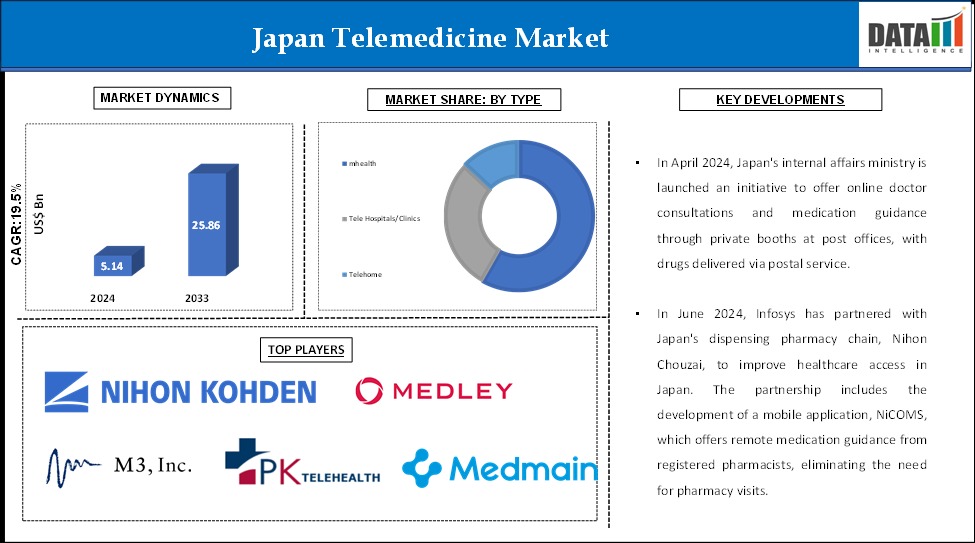
LEANDER, TX, UNITED STATES, December 1, 2025 /EINPresswire.com/ -- According to DataM Intelligence, the Japan Telemedicine Market reached US$ 5,142.91 million in 2024 and is projected to grow significantly to US$ 25,867.49 million by 2033, expanding at a strong CAGR of 19.5% during 2025–2033. Growth is driven by Japan’s rapidly aging population, increasing prevalence of chronic diseases, rising healthcare costs, and a national push toward digital health transformation. Telemedicine plays a crucial role in improving access to care, especially for remote and rural communities facing physician shortages. Government reforms supporting online consultations and reimbursement expansion have further accelerated adoption across hospitals, clinics, and home-care settings.— DataM Intelligence
Telemedicine in Japan continues to evolve with the integration of advanced technologies such as remote patient monitoring devices, AI-powered diagnostics, digital therapeutics, and real-time health data platforms. These innovations help reduce hospital burden, enable early detection of diseases, and support continuous care for elderly patients. The growing emphasis on personalized and home-based healthcare, combined with strong technological infrastructure and consumer readiness, positions Japan as one of the fastest-advancing telemedicine markets in the Asia-Pacific region.
Download your exclusive sample report today: (corporate email gets priority access): https://www.datamintelligence.com/download-sample/japan-telemedicine-market
Key Highlights from the Report:
• Growing demand for remote healthcare due to an aging population and rising chronic disease burden.
• Expansion of teleconsultation services supported by favorable government policies and digital health initiatives.
• Increased adoption of AI-enabled diagnostic tools enhancing clinical decision-making and patient monitoring.
• Rising integration of telehealth in hospitals and clinics to reduce patient load and improve accessibility.
• Strong push toward home-based care models supported by remote monitoring devices and digital platforms.
• Growing investments by technology companies to develop secure, interoperable telemedicine solutions.
• Enhanced reimbursement frameworks encouraging wider acceptance among healthcare providers.
• Rising use of telepharmacy and e-prescription services to streamline medication delivery and management.
• Expansion of mental health teleconsultation driven by increasing awareness and ease of access.
• Growing partnerships between telecom, health IT, and medical institutions to strengthen digital health infrastructure.
Key Segments
By Type
mHealth dominates the telemedicine landscape as smartphone-based health apps, remote monitoring tools, and virtual consultation platforms witness rapid adoption among tech-savvy patients and chronic disease populations. The segment grows further with increasing use of wearable devices, digital health trackers, and AI-enabled health management solutions. Tele-hospitals/clinics continue to expand as healthcare providers integrate virtual care into mainstream services, enabling remote diagnostics, e-prescriptions, and specialist consultations without physical visits. Telehome services gain strong momentum, especially for elderly care, chronic disease management, and post-operative monitoring, offering patients the convenience of receiving medical support directly at home.
By Specialty Area
Dermatology leads due to the ease of diagnosing skin conditions through images and video consultations, making it one of the most widely adopted telemedicine specialties. Cardiology is growing steadily as remote ECG monitoring, virtual cardiac check-ups, and tele-cardiac rehabilitation become essential for chronic heart patients. Gynecology sees rising adoption driven by virtual prenatal care, fertility consultations, and women’s health management. Psychiatry is one of the fastest-growing areas because of increasing acceptance of tele-counseling, mental health support apps, and virtual therapy sessions. Trauma care leverages telemedicine for rapid triage, remote emergency guidance, and enabling specialists to assist frontline responders. Other specialties, including endocrinology, pediatrics, and orthopedics, continue to expand as hospitals broaden their virtual care offerings.
Buy Now & Unlock 360° Market Intelligence: https://www.datamintelligence.com/buy-now-page?report=japan-telemedicine-market
Key Players
Nihon Kohden Corporation | MEDLEY, INC. | Terumo Corporation | M3, Inc. | Medmain | PK Telehealth | NTT Data Inc. | Sony Corporation | Others
Key Highlights
• Nihon Kohden Corporation – Holds 14.8% share of the Japan digital health & telemedicine market, driven by its advanced patient monitoring systems, diagnostics platforms, telehealth devices, and strong hospital penetration.
• MEDLEY, INC. – Accounts for 12.3% market share, supported by its leading telemedicine platform CLINICS, online medical services, and rapid expansion of digital healthcare solutions across Japan.
• Terumo Corporation – Maintains 11.1% share, recognized for its medical devices, digital diagnostics, and growing investment in remote patient monitoring technologies.
• M3, Inc. – Holds 13.6% share, driven by its dominant online medical platform, physician networking tools, e-health services, and strong pharmaceutical digital marketing ecosystem.
• Medmain – Represents 5.4% share, supported by its AI-powered pathology platform (PidPort), medical imaging tools, and machine-learning-based clinical decision support solutions.
• PK Telehealth – Holds 4.2% share, focused on teleconsultation services, remote care platforms, and digital patient engagement tools in regional healthcare facilities.
• NTT Data Inc. – Accounts for 10.7% market share, driven by its advanced healthcare IT infrastructure, electronic medical records (EMR), AI analytics, and large-scale hospital digital transformation projects.
• Sony Corporation – Maintains 6.9% share, supported by medical imaging systems, AI-enabled diagnostic tools, and innovations in biosensing and remote monitoring technologies.
• Others – Collectively represent 20.9% of the market, comprising emerging telemedicine providers, AI-health startups, EMR vendors, and digital diagnostics companies strengthening Japan’s healthcare digitalization.
Regional Insights
• Kanto Region (Tokyo & surrounding prefectures) – 38% driven by "high digital healthcare adoption, dense population, advanced hospital networks, and strong acceptance of online medical consultations and remote monitoring solutions."
• Kansai Region (Osaka, Kyoto, Hyogo) – 22% supported by "rapid expansion of teleconsultation platforms, strong urban healthcare infrastructure, and increasing uptake of telemedicine among elderly and chronic-disease patients."
• Chubu Region – 15% fueled by "growing integration of digital health services, rising hospital telemedicine deployments, and significant elderly population requiring remote care."
• Tohoku & Hokkaido – 12% driven by "large rural areas with limited specialist availability, need for remote access to medical services, and government programs promoting telehealth in underserved regions."
• Chugoku & Shikoku – 8% supported by "improving digital connectivity, increasing use of teleconsultations in smaller cities and remote islands, and adoption of remote monitoring solutions."
• Kyushu & Okinawa – 5% driven by "increasing chronic disease cases, expanding digital health initiatives, and growing focus on telemedicine for remote islands and rural communities."
Get Customization in the report as per your requirements: https://www.datamintelligence.com/customize/japan-telemedicine-market
Key Developments
October 2025: National health authorities introduced updated reimbursement frameworks to expand access to telemedicine services, improving financial support for remote consultations across hospitals and clinics.
October 2025: A leading Japanese tech company launched an integrated digital health platform combining wearable device data with electronic health records to strengthen remote monitoring and prevent-ive care.
September 2025: A major AI-driven telemedicine startup secured significant funding to expand digital therapeutics and remote-care services targeting chronic and lifestyle-related diseases.
August 2025: A collaboration was formed between health-tech providers and IT/data companies to build AI-enabled telehealth infrastructure supporting remote diagnostics, hospital-to-hospital connectivity, and real-time data exchange.
July 2025: Hospitals across Japan adopted a new AI-based triage solution designed to optimize virtual care workflows, automate patient prioritization, and improve teleconsultation efficiency.
June 2025: An AI diagnostic software solution received regulatory approval, supporting its integration into telemedicine platforms for enhanced remote disease detection and clinical decision support.
Frequently Asked Questions (FAQs):
How big is the Japan telemedicine market in terms of growth forecast?
The Japan telemedicine market was valued at around US$ 5,142.91 million in 2024, with rapid expansion expected over the coming years.
What is the projected CAGR for the Japan telemedicine market?
The market is projected to grow at a strong CAGR of 19.5% during 2025–2033.
What is the expected market size by 2033?
By 2033, the Japan telemedicine market is forecasted to reach approximately US$ 25,867.49 million.
Which type segment leads the Japan telemedicine market?
The mHealth (mobile health) segment leads the market due to rising adoption of smartphones, remote monitoring solutions, and app-based medical support, especially among elderly and chronic disease patients.
Conclusion:
The telemedicine market in Japan is entering a strong growth phase, driven by an aging population, rising chronic disease burden, and increasing need for convenient, accessible remote healthcare services. Expanding digital infrastructure, growing use of mobile health tools, and wider acceptance of virtual consultations and remote monitoring are reducing pressure on traditional healthcare facilities, especially in rural and underserved regions.
Government support, regulatory improvements, and ongoing healthcare-digitization efforts are further strengthening adoption. Although challenges such as data privacy concerns, integration issues, and regulatory complexity remain, continued technological progress and shifting patient preferences are accelerating the transition toward modernized digital care.
Related Reports:
1. Global Telemedicine Market
2. AI in Telemedicine Market
Sai Kiran
DataM Intelligence 4market Research LLP
+1 877-441-4866
email us here
Visit us on social media:
LinkedIn
X
Legal Disclaimer:
EIN Presswire provides this news content "as is" without warranty of any kind. We do not accept any responsibility or liability for the accuracy, content, images, videos, licenses, completeness, legality, or reliability of the information contained in this article. If you have any complaints or copyright issues related to this article, kindly contact the author above.
