
Going Beyond the Cosmos with Fayez Barakat

Fayez Barakat's latest work consists of individual articulated points which coalesce to form greater forms

Barakat's work explores the deepest recesses of the cosmos, examining the energy and colour at the heart of the Universe
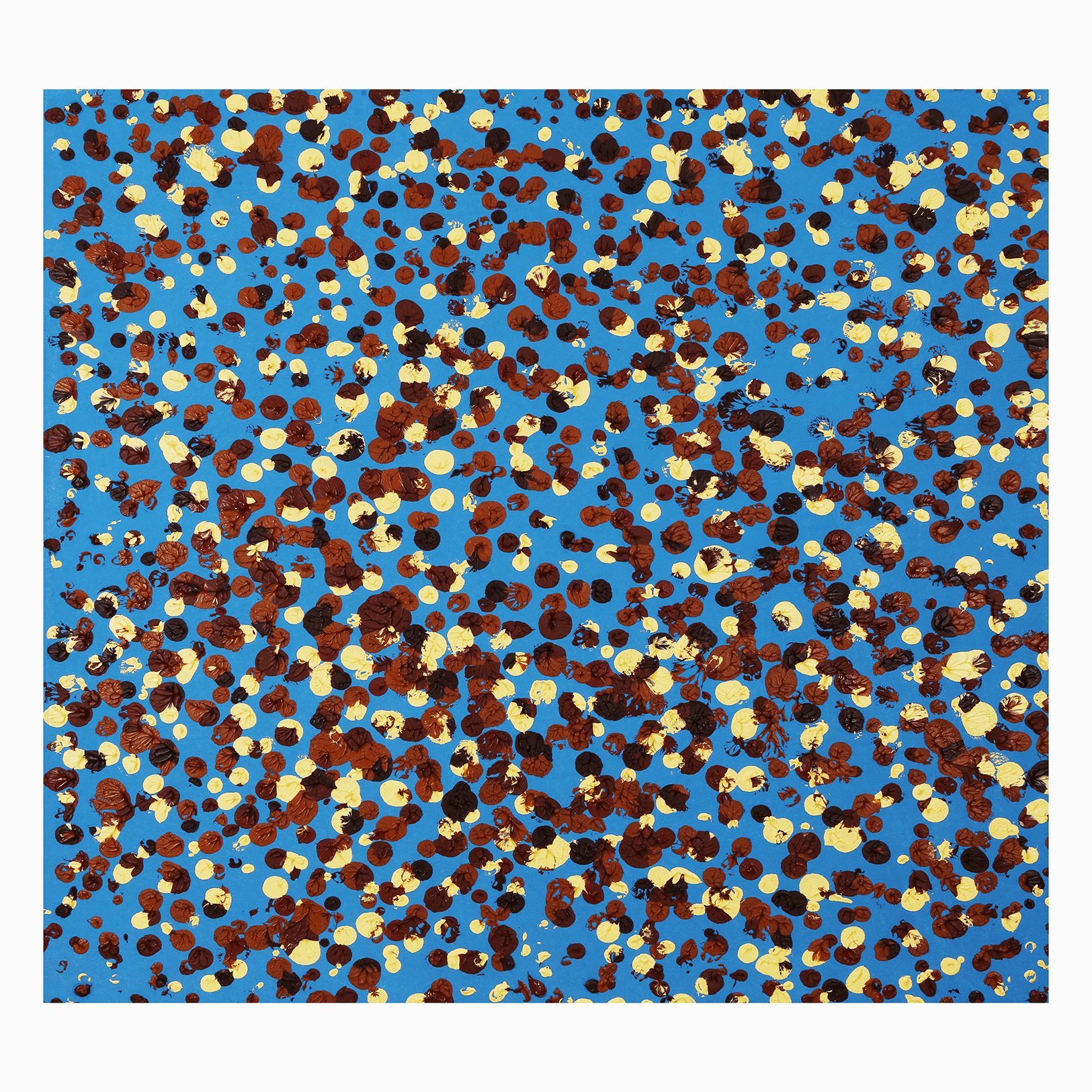
Barakat's paintings bear a remarkable resemblance to the first images from NASA's James Webb Telescope

Barakat's remarkable vision of the Universe combines his own insight with a wealth of influences

Combining technical skill with boundless imagination, Barakat weaves together techniques to create a harmonious whole
Fayez Barakat is famed as a collector of antiquities, but he is also a prolific artist in his own right. His latest collection takes viewers beyond the cosmos.
On Earth, there is another complex universe which we have barely begun to explore: the human imagination. In this universe, physical laws are meaningless, and rationality can be unbound. Nowhere is this truer than in the brain of Fayez Barakat. He is widely recognised as one of the leading authorities on ancient art; his vast collection, displayed in numerous galleries, charts the passions, preoccupations, and personalities of people over the last 60,000 years. He has lived and breathed art, and creative power of mankind, from his earliest childhood. But his own creative outlet – thousands upon thousands of canvases, the product of a restless and inquiring mind – has remained hidden from view until his autumn years. Still fizzing with energy, still excited by the arcane and unusual, and still brimming with childlike curiosity, Barakat is fascinated by the worlds we cannot see – beneath the sea, inside the mind, and beyond our planet – and brings them vividly to life in oil and acrylic.
His latest series deals with what lies beyond even the James Webb Telescope’s reach, transcending the universe we can see towards the cosmos we cannot. Each painting is a celebration of abstract pointillism, but we see little here to remind us of Seurat, Signac and Cross. For them, still operating in the world of the Impressionists, points were light. For Barakat, it seems that points are energy – physical expressions of his own boundless energy, but also a representation of the energies that pervade the Universe, animating us all and tying us together in an infinite web of connections. Each individually articulated point stands alone, but together they form an atomic structure which underpins his composition. But unlike atoms, his points do not occupy space, but rather define it on the canvas. Like in a symphony, the same motifs recur throughout the composition, but are distinguished by layers of refinement and development.
Fayez Barakat is not a man to be shackled to one technique, as even a brief glance through his impressive oeuvre reveals. Each painting, in this and other collections, dispenses with the conventional self-imposed limits of other artists. The result is a kind of richness and depth, a sumptuous banquet of textures and forms, bewildering and compelling in equal measure. Truly, the more you look, the more you see. In works exploring the cosmos, it is apt that each operates on multiple dimensions at once. Like the very Universe whose essence he seeks to capture, Barakat’s paintings are harmonious in their randomness.
Perhaps the greatest testament to the artist’s skill is that it is impossible to tell, without knowing Barakat personally, whether his compositions are planned or the result of a kind of creative spontaneous combustion. Each movement seems both meticulous and unconstrained; no part of the canvas feels cluttered or over-burdened, nor too sparse. It is as though Barakat’s creative instinct is in harmony with nature, as though this is simply how the painting should be. Perhaps, one wonders, the colours and shapes arranged themselves, and Barakat merely facilitated their existence.
As every good art student knows, oil painting is about layers. It is slow, methodical work, a process of constant refinement and adjustment. Barakat’s choice of medium may, then, seem an unlikely one for works as immediate and visceral as this. The artist himself revealed that each painting took some two and a half months to fully dry. But the patience of the artist rewards the patience of the viewer. If one can begin to mentally unpick the painting, it becomes apparent that each work is in fact multiple works, a series in and of itself, reflecting the moods, mentalities, and inspirations of Barakat himself.
The first image transmitted from the James Webb Telescope was of a cluster of galaxies, discouragingly called SMACS 0723, some five billion lightyears away. Experienced NASA scientists were reduced to tears at the beauty and clarity of the picture. The deep Universe was no longer black-and-white; it was a vibrant cacophony of colour and movement. The similarities between the earlier paintings in this series – completed before the first photographs were beamed back – and this now-iconic image are profound. The infinite universe of Barakat’s imagination was, it seems, a worthy match for the infinite universe of a cosmos unbound.
About Fayez Barakat
Fayez Barakat is a Palestinian-American artist and dealer in antiquities, who owns the Barakat Galleries, in London, Los Angeles, Seoul and Hong Kong. The Galleries offer the largest collection of antiquities for public sale in the world. Barakat’s own art has been exhibited in Bahrain, Seoul and Abu Dhabi, and critically acclaimed by the likes of Godfrey Barker, Drew McRitchie, Anthony Downey, and Bryson Howe. Beyond the Cosmos is published by Hanna Bella Publishing.
fayezbarakat.art
barakatgallery.eu
Christopher Cooper
Barakat Gallery
+442074937778 ext.
email us here
Legal Disclaimer:
EIN Presswire provides this news content "as is" without warranty of any kind. We do not accept any responsibility or liability for the accuracy, content, images, videos, licenses, completeness, legality, or reliability of the information contained in this article. If you have any complaints or copyright issues related to this article, kindly contact the author above.
