
Re-Branding Death – This Day of the Dead, See how New Digital Technologies are Revolutionizing Deathcare

In China, it's the Spring Confucian Qingming Festival. In the Hindu faith, the ritual of remembrance is called Shraddha. Regardless of the national origin and timing of these traditions, they share certain characteristics. In the Confucian tradition, young and old alike kneel down to offer prayers before tombstones of the ancestors, offer the burning of joss, sweep the tombs, and offer food in memory of the ancestors. In the Day of the Dead ceremony of the Americas, families build altars or "ofrendas" in their honor. Ofrendas vary by culture but they typically include yellow marigolds, candles, photos of dead loved ones, designs made out of cut tissue paper, as well as food and beverage offerings. Instead of the soberness typically associated with death and dying, Dia de los Muertos is a colorful celebration of the relationship between life and death, designed to mitigate our existential fears.
Changing social norms and new technologies are impacting not only the Day of the Dead and these traditional rituals, but the entire way we approach death in this country. Adapting to these changes, companies like Philadelphia startup Spring Holding Group on the East Coast and Tulip on the West Coast are responding with new offerings that are dramatically altering deathcare in America.
Expensive: Today, funerals generally cost between $7,000 and $10,000, and cremations more than $6,000. Even direct cremations (no embalming, expensive coffin, or traditional memorial service) average $2,000 - $3,000. (NFDA & CANA)
Inconvenient: Arrangements made through traditional funeral homes average two one-hour meetings and another half hour of travel. That's 150 minutes just to take care of the paperwork!
Bad for the Environment: Studies have shown that traditional burial has a significantly higher ecological cost than cremation (Berkeley Planning Journal). More than 800,000 gallons of formaldehyde are dumped into the earth as a result of burials every year in the U.S., and the amount of casket wood alone is equivalent to about 4 million acres of forest and could build 4.5 million homes.
Not Conducive to Memorialization: While nearly all funeral homes have a rudimentary Facebook presence or website where they sometimes post photos of decedents, most don’t offer much when it comes to memorialization. And fewer families want, or can afford to hold a Celebration of Life in a traditional funeral home or religious setting any longer. Plus, faced with pandemics; the high cost and inconvenience of travel, venue rental and catering; not to mention the ecological costs of events in real life (IRL); farflung families are desperate for alternatives. Fewer and fewer are visiting graveyards for traditional Day of the Dead rituals.
What’s responsible for this sea change in cremation rates? According to Spring CEO J.G. Sandom, it’s three (3) major factors: the high cost of traditional funerals; greater ecological awareness and secularization of the American culture; and the increased mobility of the U.S. population.
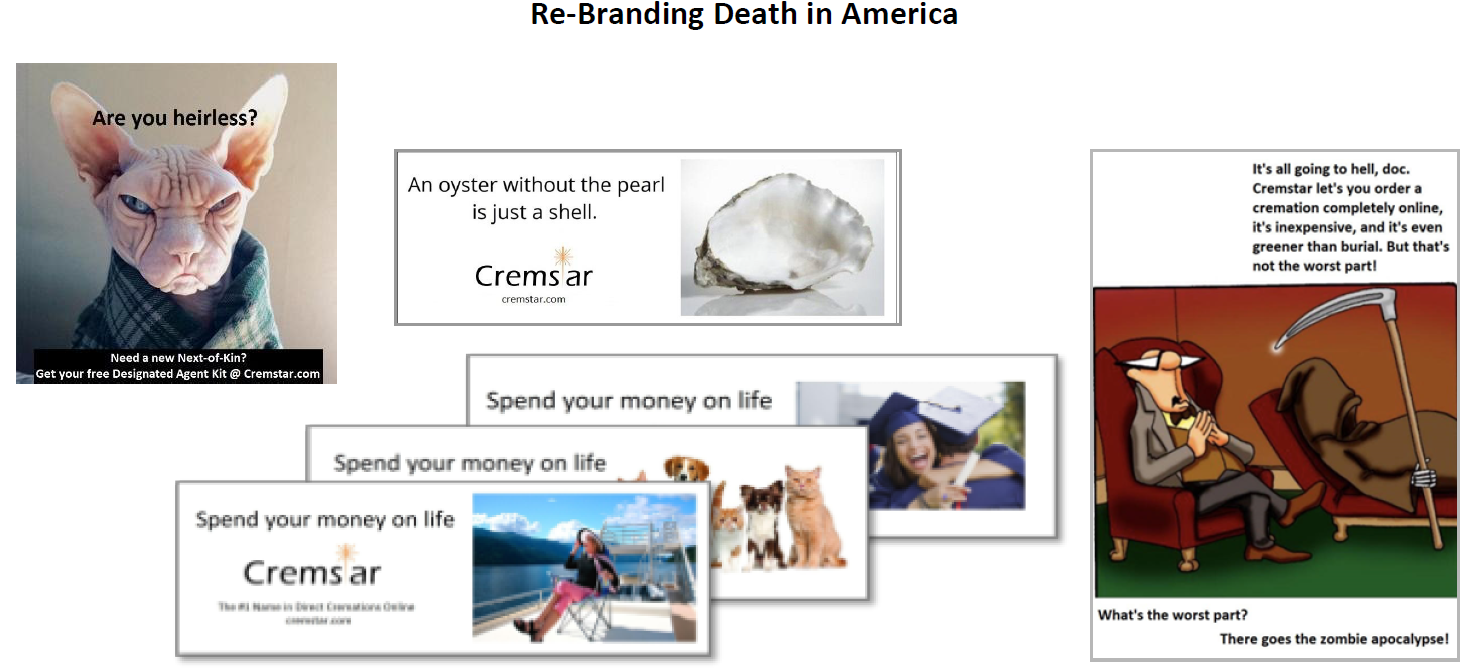
What Was Expensive: In response to these trends, Spring launched an online direct cremation service called Cremstar. While most direct cremations average $2K-$3K, since Cremstar operates exclusively online, cremations start at just $893 in the Mid-Atlantic and Northeastern regions. Tulip has a similar offering on the West Coast. The suite of mobile-first software modules and apps that power the Cremstar service offering (marketed under the brand Styx Logistics to other funeral homes - https://styxapps.com) lets funeral directors assign drivers. Drivers accept removals, and then input ETAs and progress reports. They can even place an RFID chip on the deceased in a first-in-the-nation, patent-pending digital tracking system, which monitors the removal from pickup to drop-off.
What Was Inconvenient: Instead of 150 minutes and two visits to a funeral home where the funeral director is trying to upsell you the whole time, with Cremstar’s online solution, it takes 15-20 minutes to do all the paperwork from the comfort of home or wherever you happen to be at your time of need. You can even order a personalized 3D-printed urn from Final Spring (another Spring Holding Group company - https://finalspring.com).
What Was Bad for the Environment: Burial has a 23% higher environmental cost than cremation. And in some states there are other alternatives such as aquamation or human composting. Aquamation is 95.3% greener than traditional burial. And composting, while expensive, provides the family with enough organic material to compost most backyards. Cremstar uses the most ecological solution available in each market they serve.
What Was Not Conducive to Memorialization: Research shows that creating an online memorial helps in the healing process. Spring’s solution is called MemoryBox. According to Dr. Clay Routledge, world-renowned expert on nostalgia, memory and death, “If you’re a family member or friend of someone who’s dying, or of someone who has recently passed, MemoryBox can help you cope with your loss more effectively, delivering real clinical benefits.” If families are planning a dinner, memorial service, scattering, or a Celebration of Life in real life (IRL), MemoryBox lets them create an “Event” Memory. When folks join an Event Memory, as long as their phone is equipped with the MemoryBox app, all the photographs they take with their phone during the event are copied from their photo roll and posted to the Event Memory online automatically! Or, to arrange a virtual Celebration of Life, especially in these pandemic times, for families that are distributed far and wide, for those who find traveling difficult, for folks who are sick and tired of videoconferencing, Spring has pioneered MemoryBox in the Metaverse — a 3D online environment where families can memorialize their lost loved one and host a virtual Celebration of life in real time, with live eulogies and guests from anywhere in the world. (See www.MetaMemoryBox.com) Why spend time and money, while adding to your carbon footprint, in order to travel to visit a graveside when you can visit with family and friends and honor your loved one in cyberspace?
“We need to reimagine the way we think about mortality in this country,” Sandom concludes. “The writer William Gibson once said, ‘The future is already here. It’s just not evenly distributed.’ The fixed nature and constancy of death is only matched by the ever-changing and mercurial nature of technological advancement. While each of our business units is designed to disrupt the $29 billion deathcare industry, we view Spring’s mission more broadly. We’re not only leveraging the latest digital technologies to re-engineer the way we handle deathcare in America. We’re in the business of rebranding death.”
Sylvana Marie
Cremstar
+1 267-888-8015
jsylvanita@gmail.com
Legal Disclaimer:
EIN Presswire provides this news content "as is" without warranty of any kind. We do not accept any responsibility or liability for the accuracy, content, images, videos, licenses, completeness, legality, or reliability of the information contained in this article. If you have any complaints or copyright issues related to this article, kindly contact the author above.
