
Genozip Launches Deep, an Advanced Compressor for Next Generation Sequencing Data
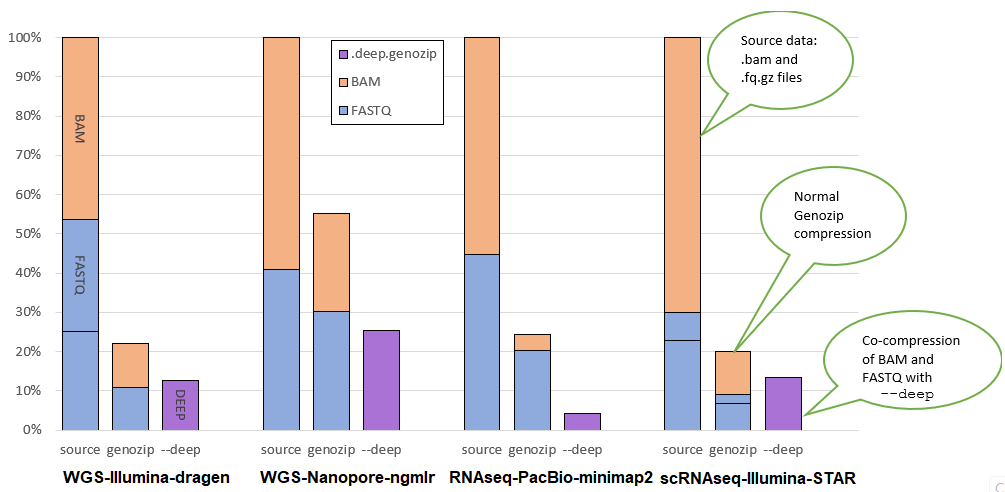
Genozip Deep benchmark
A compressor for FASTQ, BAM, VCF files
HONG KONG, HONG KONG, June 28, 2023/EINPresswire.com/ -- Today, Genozip launched Genozip Deep™, a new compression technology that substantially improves compression of genomic data.
Dr. Divon Lan, the inventor of Genozip, says: “We are now in the era of genomics, where affordable DNA sequencing technologies allow doctors to pin-point genetic causes of their patient’s illnesses and offer more precise remedies, allow researchers to understand causes of diseases by scanning and comparing the genomes of hundreds of thousands of people, and allow evolutionary biologists and population geneticists to better understand how species evolved and how genes flowed and mutated over thousands or millions of years. All of this blessed activity, results in mountains of FASTQ and BAM data that just continue to grow at an ever accelerating pace - gigabytes quickly become terabytes, and terabytes turn into petabytes.”
Genozip is a compression product for genomic data that helps institutions and companies that have a large volume of Next Generation Sequencing data dramatically reduce costs and provide better service to their internal and external customers. Also, sequencing labs and genetic analysis companies can improve their service to their customers by compressing files prior to delivery, substantially reducing the time their clients need to wait to download data, and as a result improve customer satisfaction.
Genozip Deep™, launched today, is a patent-pending co-compression technology that leverages the inherent information redundancies between BAM and related FASTQ files. It typically doubles the compression gains compared to the previous state-of-the-art genomic compression technology, and hence considerably shrinks the volume of data stored.
"The Institute of Genomic Medicine's (IGM) Bioinformatics Core, situated within the Columbia University Irving School of Medicine, manages a variant warehouse containing approximately 130,000 whole-genome sequencing (WGS) and whole-exome sequencing (WES) samples. This warehouse serves the dual purpose of gene discovery and diagnostic analysis and has been utilized in numerous published analyses. Additionally, the IGM acts as a long-term repository for original off-machine FASTQ files of internally and externally sequenced samples, which must be preserved in their original form.” Says Dr. Daniel Hughes, IGM’s Director of Bioinformatics, “After an extensive evaluation of the cost, compute, compression benefits of multiple options we decided upon the use of the Genozip Premium package. We applied the lossless Genozip compression on approximately 172,000 of our most recent internally stored FASTQ pairs. This reduced their data footprint from 537.4 TB to 115.6 TB, resulting in an average space savings of 78.5%. Not only did this significantly reduce storage costs, but it also facilitated the migration of the entire dataset to our cloud infrastructure. I can highly recommend Genozip to any organization looking to reduce the storage footprint of their FASTQ files."
Divon Lan
Genozip Limited
media@genozip.com
Legal Disclaimer:
EIN Presswire provides this news content "as is" without warranty of any kind. We do not accept any responsibility or liability for the accuracy, content, images, videos, licenses, completeness, legality, or reliability of the information contained in this article. If you have any complaints or copyright issues related to this article, kindly contact the author above.
