
Maryland Fishing Report – August 11
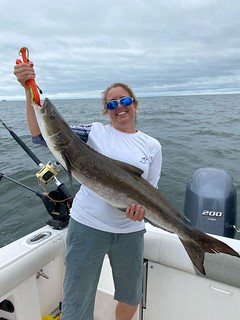
Beth Versak is all smiles with this nice cobia that she caught over the weekend. Photo by Eric Packard
Spanish mackerel and cobia are taking center stage in the lower Bay. Spanish mackerel can be found in good numbers in a variety of locations along channels, chasing schools of bay anchovies. It is a thrilling sight to see gulls diving into a surface melee of bait and a mix of Spanish mackerel, cutlass fish, small bluefish, and at times small striped bass charging through the schools of bait.
The ticket to catching Spanish mackerel is carefully positioning upwind of the action, then casting small to medium soft plastic jigs or metal jigs and retrieving them as fast as possible. A slower retrieve allows bluefish to take your lure. It pays to keep an eye on depth finders because there can be times when larger striped bass, large red drum, or maybe even a cobia can be found holding close to the bottom underneath the action near the surface. It can pay large dividends to have a stout rod rigged with a large, soft plastic jig for this very purpose.
Trolling is a popular option and a great way to cover a lot of water. Most are trolling small #1 and #2 Drone and Clark spoons pulled behind planers or inline weights at speeds of about 8 knots. The channel edges of the shipping channel and similar channels in Tangier Sound are good places to troll.
Cobia are being caught by those setting up chum slicks near the Target Ship, the Middle Grounds, and Smith Point. Most are chumming and dropping back cut bait or a live eel into the back of the chum slick. Many are reporting being overwhelmed with cownose rays and even a few small sharks taking bait. The prize is there though, and some very respectable cobia are being caught every day.
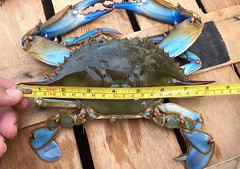
Photo by Amanda Sheets
The shallow-water fishery for a mix of striped bass and speckled trout continues to entertain anglers during the dawn or late evening hours. Casting topwater lures and paddletails near shoreline structure is a fun way to fish with light tackle. Many of the striped bass are measuring less than 20 inches, but there are larger ones. The speckled trout action in Tangier and Pocomoke sounds has been very good, and despite hotter weather it is hoped it will continue this week. Anglers are reminded that the main stem of the Potomac River is closed to striped bass fishing, and resumes on August 21. Virginia bay waters remain closed to striped bass fishing until October 4.
Recreational crabbing can be categorized as quality over quantity. It is still hard work to put together a half bushel of crabs per outing but everyone is remarking about how large the crabs are that they are catching. Opinions are split on shallow vs. deep water, but most agree that waters in the range of 10 feet to 12 feet are providing the best catches. Salinity values are higher in the tidal rivers due to the lack of rain, and there are some good catches being made in the upper reaches of tidal creeks and rivers. There are reports of quite a few small crabs in the middle Bay and rather sparse reports in the lower and upper Bay regions.
Vacationing angling families at Deep Creek Lake are enjoying fishing for a mix of species. There are northern pike being found in the coves and largemouth bass along shoreline structure, floating docks, and grass beds in the shallower coves. Smallmouth bass, yellow perch, and walleye can be found along deep grass edges using deep-diving crankbaits or by drifting live minnows. Bluegill sunfish are ready for anyone dropping a worm or mealworm their way off of docks and grass edges. Trout can be found deep along the dam face.
Fly fishing in the western and central region streams and rivers is a bit of a stealth game, with low water flows that often require long casts and light leaders. Terrestrials such as beetles, ants, and hoppers tend to be good choices during low water conditions. During high water events, working nymphs can be a good bet.

Photo by Charles Hatcher
The many ponds and impoundments spread across the Maryland landscape offer plenty of fun fly fishing for bluegills. Using a light fly rod and small rubber legged poppers, ants and similar topwater flies are good choices for a morning or evening of fun. Bluegills offer plenty of fun fishing for our younger anglers watching a bobber rigged with a worm.
Largemouth bass fishing during the summer months often involves the early morning hours or late evening in the shallower areas where they feed all night long. This type of fishing is always exciting with blowups on topwater frogs or chatterbaits. As the morning hours wear on, fishing the transition areas of slightly deeper waters often near heavy grass or structure is just as satisfying, although presentations are different. Lipless crankbaits, spinnerbaits, chatterbaits, and a variety of soft plastics are all popular offerings. Wacky rigged stick worms and grubs tend to be good choices for fishing through heavy grass or deep structure.
The Department of Natural Resources is always hard at work raising various fish at the Joseph Manning Hatchery in southern Maryland. Staff there have been raising largemouth bass fry to supplement wild populations, and recently stocked 2,500 juveniles in Piscataway Creek and 19,500 in the Mallows Bay area and Nanjemoy Creek. The hatchery staff also raised golden shiner fry and placed them in a hatchery pond that was introduced with largemouth juveniles. The small largemouth bass fed on the golden shiners to become what is labeled advanced fingerlings, which will have a major head start to bolster largemouth bass populations in the tidal Potomac River area. About 10,400 of these advanced fingerlings were stocked at Indian Head on the Potomac River and Piscataway Creek.
Fishing for northern snakeheads is certainly back in gear after the spawn and the close attention adults pay to fry balls is over. Casting chatterbaits, frogs, and other topwater lures in, over, and near grass and similar vegetation is providing plenty of action. Casting white paddletails rigged weedless through or near grass is also a good tactic.

Tom Weaver took this exciting picture of a white marlin caught and released by Matt Taylor during the tournament. Photo by Tom Weaver
The White Marlin Open is now in the history books with another year of record payouts. Also, on the last day of the tournament, Jake Bertonazzi broke the state’s nearly two-week-old swordfish record for the Atlantic Division with a 318.5-pound catch roughly 60 miles offshore in Poor Man’s Canyon.
A fair portion of visiting boats are still docked in Ocean City waiting for the upcoming Poor Girls Open and MidAtlantic tournaments. All of this offshore fishing action helps give everyone an idea of what kind of fishing opportunities exist offshore.
Fishing in the surf along Ocean City and Assateague Island beaches is mostly centered on small summer species. Kingfish, spot, and small bluefish are being caught in the surf, and because of the hot weather the best fishing success has been in the early morning hours. There is a report of at least a few pompano being caught, so it would pay to rig one surf rod with a sand flea for bait.
At the inlet there are striped bass being caught near the South Jetty and the Route 50 Bridge. Most are undersized but offer plenty of fun catch and release fishing with the occasional striped bass that measures larger than 28 inches. Casting bucktails and soft plastic jigs is the most popular way to fish. Flounder are also part of the mix at the inlet on traditional squid baits, Gulp soft plastics, or by live-lining spot, finger mullet or menhaden.
Flounder fishing in the back bay channels continues to be good, as long as water clarity is good. Due to boat traffic leading towards the inlet, many anglers are choosing to fish in front of the airport and nearby channel areas with good success.
There are some exciting developments outside the inlet near some of the inshore shoal areas this week. Spanish mackerel are being caught by those trolling small Clark and Drone spoons behind inline weights and planers. Large flounder are also being caught on these shoals.
At the wreck and reef sites, sea bass are being caught, and it is not uncommon to see a few limit catches on each party boat. Flounder are also being caught around the same wreck and reef sites by those who target them.
The anglers who are chunking at the Lumps along the 30 Fathom Line are catching yellowfin tuna. Farther offshore the boats trolling the canyons are catching a mix of yellowfin tuna, white marlin, dolphin, and the occasional blue marlin. Many charters are deep dropping to put some variety in the fish box with blueline and golden tilefish.
“We have reached the time in the life of the planet and humanity’s demands upon it, when every fisherman will have to be a riverkeeper, a steward of marine shallows, a watchman of the high seas.” — Thomas McGuane
Maryland Fishing Report is written and compiled by Keith Lockwood, Maryland Department of Natural Resources fisheries biologist.
Click Before You Cast is written by Tidewater Ecosystem Assessment Director Tom Parham.
This report is now available on your Amazon Echo device — just ask Alexa to “open Maryland Fishing Report.”
Legal Disclaimer:
EIN Presswire provides this news content "as is" without warranty of any kind. We do not accept any responsibility or liability for the accuracy, content, images, videos, licenses, completeness, legality, or reliability of the information contained in this article. If you have any complaints or copyright issues related to this article, kindly contact the author above.
