
Four Charts on Canada’s Carbon Pollution Pricing System
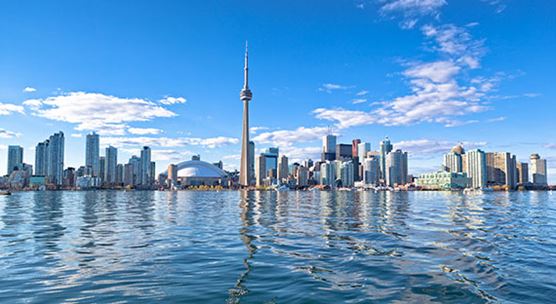
Skyline of Toronto City, Ontario. Under the federal backstop system, most households in Ontario will receive more in tax rebates than they incur in costs resulting from pollution pricing. (photo: espiegle by Getty Images)
By Ian Parry, IMF Fiscal Affairs Department
March 18, 2021
With a federal price on carbon now written into law, Canada is fighting climate change. The country’s enhanced carbon pricing measures put it on track to meet its Paris Agreement targets, providing a model for other large-emitting countries to follow.
Canada has pledged to cut greenhouse gases by about 30 percent below current levels by 2030 and to achieve emissions neutrality by 2050. To meet these ambitious targets, the country is steadily ramping up its price on carbon.
The following four charts illustrate the "why and how" of Canada’s carbon pricing arrangement.
While Canada is in the vanguard, momentum for carbon pricing is building globally. For example, carbon prices in the EU have recently risen to US$45 per ton, and more recently China and Germany have introduced pricing schemes. However, scaling up is difficult when countries act alone. Concerns about international competitiveness and whether other countries remain committed to their targets can hamper mitigation efforts.
An international carbon price floor would be more effective. Under this scheme, large emitting countries would agree to simultaneously implement a minimum price on their carbon emissions (as well as meet mitigation commitments). The price floor could be designed equitably with stricter requirements for advanced economies and assistance for lower-income economies. It could also be applied flexibly to accommodate alternative approaches and would be more effective than border carbon adjustments.
Canada’s experience, where governments have the flexibility to meet carbon pricing requirements set at a higher level, provides a valuable prototype for how this approach could be applied globally.
Legal Disclaimer:
EIN Presswire provides this news content "as is" without warranty of any kind. We do not accept any responsibility or liability for the accuracy, content, images, videos, licenses, completeness, legality, or reliability of the information contained in this article. If you have any complaints or copyright issues related to this article, kindly contact the author above.
