
New Storymap Explains the Where and Why of Amazon’s Warehouse Network
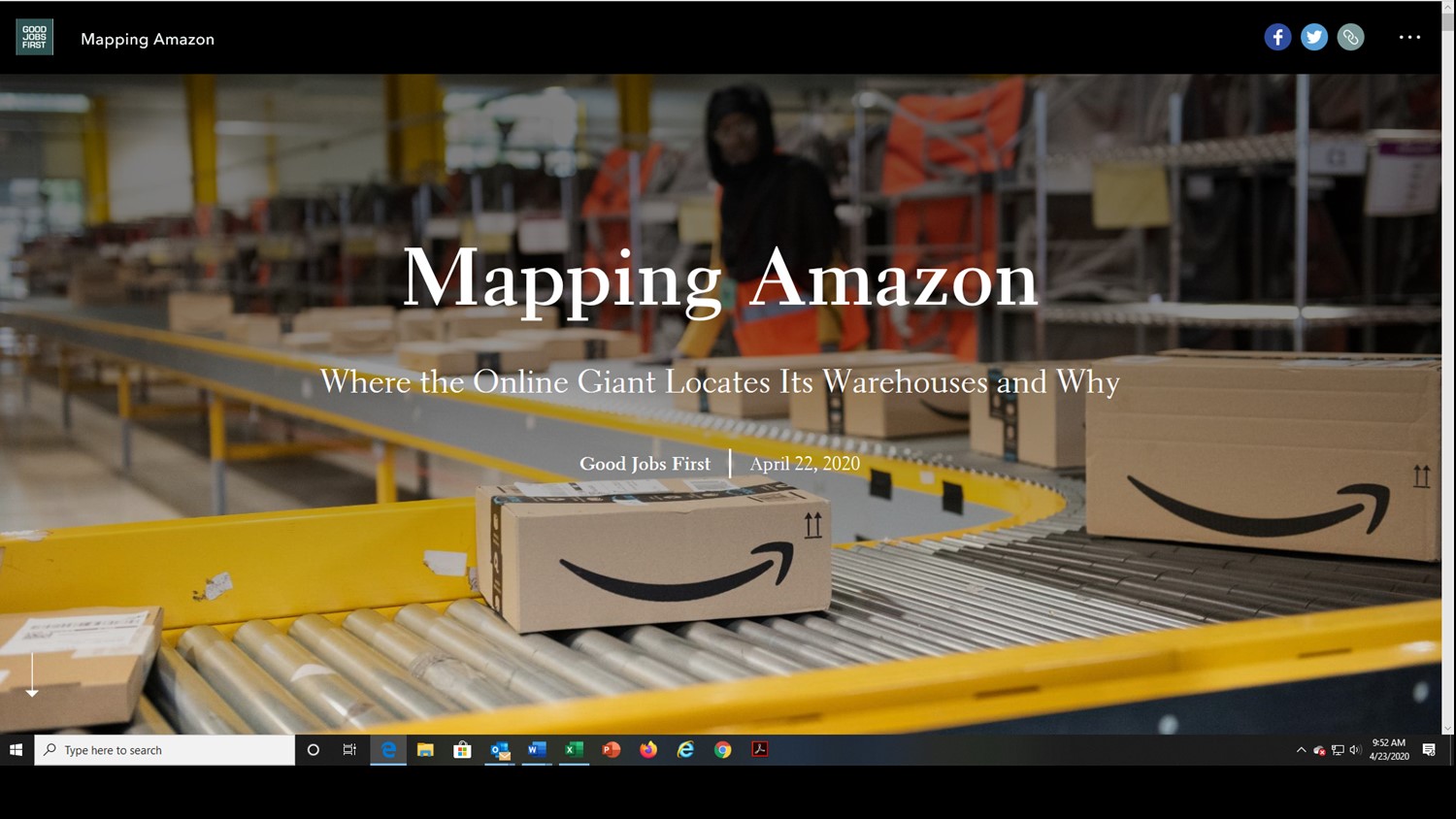
Mapping Amazon: the Where and Why of its Warehouse Locations
The geography of Amazon's network of warehouses reflects its Prime business model, disposable household income and infrastructure — NOT development incentives
Amazon.com, Inc. (NYSE:AMZN)
Contact: Greg LeRoy at goodjobs@goodjobsfirst.org or 202-494-0888
or Christine Wen at chris@goodjobsfirst.org or 202-232-1616 ext. 6
Interactive Online Map
New Storymap Explains the Where and Why of Amazon’s Warehouse Network
Washington, DC—The geography of Amazon.com’s rapidly growing network of warehouses has been driven by the evolution of its Prime subscription business model, and then by disposable household income and transportation infrastructure—not by economic development incentives.
That’s the main conclusion of an interactive storymap published today by Good Jobs First (GJF), a non-profit watchdog group on development subsidies. It is visible at www.goodjobsfirst.org/MappingAmazon.
“Our storymap enables viewers to see for themselves in all of the 48 contiguous states plus DC how Amazon warehouses invariably stay close to high-income households, highways and airports,” said Christine Wen, GJF’s coordinator of the project. “In both an interactive national map and in regional snapshots, we find the very same patterns. There was never any need for taxpayers to subsidize these inevitable facilities.”
“In its early years, Amazon had very few warehouses so that it could legally avoid collecting sales taxes, gain a price advantage, and grow its market share,” said Greg LeRoy, GJF’s executive director. “But as Prime took off and Amazon veered to rapid delivery as its new advantage, it had to build warehouses in all big metro areas with the most Prime households. Tax breaks had nothing to do with it. Yet states and cities have subsidized more than 150 of the online giant’s warehouses.”
The $2.9 billion in subsidies that states and localities have given Amazon for all of its various kinds of facilities are tallied at GJF’s Amazon Tracker webpage.
Good Jobs First renewed the call it has been making since 2016 for states and localities to stop subsidizing Amazon. “Retailing is a low-value added industry that is being convulsed by the internet. In addition to the record number of bricks and mortar store closures and chain bankruptcies, now we have the coronavirus pandemic further exacerbating that upheaval,” said LeRoy. “Governments have many far more urgent needs now in responding to the pandemic and should stop wasteful giveaways to Amazon—and to all other e-commerce corporations.”
Editor’s Note: Good Jobs First is a non-profit, non-partisan research center. Founded in 1998, it is headquartered in Washington DC. It is home to Subsidy Tracker, Tax Break Tracker and Violation Tracker, and was honored for its leadership in winning GASB Statement 77 on Tax Abatement Disclosures, a landmark in municipal finance.
-30-
Greg LeRoy
Good Jobs First
+1 202-232-1616
email us here
Visit us on social media:
Facebook
Twitter
LinkedIn
Legal Disclaimer:
EIN Presswire provides this news content "as is" without warranty of any kind. We do not accept any responsibility or liability for the accuracy, content, images, videos, licenses, completeness, legality, or reliability of the information contained in this article. If you have any complaints or copyright issues related to this article, kindly contact the author above.
