
Wireless network infrastructure a $61 billion opportunity - The Wireless Network Infrastructure Ecosystem report

4G-Reports logo
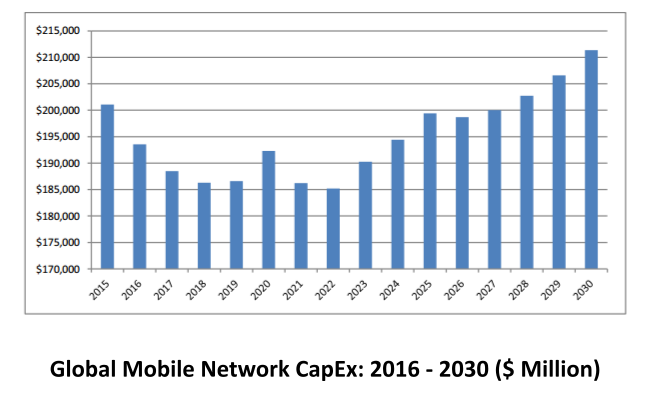
Global Mobile Network CapEx 2016 - 2030 ($ Million)
4G-Reports.com‘s latest report indicates that the wireless network infrastructure market will remain relatively flat by 2020, with investments of $61 billion.
Experts expect a significant shift in investments towards small cells, C-RAN, DAS and carrier Wi-Fi infrastructure.
LONDON, UK, April 6, 2016 /EINPresswire.com/ -- 4G-Reports.com (https://www.4g-reports.com/The-Wireless-Network-Infrastructure-Ecosystem-2016-2030) has announced the addition of the "The Wireless Network Infrastructure Ecosystem: 2016 – 2030" report to their offering. — Joe Moore, 4G-Reports
The term “Wireless Network Infrastructure” has conventionally been associated with macrocell RAN (Radio Access Network) and mobile core segments of mobile operator networks. However, the scope of the term is expanding as mobile operators increase their investments in Heterogeneous Network or HetNet infrastructure such as small cells, carrier Wi-Fi and DAS (Distributed Antenna Systems), to cope with increasing capacity and coverage requirements.
In addition, mobile operators are keen to shift towards a C-RAN (Centralized RAN) architecture, which centralizes baseband functionality to be shared across a large number of distributed radio nodes. In comparison to standalone clusters of base stations, C-RAN provides significant performance and economic benefits such as baseband pooling, enhanced coordination between cells, virtualization, network extensibility and energy efficiency.
Due to a decline in macrocell RAN infrastructure spending, experts estimate that the wireless network infrastructure market will remain relatively flat through 2020, with annual investments of over $61 Billion. Experts also expect a significant shift in investments towards small cells, C-RAN, DAS and carrier Wi-Fi infrastructure. By 2020, these four submarkets, together with their fronthaul and backhaul segments, will account for over 50% of all wireless network infrastructure spending.
The “Wireless Network Infrastructure Ecosystem: 2016 – 2030 – Macrocell RAN, Small Cells, C-RAN, RRH, DAS, Carrier Wi-Fi, Mobile Core, Backhaul & Fronthaul” (https://www.4g-reports.com/The-Wireless-Network-Infrastructure-Ecosystem-2016-2030) report presents an in-depth assessment of the wireless network infrastructure ecosystem including enabling technologies, key trends, market drivers, challenges, investment trends, mobile operator revenue potential, regional CapEx commitments, network rollout strategies, future roadmap, value chain, ecosystem player profiles and vendor market share. The report also presents forecasts for wireless network infrastructure investments from 2016 till 2030. The forecasts cover 9 individual submarkets and 6 regions.
The report comes with an associated Excel datasheet suite covering quantitative data from all numeric forecasts presented in the report.
Topics Covered
The report covers the following topics:
- Up-to-date coverage of market dynamics allowing wireless network infrastructure vendors to analyze opportunities and challenges of selling to mobile operators in different regional markets
- Analysis of demand and supply of wireless network infrastructure including forecasts of investment trends, technology requirements and deployment strategies for antenna, RAN, mobile core, backhaul and fronthaul deployments
- Review of mobile operator CapEx commitments, subscriptions, traffic projections and service revenue, by technology and region
- Market outlook for key technologies including TD-LTE, LTE-Advanced, VoLTE, RCS, LTE broadcast, unlicensed LTE small cells and 5G
- Industry roadmap and value chain
- Profiles and strategies of over 350 ecosystem players including wireless network infrastructure vendors and enabling technology providers
- Vendor market share for macrocell RAN, small cells, C-RAN, DAS, carrier Wi-Fi, mobile core, backhaul and fronthaul
- Market analysis and forecasts from 2016 till 2030
Regional Markets:
- Asia Pacific
- Eastern Europe
- Latin & Central America
- Middle East & Africa
- North America
- Western Europe
Key Questions Answered
The report provides answers to the following key questions:
- How big is the 2G, 3G, 4G and 5G wireless network infrastructure opportunity?
- What trends, challenges and barriers are influencing its growth?
- How is the ecosystem evolving by segment and region?
- Which submarkets will see the highest percentage of growth?
- What will the market size be in 2020 and at what rate will it grow?
- How will the market shape for small cell, C-RAN, carrier Wi-Fi and DAS deployments?
- How much service revenue will be generated by mobile operator networks?
- When will 2G and 3G infrastructure spending diminish?
- What is the outlook for LTE and 5G infrastructure investments?
- What are the future prospects of millimeter wave technology for backhaul, fronthaul and RAN deployments?
- Who are the key vendors in the market, what is their market share and what are their strategies?
- What strategies should wireless network infrastructure vendors and mobile operators adopt to remain competitive?
Key Findings
The report has the following key findings:
- Due to a decline in macrocell RAN infrastructure spending, experts estimate that the wireless network infrastructure market will remain relatively flat through 2020, with annual investments of over $61 Billion.
- Experts expect a significant shift in investments towards small cells, C-RAN, DAS and carrier Wi-Fi infrastructure. - - By 2020, these four submarkets, together with their fronthaul and backhaul segments, will account for over 50% of all wireless network infrastructure spending.
- Small cell and C-RAN solutions are beginning to converge as small cell OEMs seek to capitalize on the benefits of centralized coordination for in-building and enterprise coverage.
- Driven by ongoing large scale deployments, we estimate that LTE networks will generate nearly $800 Billion in annual service revenue by 2020.
- Vendors are increasing their focus on profit margins. Many are already cutting staff, embracing operational excellence, evolving their new business models, acquiring niche businesses and expanding their managed services offerings.
- New CapEx commitment avenues such as HetNet infrastructure and virtualization will continue to usher industry restructuring, and market consolidation.
Forecast Segmentation
Market forecasts are provided for each of the following submarkets and their subcategories:
- Macrocell RAN
- Mobile Core
- Macrocell Backhaul
- Small Cells
- Small Cell Backhaul
- Carrier Wi-Fi
- C-RAN
- C-RAN Fronthaul
- DAS
For more information visit: https://www.4g-reports.com/The-Wireless-Network-Infrastructure-Ecosystem-2016-2030
Media Contact:
Joe Moore, +44 20 3287 0803, joe.moore@4G-Reports.com
SOURCE 4G-Reports.com
RELATED LINKS
http://4G-Reports.com
Joe Moore
4G-Reports.com
+44 20 3287 0803
email us here
Legal Disclaimer:
EIN Presswire provides this news content "as is" without warranty of any kind. We do not accept any responsibility or liability for the accuracy, content, images, videos, licenses, completeness, legality, or reliability of the information contained in this article. If you have any complaints or copyright issues related to this article, kindly contact the author above.
