
Transportation Services Global Market Briefing Report
Transportation Services Global Market provides strategists, marketers & senior management with the critical information about Transportation Services sector.
User centric mobility services put transportation users in control and mean that public transportation will become personal.It changes the approach to operations and planning based on user preference
HYDERABAD, TELANGANA, INDIA, February 25, 2016 /EINPresswire.com/ -- Transportation Services Global Market provides strategists, marketers and senior management with the critical information they — The Business Research Company
need to assess the global Transportation Services sector.
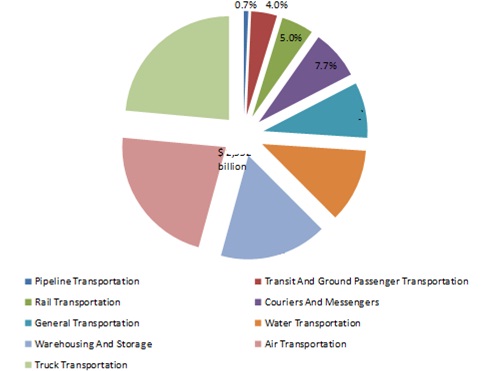
The total value of the transportation services market globally in 2014 was $ 2,352 billion. Related to a world population of
more than 7 billion in 2014 this equates to about $336 per person globally. Given that world domestic product was approximately
$78 trillion in 2014, the market makes up about 3.0% of the global economy.
In 2014, 3.3 billion passengers opted for air travel and 3.7 billion people are expected to opt for air travel in 2016.
There are around 100,000 flights per annum globally in 2015.
In 2014, movement of goods by rail was 9.6 trillion TKM (Ton-Kilometers).
Transportation is a process of moving people or things from one place to another for an amount or fee. Transportation services
include air, rail, road, water and pipeline transportation of both goods and people.
Truck transportation companies moves large quantities of raw materials, semi-finished goods and finished goods over land
typically, from manufacturing plants to distribution centers. The truck transportation industry supports the FMCG industry,
manufacturing industry, construction industry, mining industry and the agriculture industry for the movement of goods.
Road transportation includes bus and taxi transportation. Bus transportation companies move passengers along a predefined route
for a fee. Bus transportation services operations are carried out by both public and private companies. Taxi services companies
move people from one location to another location for a standard rate. Trams are also considered to be part of road
transportation.
User Centric Mobility Services – User centric mobility services put transportation users in control and mean that public
transportation will become personal. It changes the approach to operations and planning based on users preference, movements,
data flows and response to disruption. Smartphones give users access to more travel options and real time status on par with any
transportation services operator. Ride sharing companies like BlaBlaCar enabled by digital technology are challenging and
changing established business models and players. It is also clearly visible in the taxi industry where smartphone users can
book a cab in advance and secure a fare of their choice using apps like Uber.
Demand Driven Pricing – Demand driven pricing which existed in the aviation industry can also be witnessed in other
transportation services due to the emergence of internet booking and low cost carriers over the last decade. With an increase in
usage of mobile technology and the rise of the “Internet of Things” pricing mechanisms can be conceived based on time of day,
road congestion, speed, occupancy and even fuel efficiency and carbon emissions.
Dinesh Kumar
The Business Research Company
+918897263534
email us here
Legal Disclaimer:
EIN Presswire provides this news content "as is" without warranty of any kind. We do not accept any responsibility or liability for the accuracy, content, images, videos, licenses, completeness, legality, or reliability of the information contained in this article. If you have any complaints or copyright issues related to this article, kindly contact the author above.
