
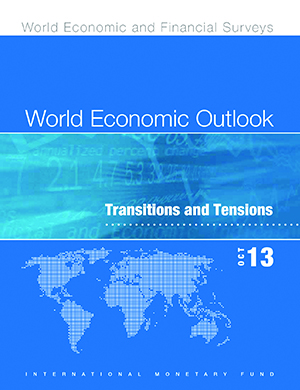
IMF World Economic Outlook (WEO) - Transitions and Tensions, October 2013 -- Analytical Chapters 3 and 4
World Economic and Financial Surveys
World Economic Outlook (WEO)
Transitions and Tensions
October 2013
Chapter 3 explores how output comovements have evolved in recent years and how they are influenced by various shocks and linkages. It assesses the possible output spillovers from those shocks that most concern policymakers, including policy shocks, such as unexpected monetary or fiscal tightening; financial shocks, such as a systemic banking crisis or renewed financial turmoil; and growth surprises (which could be driven by either real or financial shocks) in advanced economies or in large emerging markets.
Historically, surges in capital inflows to emerging market economies tended to lead to domestic booms and current account deficits and, when the flows reversed, painful adjustments and sometimes financial crisis. The global financial crisis, however, marked a change from the past. While some countries experienced the classical boom-and-bust cycle in response to volatile international capital flows, many did not. Instead, domestic residents stepped in to replace foreign capital by drawing down their own foreign assets. Chapter 4 examines whether it is possible to use policy to encourage such behavior.
Contents
Chapter 3: Dancing Together? Spillovers, Common Shocks, and the Role of Financial and Trade Linkages
| Output Comovements: Conceptual Framework and Stylized Facts | |||
| The Role of Common Shocks and Financial and Trade Linkages | |||
| Spillovers of Country-Specific Shocks to Other Countries and the Role of Financial and Trade Linkages | |||
| Summary and Implications for the Outlook | |||
| Conclusions | |||
| Appendix | |||
| 3.1 | Data Definitions, Sources, and Country Groupings | ||
| 3.2 | Multiperiod Comovement Regressions | ||
| 3.3 | Growth Regressions | ||
| Boxes | |||
| 3.1 | Output Synchronicity in the Middle East, North Africa, Afghanistan, and Pakistan and in the Caucasus and Central Asia | ||
| 3.2 | Spillovers from Changes in U.S. Monetary Policy | ||
| References | |||
| Figures | |||
| Chart | Data | 3.1 | The Evolution of Output Comovements, 2004–12 |
| Chart | Data | 3.2 | Output Comovements: 1978–2012 |
| Chart | Data | 3.3 | Output Comovements: Back to Precrisis Levels? |
| Chart | Data | 3.4 | What’s Behind “Common Shocks”? |
| Chart | Data | 3.5 | Growth Surprises in the United States, Euro Area, and China and their Impact on Growth in Other Countries |
| Chart | Data | 3.6 | Peak Impact of Growth Disappointments on Other Regions |
| Chart | Data | 3.7 | Cross-Border Impact of Financial Shocks |
| Chart | Data | 3.8 | Impact of U.S. and Euro Area Financial Shocks |
| Chart | Data | 3.9 | Cross-Border Impact of Policy Shocks |
| Chart | Data | 3.10 | Peak Impact of Fiscal Policy Shocks on Other Regions |
| Chart | Data | 3.11 | Cross-Border Impact of Monetary Policy Shocks on Industrial Production |
| Chart | Data | 3.12 | Peak Impact of Monetary Policy Shocks on Other Regions |
| Chart | Data | 3.13 | Impact of U.S. Credit Supply Shocks |
| Chart | Data | 3.14 | Comparison of Various Output Comovement Measures |
| Chart | Data | 3.15.a | Growth Surprise Shocks |
| Chart | Data | 3.15.b | Financial Shocks |
| Chart | Data | 3.15.c | Policy Shocks |
| Chart | Data | 3.16.a | Cross-Border Impact of Growth Surprises in the United States, Euro Area, and China on Growth in Other Countries |
| Chart | Data | 3.16.b | b Cross-Border Impact of Growth Surprises in the United States and Euro Area on Growth in Other Countries |
| Chart | Data | 3.16.c | Cross-Border Impact of Fiscal Policy Shocks on Growth in Other Countries |
| Chart | Data | 3.16.d | Cross-Border Impact of Monetary Policy Shocks on Growth in Other Countries |
| Chart | Data | 3.17 | Cross-Border Output Impact of Tax- versus Spending-Based Shocks |
| Chart | Data | 3.1.1 | Output Comovements between MCD Groups and External Partners |
| Chart | Data | 3.1.2 | Output Comovements in Middle East and Central Asia Country Groups |
| Chart | Data | 3.2.1 | Impact of Monetary Policy Shocks |
| Chart | Data | 3.1.1 | Monthly Percent Increase on Short-Term Rates |
| Chart | Data | 3.2.3 | Response to Federal Funds Rate Shocks |
| Chart | Data | 3.2.4 | Exchange Rate Response to Federal Funds Rate Surprises |
| Chart | Data | 3.2.5 | Monetary Policy Autonomy |
Chapter 4: The Yin and Yang of Capital Flow Management: Balancing Capital Inflows with Capital Outflows
| Financial Adjustment and Resilience | |||
| How Are the More Resilient Economies Different? | |||
| Case Studies | |||
| Overall Analysis | |||
| Conclusions | |||
| Box | |||
| 4.1 | Simulating Vulnerability to International Capital Market Conditions | ||
| Figures | |||
| Chart | Data | 4.1 | Gross Capital Inflows |
| Chart | Data | 4.2 | Account, GDP, Consumption, and Unemployment |
| Chart | Data | 4.3 | Policies and Institutions |
| Chart | Data | 4.4 | External Financial Integration |
| Chart | Data | 4.5 | Economic Structure and Reserves |
| Chart | Data | 4.6 | Chile |
| Chart | Data | 4.7 | Malaysia |
| Chart | Data | 4.8 | The Czech Republic |
| Chart | Data | 4.1.1 | Responses to Changes in International Capital Market Conditions |
Legal Disclaimer:
EIN Presswire provides this news content "as is" without warranty of any kind. We do not accept any responsibility or liability for the accuracy, content, images, videos, licenses, completeness, legality, or reliability of the information contained in this article. If you have any complaints or copyright issues related to this article, kindly contact the author above.
