
Humanoid Robot-Specific Chip Market to Expand at 27.1% CAGR, Reaching USD 5.3 Billion by 2034
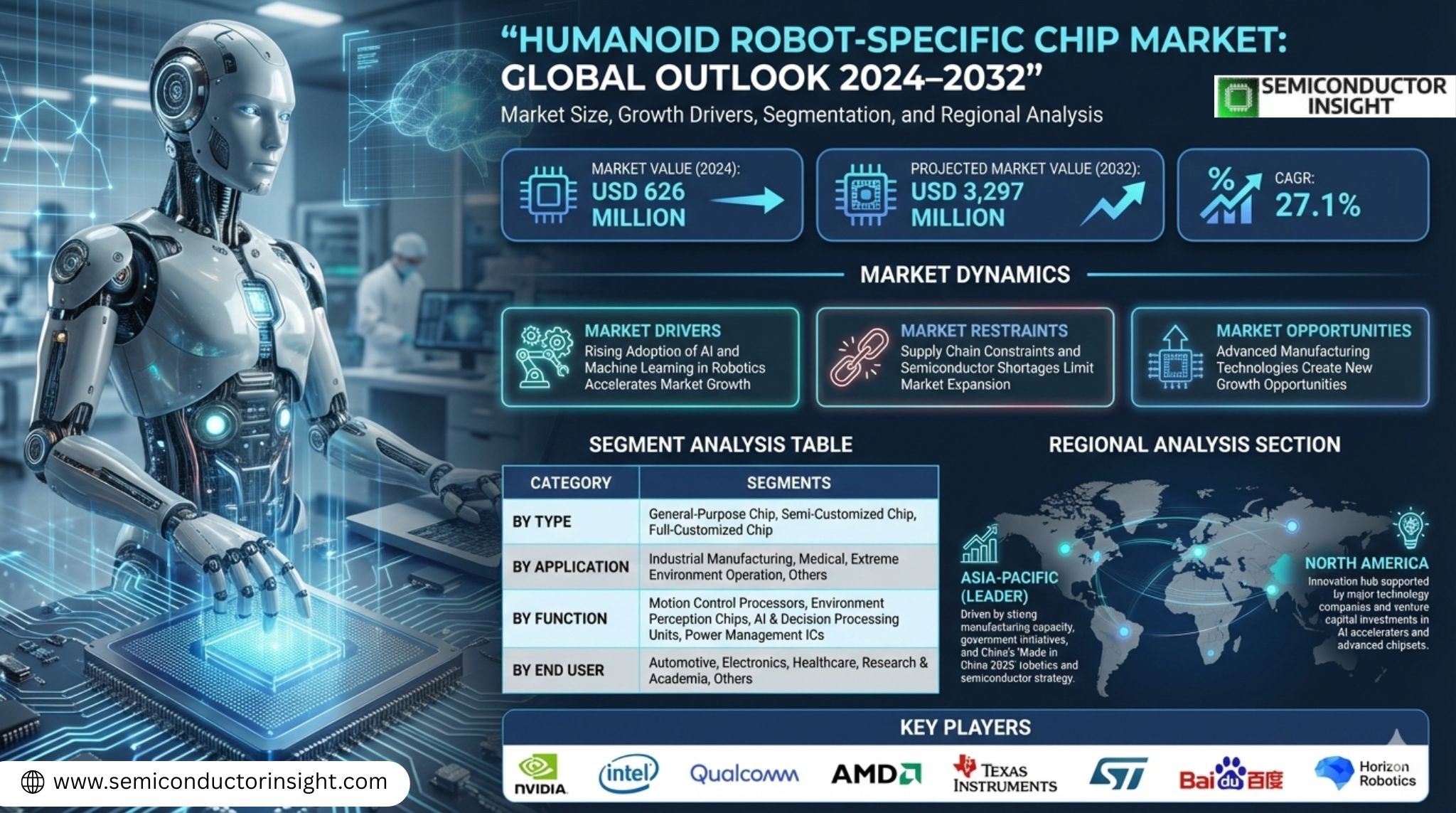
Humanoid Robot-Specific Chip Market Share
Humanoid robot-specific chip market is set to grow from USD 796 million in 2025 to around USD 5.33 billion by 2034, registering a robust CAGR of 27.1%
Humanoid robot-specific chip market is set to grow from approximately USD 796 million in 2025 to around USD 5.33 billion by 2034, registering a robust CAGR of 27.1% during the forecast period.”
PUNE, MAHARASHTRA, INDIA, December 16, 2025 /EINPresswire.com/ -- Humanoid Robot-Specific Chip Market is entering a decisive growth phase as robotics manufacturers transition from general-purpose processors to purpose-built silicon designed exclusively for human-like motion, perception, and decision-making. Unlike conventional industrial robot controllers, humanoid robots demand chips that can process real-time sensory fusion, adaptive motor control, low-latency inference, and power-efficient autonomy within compact form factors.— Semiconductor Insight
The humanoid robot-specific chip market is set to grow from USD 796 million in 2025 to around USD 5.33 billion by 2034, registering a robust CAGR of 27.1% during the forecast period.
Target Market estimates indicate accelerating adoption across healthcare robotics, service automation, logistics assistance, and advanced research platforms. As humanoid robots move from pilot deployments into commercial environments, chip architecture is becoming a core competitive differentiator, not a background component.
🔹𝗔𝗰𝗰𝗲𝘀𝘀 𝘁𝗵𝗲 𝗦𝗮𝗺𝗽𝗹𝗲 𝗥𝗲𝗽𝗼𝗿𝘁 𝗳𝗼𝗿 𝗧𝗲𝗰𝗵𝗻𝗼𝗹𝗼𝗴𝘆 & 𝗠𝗮𝗿𝗸𝗲𝘁 𝗦𝗰𝗼𝗽𝗲 𝗢𝘃𝗲𝗿𝘃𝗶𝗲𝘄: https://semiconductorinsight.com/download-sample-report/?product_id=117458
𝗪𝗵𝘆 𝗛𝘂𝗺𝗮𝗻𝗼𝗶𝗱 𝗥𝗼𝗯𝗼𝘁𝘀 𝗡𝗲𝗲𝗱 𝗦𝗽𝗲𝗰𝗶𝗮𝗹𝗶𝘇𝗲𝗱 𝗖𝗵𝗶𝗽𝘀 𝗯𝘂𝘁 𝗡𝗼𝘁 𝗚𝗲𝗻𝗲𝗿𝗮𝗹 𝗣𝗿𝗼𝗰𝗲𝘀𝘀𝗼𝗿𝘀?
Traditional CPUs and GPUs were never designed to replicate human-level responsiveness. Humanoid robots require chips optimized for simultaneous cognition, motion, and perception, often under strict power and thermal constraints.
Key functional demands shaping chip development include:
• Multi-sensor fusion (vision, tactile, auditory, force feedback)
• Sub-millisecond motion control loops for bipedal balance
• On-device AI inference to avoid cloud latency
• Energy efficiency for extended operational autonomy
• Safety-critical redundancy for human-robot interaction
This shift is pushing semiconductor developers to design robot-first architectures rather than adapting legacy silicon.
𝐐𝐮𝐢𝐜𝐤 𝐆𝐥𝐚𝐧𝐜𝐞 𝐚𝐭 𝐈𝐧𝐝𝐮𝐬𝐭𝐫𝐲 𝐋𝐚𝐭𝐞𝐬𝐭 𝐔𝐩𝐝𝐚𝐭𝐞𝐬:
➣ 𝐈𝐧 𝐃𝐞𝐜𝐞𝐦𝐛𝐞𝐫 𝟐𝟎𝟐𝟓, GMO AI & Robotics Trading Co., Ltd., part of the GMO Internet Group and a company driving AI and robotics into society, has acquired all shares of Various Robotics Inc., a developer of advanced robot solutions. This action improves GMO AIR's position in physical AI and brings together some of Japan's leading robotics engineers. The acquisition would enable the business to provide more sophisticated robot solutions targeted at addressing societal issues like population decline and labor shortages while producing experiences that make people smile and feel moved.
➣ 𝐈𝐧 𝐎𝐜𝐭𝐨𝐛𝐞𝐫 𝟐𝟎𝟐𝟓, Unitree Technology officially released its next-generation bionic humanoid robot, the Unitree H2. Standing 180 cm tall and weighing 70 kg, the Unitree H2's overall design more closely resembles a real human form, giving it a more lifelike appearance. In the official video, the Unitree H2 is shown wearing clothing, further enhancing its anthropomorphic appearance.
➣ 𝐈𝐧 𝐀𝐮𝐠𝐮𝐬𝐭 𝟐𝟎𝟐𝟓, Living or working with robots that have human-like qualities could not be limited to science fiction. While robotaxis tout the independence made possible by the most recent advancements in vehicle autonomy, collaborative robots may find clever tasks like doing the weekly shop or assembling automobile parts. IDTechEx's Robotics & Autonomy research reveals some of the emerging industrial applications and uses in the field, such as automobiles and logistics, as well as for both commercial and personal use.
➣ 𝐈𝐧 𝐀𝐮𝐠𝐮𝐬𝐭 𝟐𝟎𝟐𝟓, Nvidia has launched Jetson Thor, a powerful new robotics computer that promises to act as the brain of the next generation of AI-powered robots. The chip, which is currently widely accessible, offers a significant improvement in performance over Jetson Orin, its predecessor, and is intended to run real-time robotic applications that call for quick data processing from several sensors. Nvidia claims that Jetson Thor offers twice the memory of Jetson Orin, 3.1 times better CPU speed, and 7.5 times more AI compute. This could change how robots operate in dynamic surroundings by enabling developers to interpret high-speed sensor input and conduct sophisticated visual reasoning tasks right on the device.
🔹𝐕𝐢𝐞𝐰 𝐎𝐮𝐫 𝐋𝐚𝐭𝐞𝐬𝐭 𝐑𝐞𝐩𝐨𝐫𝐭 𝐇𝐞𝐫𝐞: https://semiconductorinsight.com/report/humanoid-robot-specific-chip-market/
𝗠𝗮𝗿𝗸𝗲𝘁 𝗚𝗿𝗼𝘄𝘁𝗵 𝗖𝗮𝘁𝗮𝗹𝘆𝘀𝘁𝘀 𝗗𝗿𝗶𝘃𝗶𝗻𝗴 𝗖𝗵𝗶𝗽-𝗟𝗲𝘃𝗲𝗹 𝗜𝗻𝗻𝗼𝘃𝗮𝘁𝗶𝗼𝗻
Humanoid robot-specific chip market is expanding due to converging technological and commercial forces:
• Rapid progress in embodied AI and reinforcement learning
• Rising labor shortages in healthcare, logistics, and service sectors
• Government-backed robotics programs in Asia, Europe, and North America
• Declining costs of advanced semiconductor manufacturing nodes
• Increased private investment in humanoid robot startups
• Demand for real-time autonomy without cloud dependency
As robots transition from controlled environments to public and semi-public spaces, chip reliability and deterministic performance are becoming non-negotiable.
𝐊𝐞𝐲 𝐓𝐞𝐜𝐡𝐧𝐨𝐥𝐨𝐠𝐲 𝐒𝐞𝐠𝐦𝐞𝐧𝐭𝐬 𝐃𝐞𝐟𝐢𝐧𝐢𝐧𝐠 𝐭𝐡𝐞 𝐌𝐚𝐫𝐤𝐞𝐭
◘ 𝗕𝘆 𝗧𝘆𝗽𝗲
• General-Purpose Chip
oHigh-performance CPUs, GPUs, and others
• Semi-Customized Chip
oASICs and FPGAs
• Full-Customized Chip
oSoCs (System on a Chip) and AI-specific processors
The full-customized chip segment is expected to dominate the target market growth as it is emerging as one of the most strategically important areas within the humanoid robot-specific chip market.
◘ 𝗕𝘆 𝗔𝗽𝗽𝗹𝗶𝗰𝗮𝘁𝗶𝗼𝗻
• Industrial Manufacturing
• Medical
• Extreme Environment Operation
• Others
Industrial Manufacturing is anticipated to hold a major share for the aimed market due to the need for flexible automation that can operate in human-designed production environments.
◘ 𝗕𝘆 𝗙𝘂𝗻𝗰𝘁𝗶𝗼𝗻
• Motion Control Processors
• Environment Perception Chips
o Vision processors and sensor fusion units
• AI and Decision Processing Units
• Power Management ICs
AI and Decision Processing Units are emerging as the fastest-growing deployment as this segment represents the intelligence core of humanoid robots. Unlike conventional processors, these units are purpose-built to execute real-time perception, reasoning, and autonomous decision-making all within the tight power, latency, and safety constraints of human-interactive machines.
◘ 𝗕𝘆 𝗘𝗻𝗱-𝗨𝘀𝗲𝗿
• Automotive
• Electronics
• Healthcare
• Research and Academia
• Others
Automotive and Electronics Industries are emerging as the fastest-growing deployment segments as it has strategic growth enablers within the humanoid robot-specific chip market, driven by their deep expertise in high-reliability semiconductors, real-time control systems, and scalable manufacturing.
𝐑𝐞𝐠𝐢𝐨𝐧𝐚𝐥 𝐌𝐚𝐫𝐤𝐞𝐭 𝐃𝐲𝐧𝐚𝐦𝐢𝐜𝐬
⁍ 𝗔𝘀𝗶𝗮-𝗣𝗮𝗰𝗶𝗳𝗶𝗰
Asia-Pacific leads development and adoption, supported by strong robotics manufacturing ecosystems in Japan, South Korea, and China. Government-funded humanoid initiatives and domestic chip development strategies are accelerating commercialization.
⁍ 𝗡𝗼𝗿𝘁𝗵 𝗔𝗺𝗲𝗿𝗶𝗰𝗮
North America remains a hub for chip architecture innovation and AI-robotics integration, driven by venture-backed startups and advanced research labs focusing on embodied intelligence.
⁍ 𝗘𝘂𝗿𝗼𝗽𝗲
Europe emphasizes safety-certified humanoid systems, driving demand for chips with deterministic behavior, redundancy, and compliance-ready designs.
⁍ 𝗠𝗶𝗱𝗱𝗹𝗲 𝗘𝗮𝘀𝘁 & 𝗘𝗺𝗲𝗿𝗴𝗶𝗻𝗴 𝗥𝗲𝗴𝗶𝗼𝗻𝘀
Smart city projects and service automation initiatives are creating early-stage demand for humanoid robotics, particularly in public-facing environments.
🔹𝗩𝗶𝗲𝘄 𝘁𝗵𝗲 𝗧𝗲𝗰𝗵𝗻𝗼𝗹𝗼𝗴𝘆 & 𝗠𝗮𝗿𝗸𝗲𝘁 𝗦𝗰𝗼𝗽𝗲 𝗢𝘃𝗲𝗿𝘃𝗶𝗲𝘄 𝗦𝗮𝗺𝗽𝗹𝗲 𝗥𝗲𝗽𝗼𝗿𝘁: https://semiconductorinsight.com/download-sample-report/?product_id=117458
𝐍𝐞𝐰 𝐃𝐞𝐯𝐞𝐥𝐨𝐩𝐦𝐞𝐧𝐭𝐬 𝐂𝐡𝐚𝐧𝐠𝐢𝐧𝐠 𝐭𝐡𝐞 𝐂𝐨𝐦𝐩𝐞𝐭𝐢𝐭𝐢𝐯𝐞 𝐄𝐧𝐯𝐢𝐫𝐨𝐧𝐦𝐞𝐧𝐭
• Shift toward robot-on-chip architectures
• Integration of edge AI and sensor fusion engines
• Development of low-power chips for untethered humanoids
• Growing interest in neuromorphic computing for adaptive behavior
• Increasing collaboration between robot OEMs and semiconductor firms
• Localization of chip supply chains to reduce geopolitical risk
• Custom silicon designed around specific robot body morphologies
These trends indicate that off-the-shelf processors will gradually be replaced by application-specific humanoid silicon.
𝐒𝐭𝐫𝐚𝐭𝐞𝐠𝐢𝐜 𝐕𝐚𝐥𝐮𝐞 𝐨𝐟 𝐀𝐜𝐜𝐞𝐬𝐬𝐢𝐧𝐠 𝐭𝐡𝐞 𝐅𝐮𝐥𝐥 𝐌𝐚𝐫𝐤𝐞𝐭 𝐑𝐞𝐩𝐨𝐫𝐭
Purchasing the full report enables stakeholders to:
1. Analyze market size forecasts by chip type and application through 2032
2. Understand architecture-level performance trade-offs
3. Benchmark emerging chip developers and robotics OEM partnerships
4. Evaluate investment hotspots and commercialization timelines
5. Track regulatory and safety-driven design requirements
6. Identify demand patterns across humanoid robot use cases
7. Access country-level data and technology roadmaps
8. Build informed go-to-market and R&D strategies
🔹𝐄𝐱𝐩𝐥𝐨𝐫𝐞 𝐭𝐡𝐞 𝐅𝐮𝐥𝐥 𝐑𝐞𝐩𝐨𝐫𝐭: https://semiconductorinsight.com/report/humanoid-robot-specific-chip-market/
🔹𝐂𝐡𝐞𝐜𝐤 𝐨𝐮𝐭 𝐭𝐡𝐞 𝐒𝐚𝐦𝐩𝐥𝐞 𝐑𝐞𝐩𝐨𝐫𝐭 𝐨𝐧 𝐓𝐞𝐜𝐡𝐧𝐨𝐥𝐨𝐠𝐲 𝐚𝐧𝐝 𝐌𝐚𝐫𝐤𝐞𝐭 𝐒𝐜𝐨𝐩𝐞 𝐎𝐯𝐞𝐫𝐯𝐢𝐞𝐰: https://semiconductorinsight.com/download-sample-report/?product_id=117458
𝐖𝐡𝐚𝐭 𝐋𝐢𝐞𝐬 𝐀𝐡𝐞𝐚𝐝 𝐟𝐨𝐫 𝐇𝐮𝐦𝐚𝐧𝐨𝐢𝐝 𝐑𝐨𝐛𝐨𝐭-𝐒𝐩𝐞𝐜𝐢𝐟𝐢𝐜 𝐂𝐡𝐢𝐩𝐬
The humanoid robotics sector is approaching a structural inflection point. As robots evolve from demonstrations to dependable co-workers, chip performance, efficiency, and reliability will define success. The next generation of humanoids will not be limited by mechanics but by silicon capability.
Manufacturers that invest early in purpose-built chips will gain decisive advantages in autonomy, safety, and scalability. Over the next decade, humanoid robot-specific chips are expected to become as specialized and mission-critical as automotive ADAS processors are today.
𝐑𝐞𝐥𝐚𝐭𝐞𝐝 𝐑𝐞𝐩𝐨𝐫𝐭𝐬 𝐘𝐨𝐮 𝐌𝐚𝐲 𝐅𝐢𝐧𝐝 𝐑𝐞𝐥𝐞𝐯𝐚𝐧𝐭
🔸𝐇𝐮𝐦𝐚𝐧𝐨𝐢𝐝 𝐇𝐞𝐚𝐥𝐭𝐡𝐜𝐚𝐫𝐞 𝐀𝐬𝐬𝐢𝐬𝐭𝐢𝐯𝐞 𝐑𝐨𝐛𝐨𝐭 𝐌𝐚𝐫𝐤𝐞𝐭: https://semiconductorinsight.com/report/humanoid-healthcare-assistive-robot-market/
🔸𝐑𝐨𝐛𝐨𝐭 𝐏𝐨𝐰𝐞𝐫 𝐌𝐨𝐝𝐮𝐥𝐞 𝐌𝐚𝐫𝐤𝐞𝐭: https://semiconductorinsight.com/report/robot-power-module-market/
🔸𝐄𝐝𝐮𝐜𝐚𝐭𝐢𝐨𝐧𝐚𝐥 𝐑𝐨𝐛𝐨𝐭𝐬 𝐌𝐚𝐫𝐤𝐞𝐭: https://semiconductorinsight.com/report/educational-robots-market/
🔸𝐑𝐨𝐛𝐨𝐭 𝐂𝐡𝐢𝐩 𝐌𝐚𝐫𝐤𝐞𝐭: https://semiconductorinsight.com/report/robot-chip-market/
🔸𝐑𝐨𝐛𝐨𝐭𝐢𝐜𝐬 𝐌𝐚𝐫𝐤𝐞𝐭: https://semiconductorinsight.com/report/robotics-market/
𝐀𝐛𝐨𝐮𝐭 𝐒𝐞𝐦𝐢𝐜𝐨𝐧𝐝𝐮𝐜𝐭𝐨𝐫 𝐈𝐧𝐬𝐢𝐠𝐡𝐭
Semiconductor Insight is a leading provider of market intelligence and strategic consulting for the global semiconductor and high-technology industries. Our in-depth reports and analysis offer actionable insights to help businesses navigate complex market dynamics, identify growth opportunities, and make informed decisions. We are committed to delivering high-quality, data-driven research to our clients worldwide.
🌐 𝗪𝗲𝗯𝘀𝗶𝘁𝗲: https://semiconductorinsight.com/
📞 𝗜𝗻𝘁𝗲𝗿𝗻𝗮𝘁𝗶𝗼𝗻𝗮𝗹: +91 8087 99 2013
🔗 𝗟𝗶𝗻𝗸𝗲𝗱𝗜𝗻: https://www.linkedin.com/company/semiconductor-insight/
Amol
Semiconductorinsight
+91 80879 92013
email us here
Legal Disclaimer:
EIN Presswire provides this news content "as is" without warranty of any kind. We do not accept any responsibility or liability for the accuracy, content, images, videos, licenses, completeness, legality, or reliability of the information contained in this article. If you have any complaints or copyright issues related to this article, kindly contact the author above.
