
Energy Storage System Industry Trends, Forecast, and Opportunities Through 2032
Energy Storage System Market Expected to Reach $329.1 Billion by 2032 Driven by Renewable Integration
Global energy storage system market grows with renewable integration, grid modernization, and rising demand for energy efficiency.”
WILMINGTON, DE, UNITED STATES, May 26, 2026 /EINPresswire.com/ -- — Allied Market Research
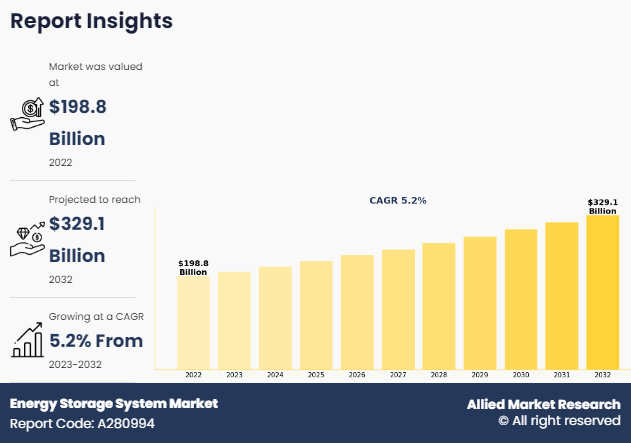
According to a new report published by Allied Market Research, the energy storage system market size was valued at $198.8 billion in 2022 and is estimated to reach $329.1 billion by 2032, growing at a CAGR of 5.2% from 2023 to 2032. The increasing adoption of renewable energy sources, modernization of power grids, and growing need for reliable energy management solutions are major factors driving the growth of the energy storage system market globally.
Download PDF Brochure: https://www.alliedmarketresearch.com/request-sample/A280994
Introduction
An energy storage system (ESS) is an advanced technology designed to store electrical energy for later use. These systems are becoming increasingly important across residential, commercial, industrial, and utility sectors as global energy demand continues to rise. Energy storage technologies help improve grid reliability, optimize electricity consumption, and support the integration of renewable energy sources such as solar and wind power.
The global energy storage system market has witnessed steady growth over the past few years due to rising investments in renewable energy infrastructure and smart grid development. Governments and private organizations across the world are actively supporting energy storage deployment to reduce carbon emissions and improve energy efficiency. As the transition toward clean energy accelerates, the demand for advanced energy storage system technologies is expected to increase significantly during the forecast period.
Energy storage systems play a critical role in balancing electricity supply and demand. Renewable energy sources such as solar and wind are intermittent in nature, meaning power generation fluctuates depending on weather conditions. Energy storage technologies bridge this gap by storing excess electricity during periods of low demand and supplying it during peak consumption periods. This capability helps stabilize power grids and ensures uninterrupted energy supply.
Moreover, energy storage systems support the development of decentralized energy infrastructure. They enable businesses, utilities, and households to optimize power consumption, reduce electricity costs, and improve energy resilience. The increasing focus on sustainability and energy security is expected to continue driving the growth of the energy storage system market worldwide.
Growing Importance of Renewable Energy Integration
One of the major factors driving the energy storage system market is the rapid expansion of renewable energy generation worldwide. Solar and wind energy installations are increasing significantly as governments and industries focus on reducing dependence on fossil fuels and lowering greenhouse gas emissions.
However, renewable energy generation is highly dependent on environmental conditions, making electricity supply inconsistent. Energy storage systems solve this challenge by storing excess renewable electricity and supplying it when generation levels decline. This improves grid stability and supports efficient renewable energy integration.
Battery energy storage systems are particularly gaining popularity due to their ability to provide fast response times and flexible energy management. Utilities are increasingly deploying large-scale battery storage projects to manage fluctuations in renewable energy supply and ensure reliable power delivery.
The rise of clean energy policies and renewable energy targets is expected to further boost investments in the energy storage system market. Several countries are introducing incentives, subsidies, and tax benefits to encourage the adoption of energy storage technologies alongside renewable energy projects.
Government Policies Supporting Market Growth
Government initiatives and regulatory frameworks are playing a vital role in accelerating the growth of the energy storage system market. Many countries are implementing policies that promote clean energy adoption and grid modernization.
Financial incentives such as investment tax credits, grants, and renewable energy mandates are encouraging utilities and businesses to invest in energy storage projects. These policies reduce financial barriers and create long-term growth opportunities for market participants.
For instance, the U.S. Inflation Reduction Act introduced investment tax credits for stand-alone energy storage systems, making large-scale storage projects more financially attractive. Similarly, India’s National Electricity Plan outlines ambitious targets for battery energy storage deployment by 2031-32.
Australia and China are also investing heavily in grid-scale storage infrastructure to support renewable energy integration and improve grid reliability. Such government-led initiatives are expected to drive strong demand for advanced energy storage systems over the coming years.
Industrial Energy Optimization Driving Adoption
Industries account for a significant share of global electricity consumption, making energy optimization a top priority for manufacturers and industrial facilities. Energy storage systems provide industries with efficient solutions to manage power demand, reduce operational costs, and improve energy resilience.
Industrial facilities often experience high electricity costs during peak demand periods. Energy storage systems help businesses reduce these costs through peak shaving and load management strategies. Excess electricity can be stored during low-demand periods and used when electricity prices are higher.
In addition, energy storage technologies improve power quality and reduce the risk of power interruptions that can disrupt industrial operations. Manufacturing plants, data centers, and commercial facilities are increasingly deploying battery storage systems to ensure uninterrupted power supply and operational continuity.
The growing focus on sustainability and energy efficiency is also encouraging industries to adopt renewable energy and energy storage solutions. Companies are actively seeking technologies that help reduce carbon footprints and achieve environmental compliance targets.
Procure This Report (250 Pages PDF with Insights, Charts, Tables, and Figures): https://www.alliedmarketresearch.com/energy-storage-system-market/purchase-options
Advancements in Battery Energy Storage Technologies
Technological advancements are significantly contributing to the growth of the energy storage system market. Battery energy storage systems have evolved rapidly in recent years, offering improved efficiency, longer lifespans, and lower operational costs.
Lithium-ion batteries are currently the most widely used energy storage technology due to their high energy density and fast charging capabilities. These batteries are increasingly deployed in grid-scale storage projects, electric vehicles, residential solar systems, and industrial applications.
Research and development activities are also driving innovation in alternative storage technologies such as solid-state batteries, flow batteries, and compressed air energy storage systems. These technologies aim to improve safety, scalability, and cost-effectiveness.
Artificial intelligence and smart energy management software are further enhancing the capabilities of energy storage systems. Advanced monitoring and analytics platforms allow utilities and businesses to optimize energy usage, forecast demand, and improve system performance.
The decline in battery prices over the past decade has also made energy storage technologies more affordable and accessible. This trend is expected to continue supporting market expansion globally.
Challenges Facing the Energy Storage System Market
Despite strong growth prospects, the energy storage system market faces several challenges that may hinder adoption during the forecast period. One of the primary concerns is the perception of risk associated with energy storage technologies.
Many investors and utilities still view energy storage systems as relatively new and unproven compared to traditional energy infrastructure. Concerns related to technology reliability, long-term performance, and financial returns can delay investment decisions.
High initial installation costs also remain a major challenge, particularly for large-scale storage projects. The deployment of advanced energy storage systems requires substantial investment in equipment, infrastructure, and software integration.
Regulatory uncertainties and evolving market structures can further complicate project development. In some regions, limited policy support and unclear revenue models create additional barriers for energy storage adoption.
However, ongoing technological improvements, falling battery prices, and supportive government policies are expected to gradually address these challenges and strengthen long-term market growth.
Market Segmentation Overview
The energy storage system market is segmented based on technology, end-use, application, and region.
By technology, the market includes pumped hydro storage, battery energy storage, compressed air energy storage, flywheel energy storage, and others. Pumped hydro storage dominated the market in 2022, accounting for more than four-fifths of the overall market share. This technology remains widely used due to its large storage capacity and long operational lifespan.
Battery energy storage systems are expected to witness strong growth during the forecast period due to rising demand for renewable energy integration and smart grid applications.
Based on end-use, the market is segmented into residential, commercial, and industrial sectors. The residential segment is expected to experience the fastest growth, driven by increasing adoption of rooftop solar systems and home energy storage solutions.
On the basis of application, the market is divided into stationary and transportation. The stationary segment accounted for the largest market share in 2022, supported by growing investments in grid-scale energy storage projects and utility infrastructure modernization.
Regional Analysis
Asia-Pacific
Asia-Pacific dominated the global energy storage system market in 2022 and is expected to maintain its leadership during the forecast period. Countries such as China, India, Japan, and South Korea are investing heavily in renewable energy infrastructure and grid modernization projects.
China announced plans to install over 30 GW of energy storage capacity by 2025, highlighting the region’s strong commitment to clean energy transition. India is also focusing on large-scale battery storage deployment to support renewable energy expansion and energy security goals.
Rapid industrialization, urbanization, and increasing electricity demand are further contributing to market growth across Asia-Pacific.
North America
North America represents another significant market for energy storage systems. The region is witnessing strong investments in renewable energy projects, smart grids, and battery storage infrastructure.
Government incentives and policies such as the U.S. Inflation Reduction Act are supporting energy storage deployment across residential, commercial, and utility sectors.
Utilities in North America are increasingly integrating energy storage systems with solar and wind projects to improve grid stability and reduce carbon emissions.
Europe
Europe is actively investing in energy storage technologies as part of its clean energy transition strategy. Stringent environmental regulations and ambitious carbon neutrality targets are driving the adoption of renewable energy and storage solutions.
Countries such as Germany, the UK, and France are implementing advanced battery storage projects to support renewable integration and improve energy resilience.
LAMEA
The LAMEA region is gradually expanding its energy storage infrastructure due to rising energy demand and increasing investments in renewable energy projects. Governments and utilities are exploring storage technologies to improve grid reliability and reduce energy shortages.
Competitive Landscape
Leading companies operating in the energy storage system market are focusing on technological innovation, strategic partnerships, and capacity expansion to strengthen their market presence.
Major players profiled in the report include Schneider Electric, SMA Solar Technology AG, Exide Industries Ltd., SK Holdings, Eguana Technologies, and Tata Power.
These companies are investing in advanced battery technologies, energy management software, and grid-scale storage projects to address growing market demand. Strategic collaborations and acquisitions are also helping market players expand their global footprint and technological capabilities.
Get a Customized Research Report: https://www.alliedmarketresearch.com/request-for-customization/A280994
Future Outlook
The future of the energy storage system market looks highly promising as global demand for clean and reliable energy continues to rise. Energy storage technologies are expected to become essential components of modern energy infrastructure, supporting renewable energy integration, grid stability, and energy efficiency initiatives.
Technological advancements in battery systems, artificial intelligence, and smart grid technologies will continue to improve the performance and affordability of energy storage solutions. Governments worldwide are expected to introduce additional incentives and regulatory support to accelerate market adoption.
The increasing electrification of transportation, rising deployment of renewable energy projects, and growing focus on sustainability will create strong growth opportunities for the energy storage system market during the forecast period.
As industries, utilities, and consumers continue prioritizing energy efficiency and resilience, energy storage systems will play a critical role in shaping the future of the global energy sector.
Trending Reports in Energy and Power Industry:
Energy Storage Systems Market
https://www.alliedmarketresearch.com/energy-storage-system-market-A280994
Thermal Energy Storage Market
https://www.alliedmarketresearch.com/thermal-energy-storage-market
Ice Thermal Energy Storage Market
https://www.alliedmarketresearch.com/ice-thermal-energy-storage-market
Flywheel Energy Storage Systems Market
https://www.alliedmarketresearch.com/flywheel-energy-storage-systems-market-A70218
Compressed Air Energy Storage Market
https://www.alliedmarketresearch.com/compressed-air-energy-storage-market-A31889
Solar Energy Storage Market
https://www.alliedmarketresearch.com/solar-energy-storage-market-A17238
Hydrogen Energy Storage Market
https://www.alliedmarketresearch.com/hydrogen-energy-storage-market-A10578
Residential Energy Storage Market
https://www.alliedmarketresearch.com/residential-energy-storage-market-A284438
Clean Energy Market
https://www.alliedmarketresearch.com/clean-energy-market-A43785
U.S. Clean Energy Market
https://www.alliedmarketresearch.com/us-clean-energy-market-A325461
Clean Energy Infrastructure Market
https://www.alliedmarketresearch.com/clean-energy-infrastructure-market-A323711
Renewable Energy Market
https://www.alliedmarketresearch.com/renewable-energy-market
Distributed Energy Generation Market
https://www.alliedmarketresearch.com/distributed-energy-generation-market-A13784
About Us
Allied Market Research (AMR) is a full-service market research and business-consulting wing of Allied Analytics LLP based in Portland, Oregon. Allied Market Research provides global enterprises as well as medium and small businesses with unmatched quality of "Market Research Reports" and "Business Intelligence Solutions." AMR has a targeted view to provide business insights and consulting to assist its clients to make strategic business decisions and achieve sustainable growth in their respective market domain.
Pawan Kumar, the CEO of Allied Market Research, is leading the organization toward providing high-quality data and insights. We are in professional corporate relations with various companies and this helps us in digging out market data that helps us generate accurate research data tables and confirms utmost accuracy in our market forecasting. Each and every data presented in the reports published by us is extracted through primary interviews with top officials from leading companies of domain concerned. Our secondary data procurement methodology includes deep online and offline research and discussion with knowledgeable professionals and analysts in the industry.
David Correa
Allied Market Research
+ + + + + + + + + + + + +1 800-792-5285
email us here
Visit us on social media:
LinkedIn
Facebook
YouTube
X
Legal Disclaimer:
EIN Presswire provides this news content "as is" without warranty of any kind. We do not accept any responsibility or liability for the accuracy, content, images, videos, licenses, completeness, legality, or reliability of the information contained in this article. If you have any complaints or copyright issues related to this article, kindly contact the author above.
