
Optical Character Recognition (OCR) Market Growth Accelerates with AI-Powered Document Automation Solutions
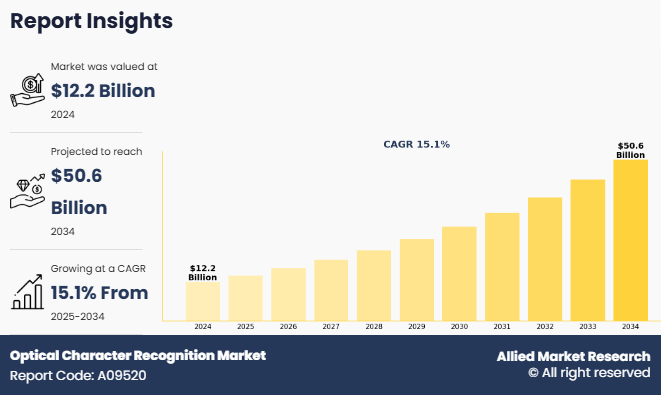
OCR market growth is driven by AI-powered automation, cloud adoption, digital transformation, and paperless workflows.
OCR Technology Adoption Expands Across Banking, Healthcare, and Logistics Sectors.”
WILMINGTON, DE, UNITED STATES, May 26, 2026 /EINPresswire.com/ -- — Allied Market Research
According to a new report published by Allied Market Research, the optical character recognition (OCR) market size was valued at $12,211.6 million in 2024 and is projected to reach $50,605.5 million by 2034, growing at a CAGR of 15.1% from 2025 to 2034. The increasing demand for digital transformation, document automation, intelligent data extraction, and cloud-based workflow solutions is significantly driving the growth of the optical character recognition market globally.
Download PDF Brochure: https://www.alliedmarketresearch.com/request-sample/A09520
Introduction to the Optical Character Recognition Market
The optical character recognition market has emerged as a crucial part of modern digital transformation strategies across industries. Optical character recognition, commonly known as OCR, refers to technology that converts printed, handwritten, or scanned text into machine-readable digital data. OCR solutions help organizations automate document processing, reduce manual data entry, improve accuracy, and enhance operational efficiency.
Businesses across banking, healthcare, education, logistics, retail, government, and legal sectors increasingly rely on OCR systems to streamline document-intensive operations. The growing shift toward paperless workflows and digital record management has accelerated adoption of OCR technologies worldwide.
Modern OCR platforms are now powered by advanced technologies such as artificial intelligence (AI), machine learning (ML), and natural language processing (NLP). These innovations allow OCR systems to recognize complex document formats, multilingual content, and handwritten text with high accuracy. As enterprises continue prioritizing automation and digital accessibility, the optical character recognition market is expected to witness substantial expansion over the next decade.
Digital Transformation Driving the Optical Character Recognition Market
One of the major drivers fueling the optical character recognition market is the rapid pace of digital transformation across industries. Organizations are increasingly replacing manual paper-based workflows with automated digital systems to improve productivity and operational efficiency.
Businesses generate enormous volumes of documents daily, including invoices, contracts, receipts, forms, medical records, customer applications, and compliance documents. Managing these records manually is time-consuming and prone to human error. OCR technology simplifies this process by converting physical documents into searchable and editable digital files.
Government agencies and enterprises are also investing heavily in paperless operations and electronic document management systems. The need to digitize historical records, streamline workflow automation, and improve data accessibility is significantly boosting demand for OCR solutions globally.
Furthermore, the increasing adoption of remote work and cloud-based collaboration platforms has accelerated the need for digital document processing technologies, contributing to strong growth in the optical character recognition market.
AI and Machine Learning Revolutionizing OCR Technology
Artificial intelligence and machine learning technologies are transforming the optical character recognition market by improving accuracy, speed, and automation capabilities.
Traditional OCR systems were limited in handling handwritten text, low-quality scans, or complex document layouts. However, AI-powered OCR solutions can now recognize diverse fonts, languages, symbols, and handwritten content with significantly improved precision.
Machine learning algorithms continuously learn from document patterns and user corrections, enabling OCR platforms to deliver more accurate text extraction over time. Natural language processing further enhances OCR systems by understanding contextual information and organizing extracted data intelligently.
AI-driven OCR solutions are widely used for identity verification, invoice automation, financial documentation, healthcare record management, and customer onboarding processes. These intelligent systems reduce processing time while minimizing operational costs for businesses.
The integration of AI and automation technologies is expected to remain a major growth catalyst for the optical character recognition market throughout the forecast period.
Cloud-Based OCR Solutions Supporting Market Growth
The increasing adoption of cloud computing is another key factor driving the optical character recognition market. Cloud-based OCR platforms offer scalable, flexible, and cost-effective document processing solutions for businesses of all sizes.
Cloud OCR solutions eliminate the need for expensive on-premise infrastructure and simplify deployment across multiple business locations. Organizations can access OCR services remotely through web-based applications and APIs, improving operational flexibility and workforce collaboration.
Cloud deployment also enables businesses to process large volumes of documents efficiently while maintaining secure data access and centralized storage. This capability is particularly important for industries managing highly sensitive information, such as banking, healthcare, and government sectors.
Furthermore, cloud-based OCR systems support real-time data synchronization, automated backups, and seamless integration with enterprise software platforms. As digital transformation initiatives continue expanding globally, cloud OCR adoption is expected to grow significantly.
Increasing Demand for Workflow Automation
The rising need for workflow automation is positively influencing the optical character recognition market worldwide. Organizations are increasingly automating repetitive administrative tasks to reduce operational complexity and improve productivity.
OCR technology enables businesses to automate invoice processing, form recognition, customer onboarding, payroll management, insurance claims handling, and contract management. By eliminating manual data entry, organizations can reduce errors and accelerate document processing times.
The integration of OCR with robotic process automation (RPA) has further expanded automation capabilities. OCR extracts information from documents, while RPA software automates subsequent business processes such as data validation, approvals, reporting, and record updates.
This end-to-end automation approach improves operational efficiency while reducing labor costs and human intervention. The growing focus on intelligent business process automation is expected to drive strong demand for OCR solutions across industries.
Rising Adoption in Banking and Financial Services
The banking and financial services sector represents one of the largest application areas for the optical character recognition market. Financial institutions process massive volumes of customer documents, transaction records, loan applications, and compliance forms daily.
OCR technology helps banks automate customer onboarding, account verification, invoice processing, fraud detection, and eKYC procedures. Digital document scanning and intelligent text extraction significantly improve customer experiences while ensuring regulatory compliance.
Mobile banking applications increasingly incorporate OCR functionality that allows users to scan checks, identity documents, and payment receipts using smartphones. These capabilities simplify digital banking services and reduce manual verification processes.
Financial institutions are also adopting OCR-powered analytics tools to extract valuable insights from unstructured financial documents and customer records. As digital banking continues expanding globally, demand for OCR solutions in the financial sector is expected to rise steadily.
Procure This Report (255 Pages PDF with Insights, Charts, Tables, and Figures): https://www.alliedmarketresearch.com/optical-character-recognition-market/purchase-options
Growing Applications in Healthcare and Education
Healthcare organizations are increasingly utilizing OCR systems to digitize patient records, prescriptions, insurance claims, and medical reports. OCR technology improves healthcare workflow efficiency while reducing paperwork and administrative burdens.
Hospitals and clinics benefit from faster access to patient information, accurate record management, and improved compliance with healthcare regulations. OCR-powered healthcare systems also support telemedicine platforms and digital health services.
In the education sector, OCR technology helps institutions digitize academic records, examination papers, library documents, and student registration forms. Educational organizations use OCR applications to simplify document management and improve access to learning resources.
The expansion of digital education platforms and electronic healthcare systems is expected to contribute significantly to the growth of the optical character recognition market.
Segment Analysis of the Optical Character Recognition Market
The optical character recognition market is segmented based on component, end user, deployment, and region.
Software Segment Leading the Market
Based on component, the software segment held the largest share of the optical character recognition market in 2024.
Organizations increasingly invest in OCR software solutions capable of handling intelligent text recognition, multilingual support, automated classification, and real-time data extraction. Software advancements driven by AI and machine learning are continuously improving OCR performance and scalability.
The demand for enterprise-grade OCR software integrated with cloud platforms, analytics tools, and workflow automation systems is supporting strong market growth.
B2B Segment Dominating Market Adoption
Based on end user, the B2B segment accounted for the highest optical character recognition market share in 2024.
Businesses across finance, healthcare, logistics, manufacturing, and government sectors handle extensive document volumes requiring efficient processing and storage. OCR technology enables enterprises to automate document-centric operations while improving accuracy and compliance.
Companies use OCR systems for invoice processing, legal documentation, customer onboarding, and digital archiving, making B2B adoption a major revenue contributor to the optical character recognition market.
B2C Segment Witnessing Rapid Growth
Although B2B dominates the market, the B2C segment is expected to witness the fastest growth during the forecast period.
Consumers increasingly use OCR-enabled mobile applications for scanning receipts, digitizing notes, translating text, and organizing personal documents. Smartphone penetration and growing demand for convenient digital tools are accelerating OCR adoption among individual users.
Mobile OCR applications have become particularly popular for travel, education, banking, and productivity purposes.
Cloud Deployment Maintaining Leadership
By deployment mode, the cloud segment held the largest share in the optical character recognition market for 2024.
Cloud OCR platforms offer scalability, affordability, and easier implementation compared to traditional on-premise systems. Organizations prefer cloud deployment due to its ability to support remote access, data synchronization, and integration with enterprise applications.
The increasing adoption of software-as-a-service (SaaS) business models is expected to further strengthen cloud OCR growth.
Regional Analysis of the Optical Character Recognition Market
North America Leading the Market
North America dominated the optical character recognition market in 2024 and is expected to maintain its leadership position during the forecast period.
The region benefits from advanced IT infrastructure, strong enterprise digitalization initiatives, and high investment in AI-powered automation technologies. Businesses in North America are early adopters of OCR solutions for document management, compliance, and workflow optimization.
Stringent data security regulations and growing demand for digital transformation further contribute to OCR market growth across the U.S. and Canada.
LAMEA Emerging as the Fastest-Growing Region
LAMEA is projected to witness the highest CAGR during the optical character recognition market forecast period.
Rapid urbanization, increasing smartphone penetration, expanding internet connectivity, and growing awareness regarding digitization are supporting market growth in Latin America, the Middle East, and Africa.
Governments across the region are investing in smart city projects, e-governance platforms, and digital public services, creating strong demand for OCR technologies. Small and medium-sized enterprises are also increasingly adopting digital tools to improve operational efficiency and competitiveness.
Competitive Landscape of the Optical Character Recognition Market
The optical character recognition market is highly competitive, with major companies focusing on AI integration, cloud innovation, product development, and strategic partnerships.
Key players operating in the market include Adobe Inc., Microsoft Corporation, IBM Corporation, Amazon Web Services, Inc., Apple Inc., and Alphabet.
These companies are investing heavily in intelligent automation, multilingual OCR systems, AI-powered analytics, and cloud-based document management platforms to strengthen their market position.
Get a Customized Research Report: https://www.alliedmarketresearch.com/request-for-customization/A09520
Future Outlook of the Optical Character Recognition Market
The future of the optical character recognition market appears highly promising as organizations continue embracing digital transformation and automation strategies.
Technological advancements in AI, machine learning, natural language processing, and robotic process automation will continue improving OCR accuracy, efficiency, and scalability. Businesses are expected to increasingly adopt OCR solutions to automate document workflows, improve compliance, and enhance operational productivity.
The growing shift toward paperless operations, remote work environments, and cloud computing will further accelerate demand for OCR technologies globally.
As enterprises and consumers generate larger volumes of digital content, the optical character recognition market is expected to play a vital role in enabling intelligent document processing, data accessibility, and workflow automation across industries worldwide.
Trending Reports in Energy and Power Industry:
Optical Character Recognition Market
https://www.alliedmarketresearch.com/optical-character-recognition-market-A09520
fraud detection and prevention market
https://www.alliedmarketresearch.com/fraud-detection-and-prevention-market
smart cities market
https://www.alliedmarketresearch.com/smart-cities-market
Enterprise Resource Planning (ERP) Market
https://www.alliedmarketresearch.com/ERP-market
Energy management systems market
https://www.alliedmarketresearch.com/energy-management-systems-market
Building Information Modeling Market
https://www.alliedmarketresearch.com/building-information-modeling-market
About Us
Allied Market Research (AMR) is a full-service market research and business-consulting wing of Allied Analytics LLP based in Portland, Oregon. Allied Market Research provides global enterprises as well as medium and small businesses with unmatched quality of "Market Research Reports" and "Business Intelligence Solutions." AMR has a targeted view to provide business insights and consulting to assist its clients to make strategic business decisions and achieve sustainable growth in their respective market domain.
Pawan Kumar, the CEO of Allied Market Research, is leading the organization toward providing high-quality data and insights. We are in professional corporate relations with various companies and this helps us in digging out market data that helps us generate accurate research data tables and confirms utmost accuracy in our market forecasting. Each and every data presented in the reports published by us is extracted through primary interviews with top officials from leading companies of domain concerned. Our secondary data procurement methodology includes deep online and offline research and discussion with knowledgeable professionals and analysts in the industry.
David Correa
Allied Market Research
+ + + + + + + + + + + + +1 800-792-5285
email us here
Visit us on social media:
LinkedIn
Facebook
YouTube
X
Legal Disclaimer:
EIN Presswire provides this news content "as is" without warranty of any kind. We do not accept any responsibility or liability for the accuracy, content, images, videos, licenses, completeness, legality, or reliability of the information contained in this article. If you have any complaints or copyright issues related to this article, kindly contact the author above.
