
Inside MDSO’s Guardian Program: Training for Potential Lethal Threats at Schools
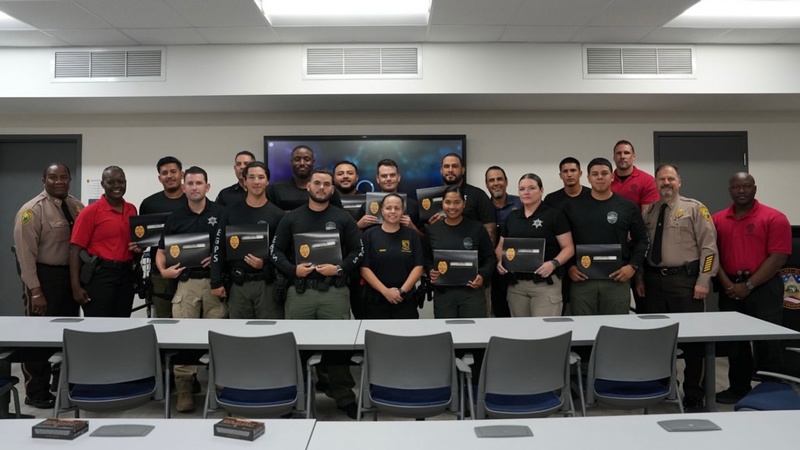
2025-08-15-mdso-guardian-program-graduation
For the 15 people who recently graduated from the Guardian Academy at the Miami-Dade Sheriff’s Office (MDSO) Training Center, the responsibility of their new role was emphasized by the center’s commander, Major Yolande Jacinthe.
“As I stand in front of you here today, I want to remind each and every one of you, that you are primarily responsible for preventing, or mitigating, active assailant incidents thereby enhancing the security and safety of students and staff,” Major Jacinthe said during the graduation ceremony on July 30, 2025, held inside a large conference room at the training center in Doral. Approximately 80 family and friends of those newly minted Guardians attended the ceremony.
The Guardian Program was born out of an unthinkable and heinous attack—the February 14, 2018, shooting at Marjory Stoneman Douglas High School in Parkland, where a lone gunman opened fire, killing 14 students and three staff members, and injuring 17 others in a matter of minutes. The Chris Hixon, Coach Aaron Feis, and Coach Scott Beigel Guardian Program—named after three of the victims—was approved by the Florida Legislature in the wake of that tragedy. It allows trained and vetted school employees to serve as armed school guardians.
“You will be expected to maintain a vigilant presence on school campuses, monitoring the premises and identifying potential threats,” Major Jacinthe said. “You will be expected to collaborate closely with law enforcement to ensure coordinated response to emergencies. And lastly, I want to remind you what has occurred in the past two decades and remind you what you may encounter.”
She mentioned several school shootings that occurred from 1999 through the Parkland shooting that have taken dozens of innocent lives: the Columbine High School shooting in Littleton, Colorado; the Sandy Hook Elementary School shooting in Newtown, Connecticut; and the Robb Elementary School shooting in Uvalde, Texas.
“I ask you today, to please take your safety drills, and your school safety plans seriously, because students are counting on your training and expertise to stop threats and save lives.”
While the program initially focused on training school employees, such as teachers, it was expanded in 2019 to include licensed security guards and other school staff who volunteer. In 2023, the program was expanded beyond public schools, including charter schools, to private schools. The Guardians provide another layer of security, in addition to school resource officers, who are sworn law enforcement officers assigned to schools through agreements with school districts.
“Eight of the most recent graduates are security guards from Eagle Globe Protective Services, a private security company that offers hourly, daily, monthly and yearly contracts to a wide variety of clients, including schools and retail outlets. There were also graduates from educational institutions such as the Miami Community Charter School in Florida City, and the HIVE Preparatory School in Hialeah.”
Each Guardian candidate must pass a 144-hour training course. That includes 80 hours of firearms instruction modeled on Florida’s Law Enforcement Academy. With the latest class to undergo training, MDSO has trained 12 classes since the law was established. MDSO’s training goes beyond what is mandated—potential candidates must qualify with their firearm at the same standard as a firearms trainer, above the deputy or police officer standard.
The Guardians were put through rigorous training. At MDSO’s Guardian Academy, the program is run similarly to an actual police academy. The candidates wear uniforms—bright yellow T-shirts with numbers on the back, black cargo pants, and black athletic shoes. They carry around their water bottles everywhere and run from location to location. They wear gun belts. Discipline comes in the form of pushups or calisthenics. The Guardian Academy does not pass everyone. In the latest class, two people were dismissed.
On a recent training exercise, candidates were put through strenuous physical training moments before they arrived at the shooting range. Out of breath and with elevated heart rates, they performed discretionary shooting—distinguishing a shooter from a victim. The candidates also had to practice clearing rooms at the facility’s shoot house.
The firearms trainers yelled at the candidates when mistakes were made. Performing under such stress is part of the training routine at most academies, including MDSO’s, to get candidates accustomed to focusing under pressure and fatigue.
“Shooting is 80% mental, you have to have the ability to focus,” said the center’s lead firearms trainer, Sergeant Armando Borrego.
At another four-hour training session, the candidates spent several hours inside a classroom, where Sergeant Borrego instructed them on how to react to an active shooter scenario.
After the classroom session, the candidates spent two hours on a shooting range. It was nighttime and they were required to use their flashlights and shoot from behind a barrier at a target. One of the finer points of the exercise was getting the candidates to shine their flashlights in a way that the light did not refract off the barrier, which hinders vision. At the end of the exercise, Firearms Instructor Jamie Pino gathered the candidates at the rear of the range to emphasize how proper technique is critical.
“Listen, we can teach you technique, but you have to think, and be able to make decisions quickly. Imagine what it would be like in real life, a hundred times worse,” he told the candidates.
Legal Disclaimer:
EIN Presswire provides this news content "as is" without warranty of any kind. We do not accept any responsibility or liability for the accuracy, content, images, videos, licenses, completeness, legality, or reliability of the information contained in this article. If you have any complaints or copyright issues related to this article, kindly contact the author above.
