
SRM Story: SRM 1947a Great Lakes Fish Tissue
Credit: Carolyn Burdette, NIST
The American Sportfishing Association indicates that US recreational and sport fishing is a $230.5 billion industry that supports 1.1 million jobs nationwide and provides entertainment for one in six Americans. Even an experienced angler cannot tell if the water in which they fish or the fish they catch are safe and free from pollution. The only way to know is through chemical testing in a laboratory. To ensure that fish caught by anglers are safe to eat, each State monitors the fish in its waters, with support from the Environmental Protection Agency. Because fish live and feed in our waterways, they accumulate heavy metals and other chemicals present in the water from sources such as factories, sewage treatment plants, or runoff from cities and farms. Some chemicals make fish unsafe to eat for everyone, while others are particularly risky only for certain populations, such as pregnant women, children, or the elderly. State and federal laboratories monitor fish for contaminants such as mercury, per- and polyfluoroalkyl substances (PFAS), polychlorinated biphenyls (PCBs), and dichloro-diphenyl-trichloroethane (DDT). NIST supports the accuracy of these monitoring efforts by providing SRMs designed for detecting these low-level contaminants in real fish tissue.
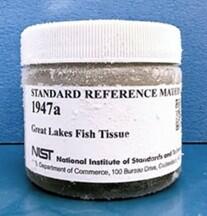
SRM 1947a Great Lakes Fish Tissue is designed as the successor to two widely used but now sold-out standards: SRM 1946 Lake Superior Fish Tissue and SRM 1947 Lake Michigan Fish Tissue. Since the early 2000s, these materials have enabled accurate, precise determination of contaminants to protect public health and our natural water resources. Released in December 2025, SRM 1947a was prepared from twice-cryomilled Lake Ontario trout, ensuring perfectly uniform, homogenized frozen fish tissue for unparalleled precision across every bottle. NIST researchers utilized state-of-the-art techniques to assign values for total mercury and persistent organic pollutants. The availability of this SRM and its accompanying Certificate of Analysis (COA) is essential to ensure users can appropriately validate their testing methods and ensure the accuracy of monitoring efforts.
As the US National Metrology Institute (NMI), NIST provides materials like SRM 1947a to enable users to establish metrological traceability to the International System of Units (SI). The international network of NMIs, including NIST, maintains measurement equivalence through SI traceability, ensuring, for decades to come, that laboratories around the world can accurately and comparably measure contaminants in our environment. Whether validating a new analytical method or performing routine quality control, measurements performed by a laboratory in California will yield the same results as those in Ontario. With accurate test methods and appropriate reference materials, contamination of fish can be identified before it’s consumed and people get sick.
Technical details regarding the production and certification of this material are documented in NIST Special Publication 260-260.
Legal Disclaimer:
EIN Presswire provides this news content "as is" without warranty of any kind. We do not accept any responsibility or liability for the accuracy, content, images, videos, licenses, completeness, legality, or reliability of the information contained in this article. If you have any complaints or copyright issues related to this article, kindly contact the author above.
