
Sustainability: Scarce Signals From Significant Resolutions
Key Observations
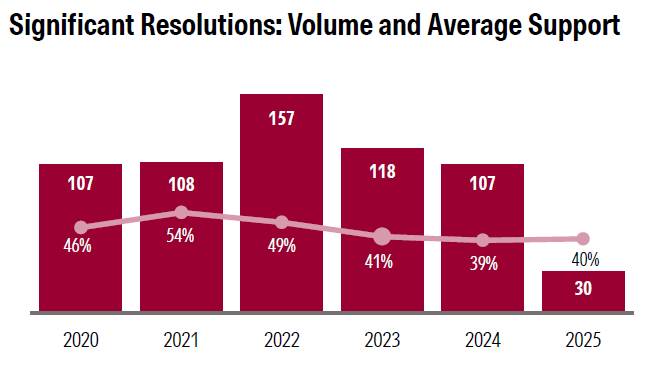
- In 2025, there was a steep drop in the number of shareholder resolutions on sustainability that got significant shareholder support (our definition being at least 30% of independent shareholders).
- There were only 30 such resolutions in the US in the 2025 proxy year, compared with over 100 in each of the previous five years.
- These significant resolutions are a useful guide to the sustainability topics institutional investors view as material, so their shrinking number creates an information gap.
- Despite this, our research is still able to surface some useful trends for investors evaluating asset manager intentionality on environmental, social, and governance topics.
- Overall, average support for significant resolutions on sustainability remained steady at around 40% for the past three proxy years, down from 54% in 2021.
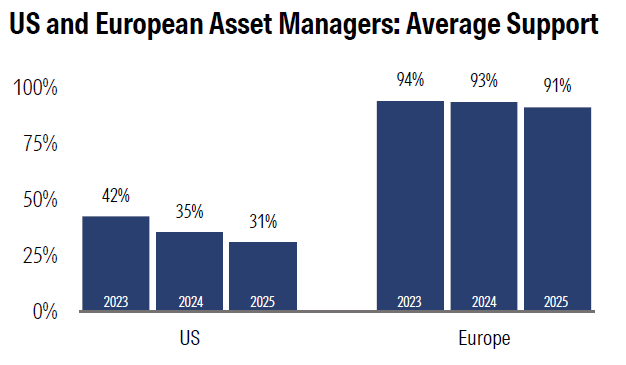
- The overall stability in average support for significant resolutions masks continued divergence in voting preferences of US and European asset managers, which has persisted since the 2021 peak.
- Average support by 20 US asset managers for significant resolutions fell by 11 percentage points to 31% over the past three proxy years. Among 18 European firms, there was only a 3-percentage-point drop to 91% over the same period. US sustainable funds showed a similar stable trend.
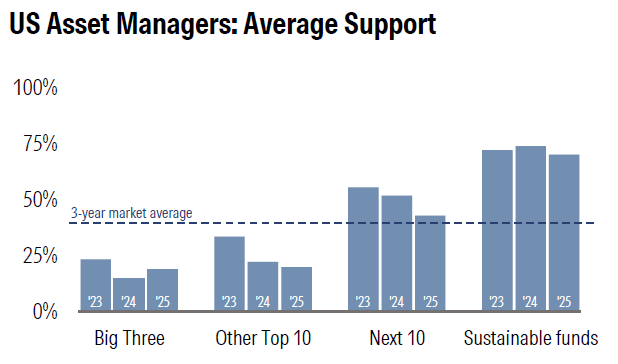
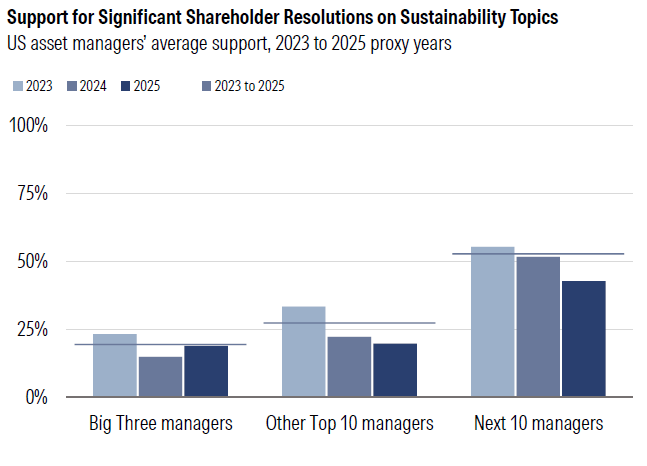
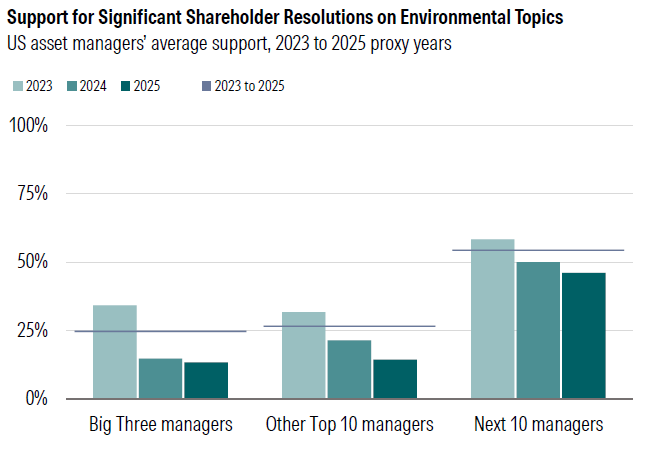
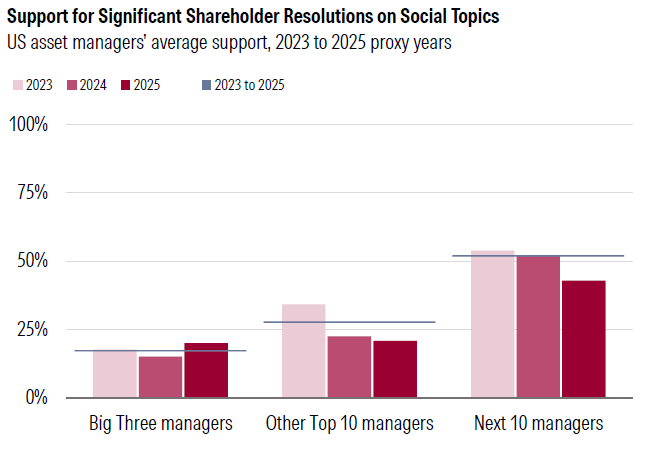
- We see a relationship between firm size and the timing of reductions in support for these proposals. The largest reductions in support by the top 10 US firms by size occurred in the 2024 proxy year. For the next 10 US firms in this study, this happened in 2025.
Source: Morningstar proxy-voting database, Morningstar Direct, asset manager disclosures. Data as of March 31, 2026. Note: Data shown is for proxy years ended June 30. The Big Three index asset managers are BlackRock, State Street, and Vanguard. The other seven managers in the top 10 by equity and allocation fund assets are Capital Group, Dimensional, Fidelity, Invesco, J.P. Morgan, Schwab, and T. Rowe Price. See Appendixes for further details.
Fewer Significant Resolutions, Stable Average Support
Significant Sustainability Resolutions Are Increasingly Rare, But Support Has Stabilized
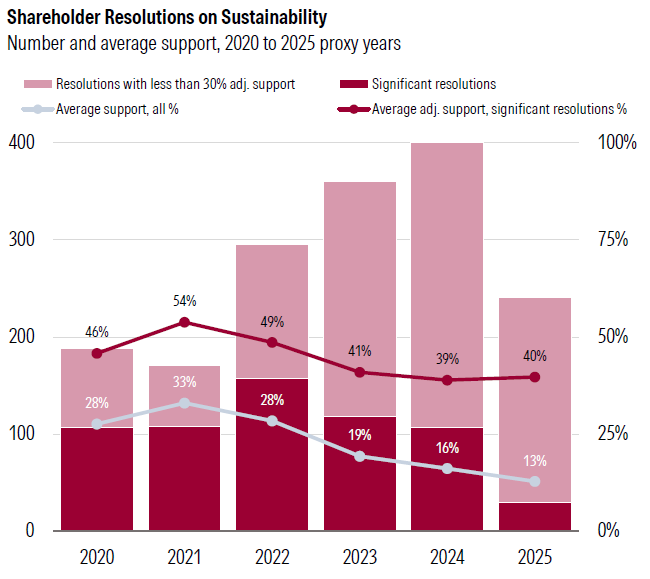
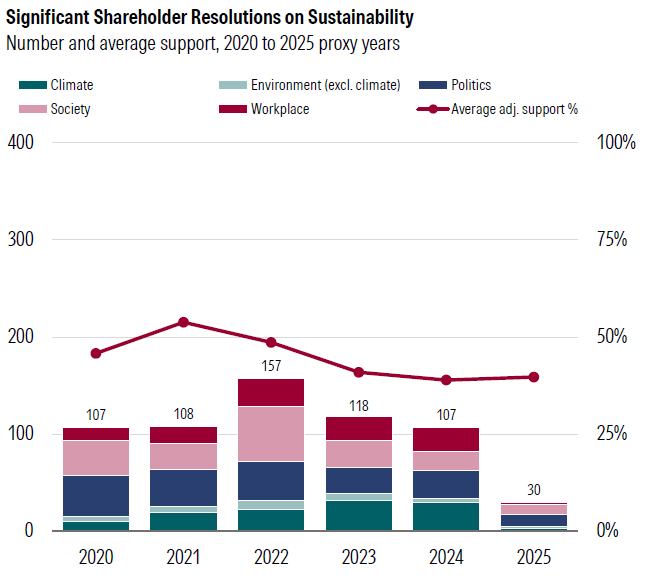
Each year, we review US shareholder resolutions on sustainability that got significant shareholder support. These are resolutions addressing environmental and social themes that gain at least 30% adjusted support when voted. (Adjusted support includes voting results only of shareholders independent of the company.) In 2025, there was a steep drop in the number of significant resolutions on sustainability. There were only 30 such resolutions in the 2025 proxy year, compared with over 100 in each of the previous five years, as the chart opposite shows.
These significant resolutions are a useful guide to the sustainability topics institutional investors view as material and are prepared to use the proxy-voting process to request greater transparency. So, the shrinking number of significant resolutions creates an information gap when it comes to assessing what those topics are. This development comes at a time when useful market signals on sustainability are becoming difficult to differentiate from the wider noise. The number of shareholder resolutions on environmental and social themes in the US fell almost 40% in the 2025 proxy year following changes to the Securities and Exchange Commission guidance governing the shareholder proposal process. Average support for these resolutions dropped to just 13% in the 2025 proxy year, compared with 16% in 2024 and a 2021 peak of 33%.
Average adjusted support for the significant resolutions stayed largely stable at around 40% over the past three proxy years. Although we note that this average cannot fall below 30%, it illustrates that recent market sentiment toward sustainability in the US is largely reflected by the shrinking population size of significant resolutions, with average support trends remaining more resilient.
Source: Morningstar proxy-voting database. Data as of March 31, 2026. Note: Data shown is for proxy years ended June 30.
Thin Population of Significant Resolutions Poses New Interpretation Challenges
Although average support for significant resolutions on sustainability has been largely stable for the past three proxy years, the small cohort of resolutions in 2025 poses challenges for interpretation.
The problem is most acute for significant resolutions on environmental themes. There were only five such resolutions in the 2025 proxy year: three on climate matters and two on other environment-related matters. There were over 30 environment-related significant resolutions in each of the previous two years.
Of the remaining 25 resolutions, 12 address political influence and lobbying matters. Investors have clearly identified this as a material theme—there are 188 significant resolutions on this topic in the six years shown on the chart opposite. However, many investors approach political influence from a governance angle rather than a social one.
That leaves only 13 significant resolutions in the 2025 proxy year on core social topics. Of that number, eight proposals targeted just three Big Tech companies: Alphabet, Meta Platforms, and Microsoft.
It is still useful to examine significant resolutions to determine market trends on sustainability. But it is worth noting that the thin populations of significant voting decisions described above have led to more volatile trends, especially when observed at individual firms or for specific topics. As a result, it has become more difficult to draw solid conclusions from more recent voting results, other than general trends for broad segments of the market. On the following pages, we examine the observable trends for US and European asset managers.
Source: Morningstar proxy-voting database. Data as of March 31, 2026. Note: Data shown is for proxy years ended June 30.
Further Divergence in Levels of Asset Manager Support
Asset Manager Voting Trends Have Diverged Both by Location and by Size
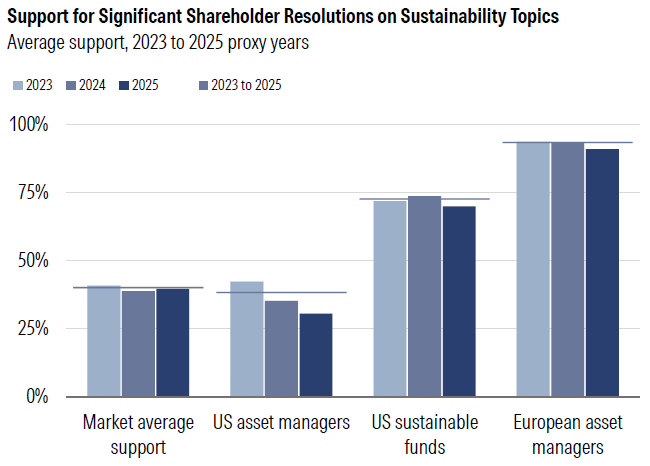
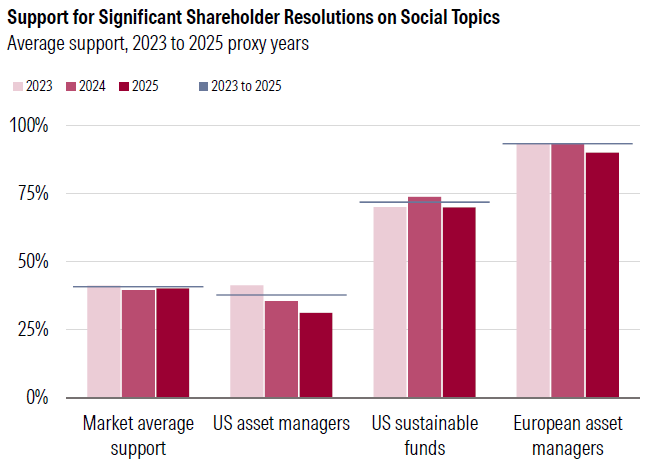
In contrast to stable trends in the wider market, average support by 20 US asset managers for significant resolutions fell by 11 percentage points to 31% over the past three proxy years. Among 18 European firms, there was only a 3-percentage-point drop to 91% over the same period. US sustainable funds showed a similar stable trend with between 70% and 75% average support in each year. We observe large differences in average support between the top 10 US managers (by equity and allocation fund assets) and the remaining 10 US managers. It also appears that most of the top 10 managers’ recent pullback in support for significant resolutions occurred in 2024, with the other 10 cutting back more in 2025.
Source: Morningstar proxy-voting database, Morningstar Direct, Morningstar research, asset manager disclosures. Data as of March 31, 2026. Note: Data shown is for proxy years ended June 30.
Lower Support by US Managers for Resolutions on Climate and Environment
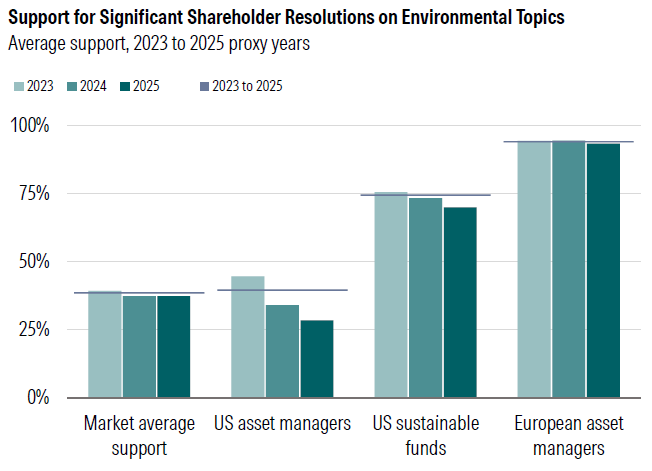
Market average support for significant resolutions on climate and the environment was also largely stable over the past three proxy years, starting at 39% in the 2023 proxy year and dropping slightly to 37% in 2024 and 2025. European asset manager support was similarly unchanged over this period at between 93% and 95% each year. In contrast, US asset manager support for significant environmental resolutions fell each year in all peer groups shown below. (We note that only five such resolutions were voted in the 2025 proxy year, compared with over 30 in each of the two previous years.)
Source: Morningstar proxy-voting database, Morningstar Direct, Morningstar research, asset manager disclosures. Data as of March 31, 2026. Note: Data shown is for proxy years ended June 30.
Sentiment Toward Social Resolutions Set the Tone for the Wider Market
Market average support for significant resolutions on social matters also remained relatively stable overall across the past three proxy years. However, here too, we saw a substantial pullback by the US asset managers, whose support fell from 41% in the 2023 proxy year to 36% in 2024 and down to 31% in 2025. The European managers’ average support fell slightly from 94% to 90% over the same period. In the 2025 proxy year, the US sustainable funds’ average support stood at 70%, giving back the 4-percentage-point gain seen in 2024. As with the other categories, asset manager size is negatively correlated with average support for the US managers.
Source: Morningstar proxy-voting database, Morningstar Direct, Morningstar research, asset manager disclosures. Data as of March 31, 2026. Note: Data shown is for proxy years ended June 30.
Support Trends for Resolutions on Workplace and Societal Issues Are Even More Negative
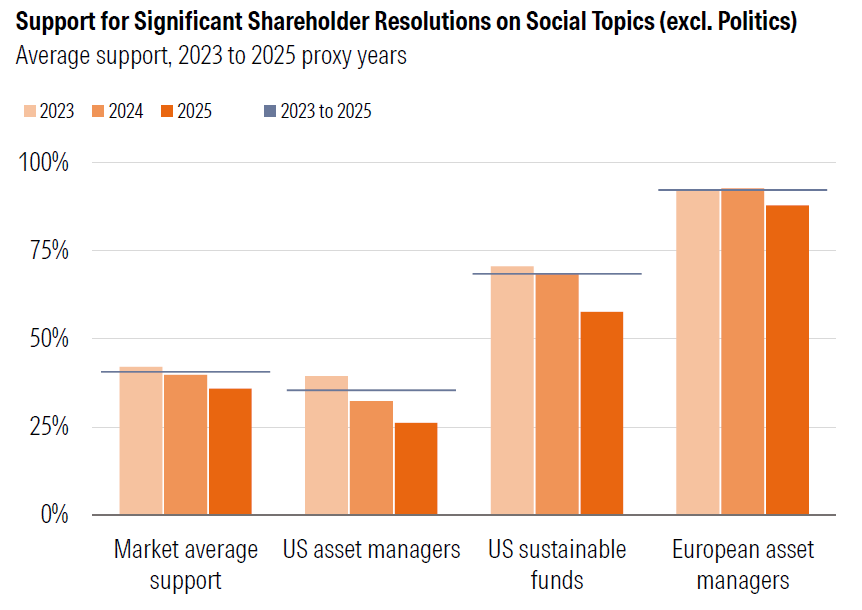
Excluding the significant social resolutions that address political influence and lobbying reveals more negative support trends for social resolutions than those shown on the previous page, particularly in the 2025 proxy year. This exclusion causes the US asset managers’ average support for 2025 to fall from 40% to 26% over three years. The decline is steeper for the US sustainable funds: from 70% to 58%. We think it is likely that political and regulatory actions in the US in 2025 had the effect of curtailing sustainability- and human capital-related engagement by some US asset managers and fed into the trends shown below. Voting trends for European managers remain similar, whether resolutions on politics are included or not.
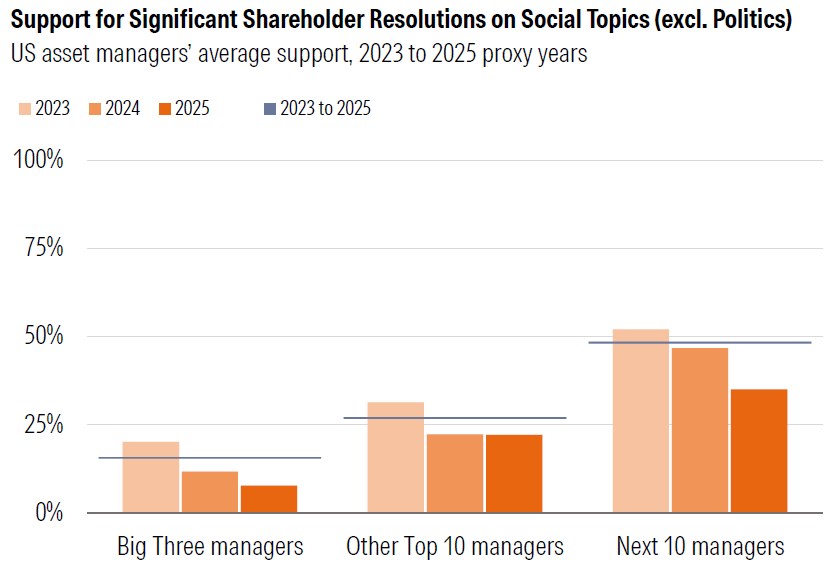
Source: Morningstar proxy-voting database, Morningstar Direct, Morningstar research, asset manager disclosures. Data as of March 31, 2026. Note: Data shown is for proxy years ended June 30.
The complete publication is available here.
Legal Disclaimer:
EIN Presswire provides this news content "as is" without warranty of any kind. We do not accept any responsibility or liability for the accuracy, content, images, videos, licenses, completeness, legality, or reliability of the information contained in this article. If you have any complaints or copyright issues related to this article, kindly contact the author above.
