
The Proof is in the Proxy: Connecting Governance to Returns
Investors have long suspected that companies with poor corporate governance may be more prone to mismanagement and weak returns. Our research suggests they’re right.
Specifically, our proxy voting study shows a connection between governance and return. We think proxy voting is one of the best tools investors can use to express a view on the quality of a firm’s governance, providing it’s based on careful analysis and accountability, not a rubber stamp.
We believe that proxy voting—alongside direct engagement*—may encourage companies to improve their governance practices, which may result in better long-term outcomes. Several studies, including our own findings, have made this connection much more apparent.
The Governance-Return Nexus
In one study, professors at Harvard Law School constructed an entrenchment index, or “E-index,” based on six key governance provisions. Their findings linked poorer E-index ratings with reductions in firm valuations and returns across US equities from 1990 to 2003. Since then, the predictive power of the E-index has waned, as investors learned to more accurately price these governance risks.
More recently, S&P Global found that, between 2000 and 2017, companies in the bottom quartile of S&P Dow Jones Indices’ governance scores underperformed those in the top quintile by about 2% on an annualized basis.
Inspired by these observations and our own experience, we designed an internal study to determine if a similar association exists between our proxy-voting record and returns. We found that, on average, companies where we voted against management (VAM) on any number of proposals later underperformed those with which we were aligned.
Standing Up for Governance—One Company at a Time
Evaluating governance isn’t a one-size-fits-all proposition. Our approach focuses on issues that are material to investors, backed by a willingness to vote independently of management and proxy advisors. We use a proprietary proxy-voting policy to vet each company’s alignment with our basic expectations, followed by a collaborative review process that leverages analyst expertise and engagement data. This approach enables us to incorporate company-specific insights to implement more constructive voting strategies.
When we surmise a company’s governance practices aren’t supporting our clients’ best interests, we may vote against management to signal our objection; when executive compensation is misaligned with performance, we vote against it.
Some governance issues may warrant a stance against the specific board member(s) responsible—also known as an “accountability vote.” For instance, seeing internal accounting problems, we may record our opposition to the chair of the audit committee.
Entered into Evidence, Thousands of AB Proxy Votes
Within this backdrop, our study retraced approximately 12,000 shareholder meetings with MSCI AWCI firms between 2019 and 2025.
To help quantify a company’s degree of alignment with our governance expectations, we grouped the companies into equal-weighted baskets based on our number of VAMs. For example, zero VAMs may reflect stronger alignment based on what we believe is sound governance and oversight across the firm. One VAM indicates a single “no” vote on any of the proposed matters, from capitalization and audits to compensation and director elections. Two VAM reflects our disapproval on two such measures, and so forth.
VAMs occurred in approximately 55% of all shareholder meetings during the period, which means we pushed back—whether on minor issues or proposals of greater consequence—a majority of the time. This reflects our rigorous standards and desire to improve on the status quo. Multiple VAMs can be vital for voicing material concerns, especially if a firm’s governance has been a growing issue for several years.
We next linked our proxy votes to each company’s stock returns in the following calendar year. Companies with higher governance quality—as approximated by our proxy votes—delivered stronger absolute and risk-adjusted returns during the period studied (Display). We found that zero-VAM companies—those we fully supported—outperformed those in the other VAM baskets by 2.6% to 4.6% per year on average. We observed this trend among similarly sized peers and across most—but not all—sectors and regions.
Companies Meeting AB’s Governance Expectations Have Yielded Better Returns
Historical returns do not guarantee future results. |
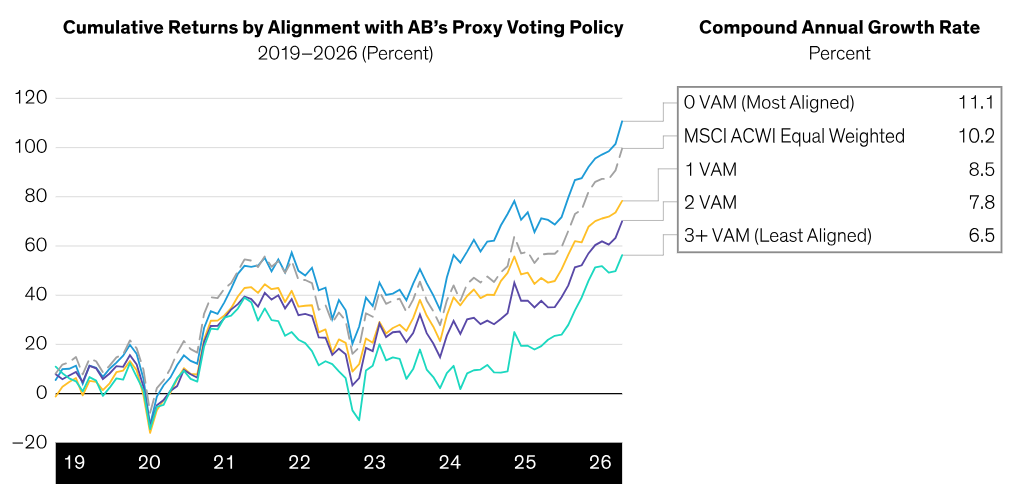
For the seven-year period, the zero-VAM basket delivered a compound annual growth rate (CAGR) of 11.1% with a 0.72 Sharpe ratio, while the three+-VAM basket delivered a 6.5% CAGR with a 0.42 Sharpe ratio.
Legal Disclaimer:
EIN Presswire provides this news content "as is" without warranty of any kind. We do not accept any responsibility or liability for the accuracy, content, images, videos, licenses, completeness, legality, or reliability of the information contained in this article. If you have any complaints or copyright issues related to this article, kindly contact the author above.
