
Smart Data Center Market Accelerates with AI, Cloud, and Energy-Efficient Infrastructure
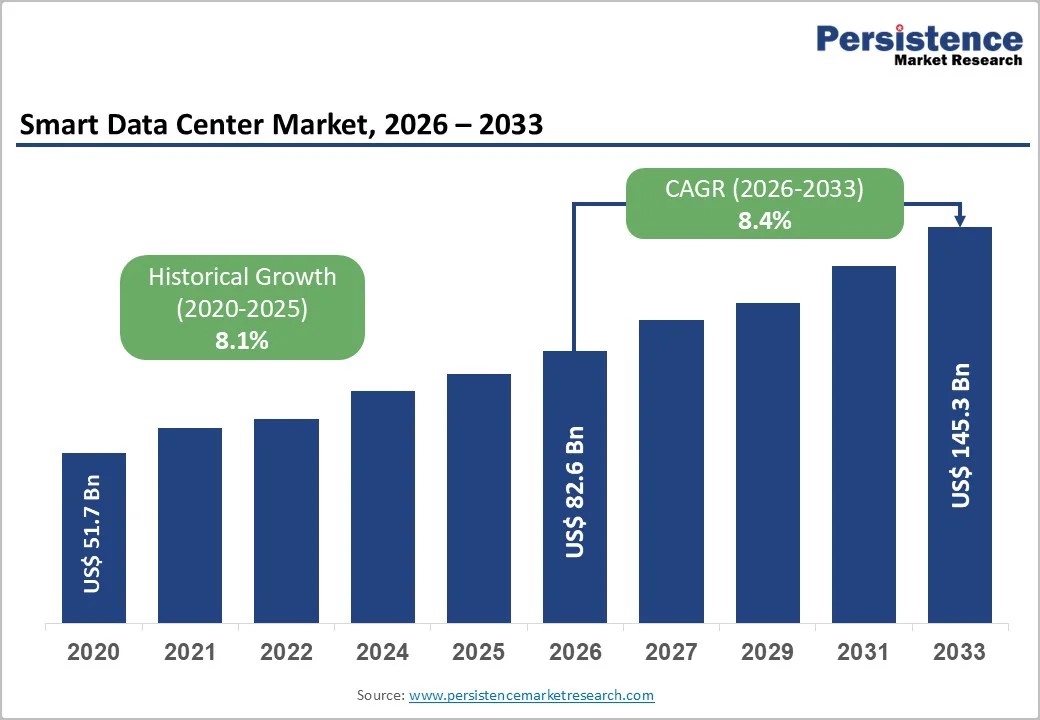
Global smart data center market is set to grow from US$82.6 Bn in 2026 to US$145.3 Bn by 2033, driven by cloud, AI, and high-performance computing demand
BRENTFORD, ENGLAND, UNITED KINGDOM, February 9, 2026 /EINPresswire.com/ -- The Smart Data Center Market is undergoing a rapid transformation as digitalization accelerates across industries worldwide. Smart data centers integrate advanced technologies such as artificial intelligence (AI), Internet of Things (IoT), automation software, and real-time analytics to optimize data center operations. These facilities are designed to improve energy efficiency, enhance uptime, and reduce operational costs while supporting high-performance computing and cloud-native workloads. As enterprises manage exponentially growing data volumes, smart data centers are becoming the backbone of modern digital ecosystems.
From a market size perspective, the global smart data center market is likely to be valued at US$ 82.6 billion in 2026 and is estimated to reach US$ 145.3 billion by 2033, expanding at a CAGR of 8.4% during 2026–2033. Growth is primarily driven by the rising adoption of cloud computing, AI-driven workloads, and software-defined infrastructure. The solution segment, particularly data center infrastructure management (DCIM) and intelligent power and cooling systems, holds a leading share due to immediate ROI benefits. North America dominates the market, supported by strong hyperscale investments, early technology adoption, and the presence of major cloud service providers.
𝐆𝐞𝐭 𝐚 𝐒𝐚𝐦𝐩𝐥𝐞 𝐏𝐃𝐅 𝐁𝐫𝐨𝐜𝐡𝐮𝐫𝐞 𝐨𝐟 𝐭𝐡𝐞 𝐑𝐞𝐩𝐨𝐫𝐭: https://www.persistencemarketresearch.com/samples/18511
Key Highlights from the Report
• The smart data center market is projected to grow steadily, driven by AI, cloud, and high-performance computing workloads.
• Intelligent power management and cooling solutions account for a significant share of total deployments.
• Hyperscale and colocation data centers are the primary adopters of smart infrastructure technologies.
• North America leads the market due to advanced digital infrastructure and high cloud penetration.
• Energy-efficiency regulations are accelerating investments in smart monitoring and automation systems.
• Emerging economies are creating new growth opportunities through digital transformation initiatives.
Smart Data Center Market Segmentation Analysis
The smart data center market is segmented based on component, data center type, and end-user industry. By component, the market is broadly divided into solutions and services. Solutions include DCIM software, intelligent power distribution units, smart cooling systems, and monitoring sensors, while services cover consulting, integration, and managed services. Among these, solution-based offerings dominate the market as enterprises focus on real-time visibility and automation to improve efficiency and uptime.
Based on data center type, the market is categorized into hyperscale, colocation, enterprise, and edge data centers. Hyperscale data centers hold the largest share due to massive investments by cloud service providers to support AI, big data analytics, and digital services. In terms of end users, IT & telecom, BFSI, government, healthcare, and retail are key contributors. The IT & telecom sector leads adoption, as it requires scalable, resilient, and energy-efficient infrastructure to handle continuous data traffic growth.
Regional Insights and Market Trends
North America remains the leading region in the smart data center market, supported by strong investments from hyperscale cloud providers and advanced adoption of AI-driven infrastructure management. The region benefits from stringent energy-efficiency standards, which encourage data center operators to deploy intelligent cooling, monitoring, and automation solutions to reduce carbon footprints.
Asia Pacific is emerging as the fastest-growing regional market due to rapid digitalization, expanding cloud adoption, and government-led digital infrastructure initiatives. Countries such as China, India, and Southeast Asian nations are investing heavily in smart data centers to support e-governance, fintech, and e-commerce platforms, creating long-term growth potential.
𝐃𝐨 𝐘𝐨𝐮 𝐇𝐚𝐯𝐞 𝐀𝐧𝐲 𝐐𝐮𝐞𝐫𝐲 𝐎𝐫 𝐒𝐩𝐞𝐜𝐢𝐟𝐢𝐜 𝐑𝐞𝐪𝐮𝐢𝐫𝐞𝐦𝐞𝐧𝐭? 𝐑𝐞𝐪𝐮𝐞𝐬𝐭 𝐂𝐮𝐬𝐭𝐨𝐦𝐢𝐳𝐚𝐭𝐢𝐨𝐧 𝐨𝐟 𝐑𝐞𝐩𝐨𝐫𝐭: https://www.persistencemarketresearch.com/request-customization/18511
Market Drivers Shaping Industry Growth
One of the primary drivers of the smart data center market is the explosive growth of cloud computing and AI workloads. Enterprises increasingly rely on data-intensive applications, requiring intelligent infrastructure capable of dynamic resource allocation and predictive maintenance. Smart data centers enable automated operations, reducing downtime and improving service reliability in mission-critical environments.
Another key driver is the growing emphasis on energy efficiency and sustainability. Governments and regulatory bodies worldwide are enforcing stricter carbon-reduction and energy-efficiency mandates. This has pushed data center operators to invest in smart power management, advanced cooling technologies, and real-time energy monitoring to lower operational costs and environmental impact.
Market Restraints Impacting Adoption
Despite strong growth prospects, high initial capital investment remains a major restraint for the smart data center market. Deploying intelligent infrastructure, advanced sensors, and AI-based management platforms requires significant upfront expenditure, which can be a barrier for small and mid-sized enterprises. Integration with legacy data center systems further increases complexity and cost.
Cybersecurity concerns also pose challenges, as smart data centers rely heavily on interconnected systems and real-time data exchange. Any vulnerabilities in software-defined infrastructure or IoT-enabled components can increase the risk of cyberattacks, making security investments essential and sometimes costly for operators.
Market Opportunities and Future Outlook
The rise of edge computing presents significant growth opportunities for the smart data center market. As latency-sensitive applications such as autonomous vehicles, IoT, and 5G networks expand, demand for intelligent edge data centers is increasing. These facilities require smart monitoring, automated management, and energy-efficient designs to operate effectively in distributed environments.
Additionally, emerging economies offer untapped potential as governments and enterprises invest in digital infrastructure. Smart data centers supporting e-governance, digital payments, and smart city initiatives are expected to create long-term opportunities for technology providers and service integrators across global markets.
𝐁𝐮𝐲 𝐍𝐨𝐰 𝐭𝐡𝐞 𝐃𝐞𝐭𝐚𝐢𝐥𝐞𝐝 𝐑𝐞𝐩𝐨𝐫𝐭: https://www.persistencemarketresearch.com/checkout/18511
Company Insights
• IBM Corporation
• Schneider Electric SE
• Siemens AG
• Cisco Systems, Inc.
• Huawei Technologies Co., Ltd.
• Hewlett Packard Enterprise (HPE)
• Dell Technologies
• Vertiv Group Corp.
Recent Developments:
Leading players are increasingly integrating AI-driven analytics into DCIM platforms to enable predictive maintenance and automated optimization. Additionally, several hyperscale operators have announced investments in renewable-powered smart data centers to align with global sustainability goals and carbon-neutral targets.
Related Reports:
Pooja Gawai
Persistence Market Research
+1 646-878-6329
email us here
Visit us on social media:
LinkedIn
Instagram
Facebook
YouTube
Legal Disclaimer:
EIN Presswire provides this news content "as is" without warranty of any kind. We do not accept any responsibility or liability for the accuracy, content, images, videos, licenses, completeness, legality, or reliability of the information contained in this article. If you have any complaints or copyright issues related to this article, kindly contact the author above.
