
Tiny machines that rebuild themselves on demand
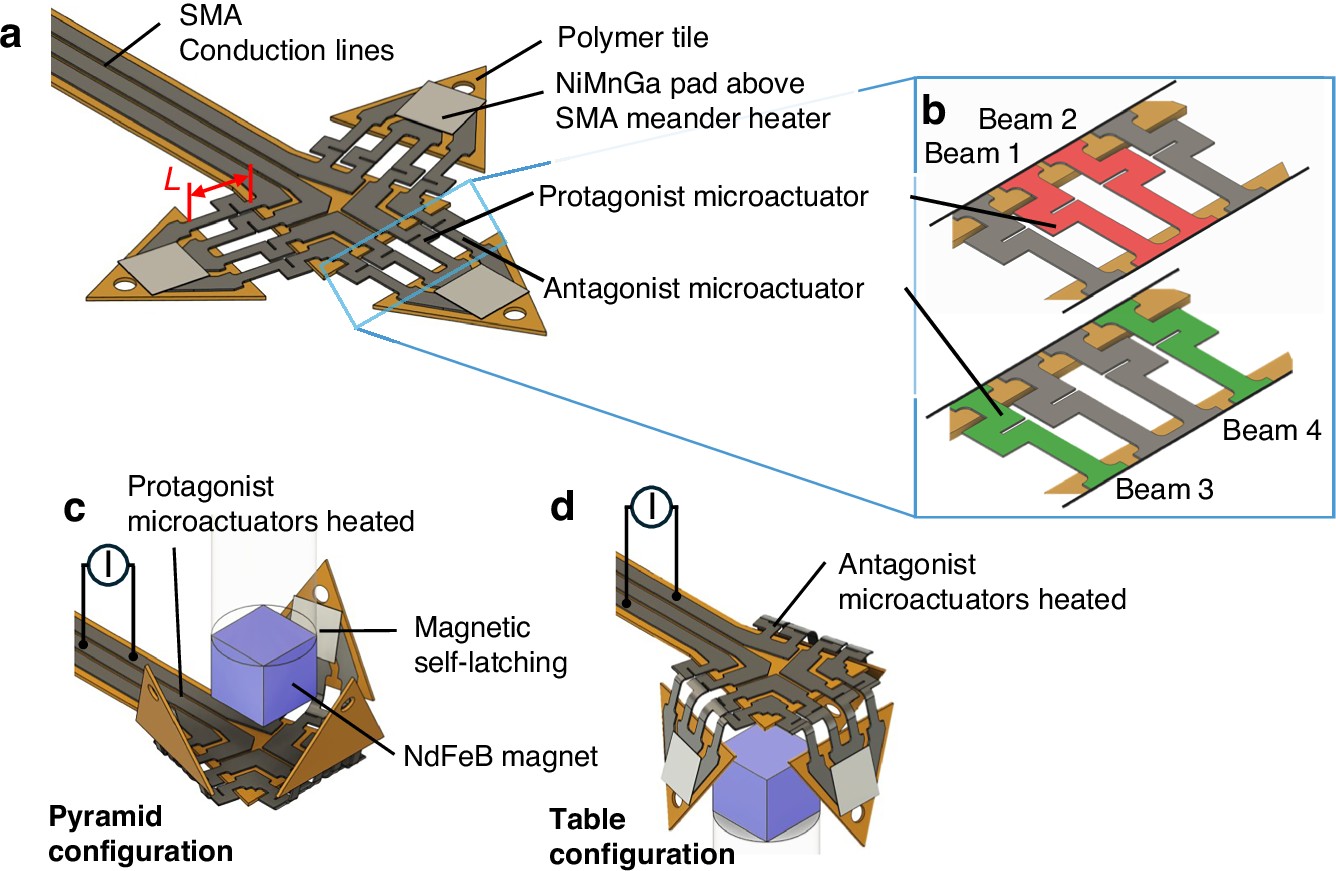
Layout of the reprogrammable origami-inspired microactuator system consisting of a centrally located polymer tile and three movable polymer tiles.
GA, UNITED STATES, February 4, 2026 /EINPresswire.com/ -- Reconfigurable structures that can repeatedly change their three-dimensional shape without manual intervention represent a long-standing goal in microscale engineering. A new origami-inspired microactuator system now demonstrates how miniature components can self-fold, self-unfold, and adopt entirely different functional shapes on demand. The system integrates bidirectional microactuators with switchable magnetic latching, allowing precise control over folding direction, angle, and stability. By combining mechanical actuation and reversible locking in a tightly integrated design, the approach enables repeated reprogramming of complex 3D configurations at sub-millimeter scales. This advance moves programmable matter beyond one-time shape formation toward truly reprogrammable microdevices capable of dynamic adaptation.
Origami-inspired engineering has emerged as a powerful strategy for transforming flat structures into complex three-dimensional forms, with applications ranging from robotics and optics to biomedical devices. At the microscale, however, most self-folding systems remain limited to a single programmed shape, after which manual resetting is required. This constraint becomes increasingly problematic as device dimensions shrink and physical manipulation becomes impractical. Achieving reversible folding, controlled unlocking, and reliable reconfiguration at small scales requires precise coordination of actuation forces, material responses, and stabilization mechanisms. Based on these challenges, it is necessary to develop a micro-origami system capable of reversible, programmable shape transformation through integrated actuation and latching mechanisms.
Researchers from the Karlsruhe Institute of Technology, in collaboration with partners in Japan and Germany, report a reprogrammable origami-inspired microactuator system in Microsystems & Nanoengineering, published (DOI: 10.1038/s41378-025-01026-x) in 2025. The study presents a miniature platform composed of multiple rigid tiles connected by antagonistic shape-memory alloy actuators and reversible magnetic latches. By selectively applying electrical heating, the system can autonomously switch between distinct three-dimensional configurations—such as a pyramid and a table—without physical intervention, demonstrating a new pathway toward reprogrammable micromachines.
At the core of the system are pairs of antagonistic shape-memory alloy microactuators that enable bidirectional folding. When electrically heated, one actuator bends the connected tiles upward, while its counterpart can reverse the motion when activated. This antagonistic design allows controlled folding and unfolding with angular ranges approaching ±80 degrees, extended to nearly ±100 degrees through magnetic stabilization.
To lock and unlock folded configurations, the researchers integrated soft-magnetic pads with a low ferromagnetic transition temperature. These pads generate strong magnetic attraction to a nearby permanent magnet, stabilizing the folded shape. When locally heated above the transition temperature, the magnetic force sharply decreases, allowing the structure to self-unlatch and reconfigure.
A key challenge addressed in the study is thermal cross-coupling, as actuators, heaters, and magnetic elements are packed within a space smaller than a millimeter. Through model-based design and carefully tuned heating protocols, the team achieved selective actuation without unintended cross-coupling. A demonstrator system consisting of four triangular tiles—each only 500 micrometers in size—successfully transitioned from a flat state to a pyramid, unfolded autonomously, and then reassembled into a table-like structure. This cycle could be repeated multiple times, illustrating genuine reprogrammability at the microscale.
“This work shows that reprogrammable matter does not have to stop at the macroscale,” said one of the study’s senior researchers. “By combining bidirectional shape-memory actuation with switchable magnetic latching, we can repeatedly reshape microsystems without touching them. The ability to autonomously unfold and refold into different stable configurations is essential for future micromachines that must adapt to changing environments. Our results demonstrate that such adaptability is achievable even at dimensions where manual intervention is no longer possible.”
Reprogrammable micro-origami systems open new possibilities for adaptive technologies that must operate in confined or inaccessible environments. Potential applications include reconfigurable micro-optical components, miniature robotic systems, and dynamically adjustable microfluidic devices. In biomedical contexts, shape-changing microstructures could enable deployable tools that alter their geometry after insertion. Beyond specific applications, the work establishes a general design framework for integrating actuation, locking, and control within extreme size constraints. As microfabrication techniques continue to advance, the
DOI
10.1038/s41378-025-01026-x
Original Source URL
https://doi.org/10.1038/s41378-025-01026-x
Funding information
This research was funded by the German Science Foundation within the Priority Program “Cooperative Multistage Multistable Microactuator Systems” (SPP2206). This work was partly carried out with the support of the Karlsruhe Nano Micro Facility (KNMFi, www.knmf.kit.edu ), a Helmholtz Research Infrastructure at Karlsruhe Institute of Technology (KIT, www.kit.edu ). L.B. and E.Q. acknowledge funding by the German Science Foundation (DFG) through the project 413288478.
Lucy Wang
BioDesign Research
email us here
Legal Disclaimer:
EIN Presswire provides this news content "as is" without warranty of any kind. We do not accept any responsibility or liability for the accuracy, content, images, videos, licenses, completeness, legality, or reliability of the information contained in this article. If you have any complaints or copyright issues related to this article, kindly contact the author above.
