
Space Battery Market In 2029
Space Battery Market Report
Space Battery Market Report
Space Battery Market Report
The Business Research Company’s Space Battery Global Market Report 2025 – Market Size, Trends, And Forecast 2025-2034
LONDON, GREATER LONDON, UNITED KINGDOM, January 21, 2026 /EINPresswire.com/ -- Space Battery Market to Surpass $5 billion in 2029. Within the broader Aerospace & Defense industry, which is expected to be $1,102 billion by 2029, the Space Battery market is estimated to account for nearly 0.5% of the total market value.
Which Will Be the Biggest Region in the Space Battery Market in 2029
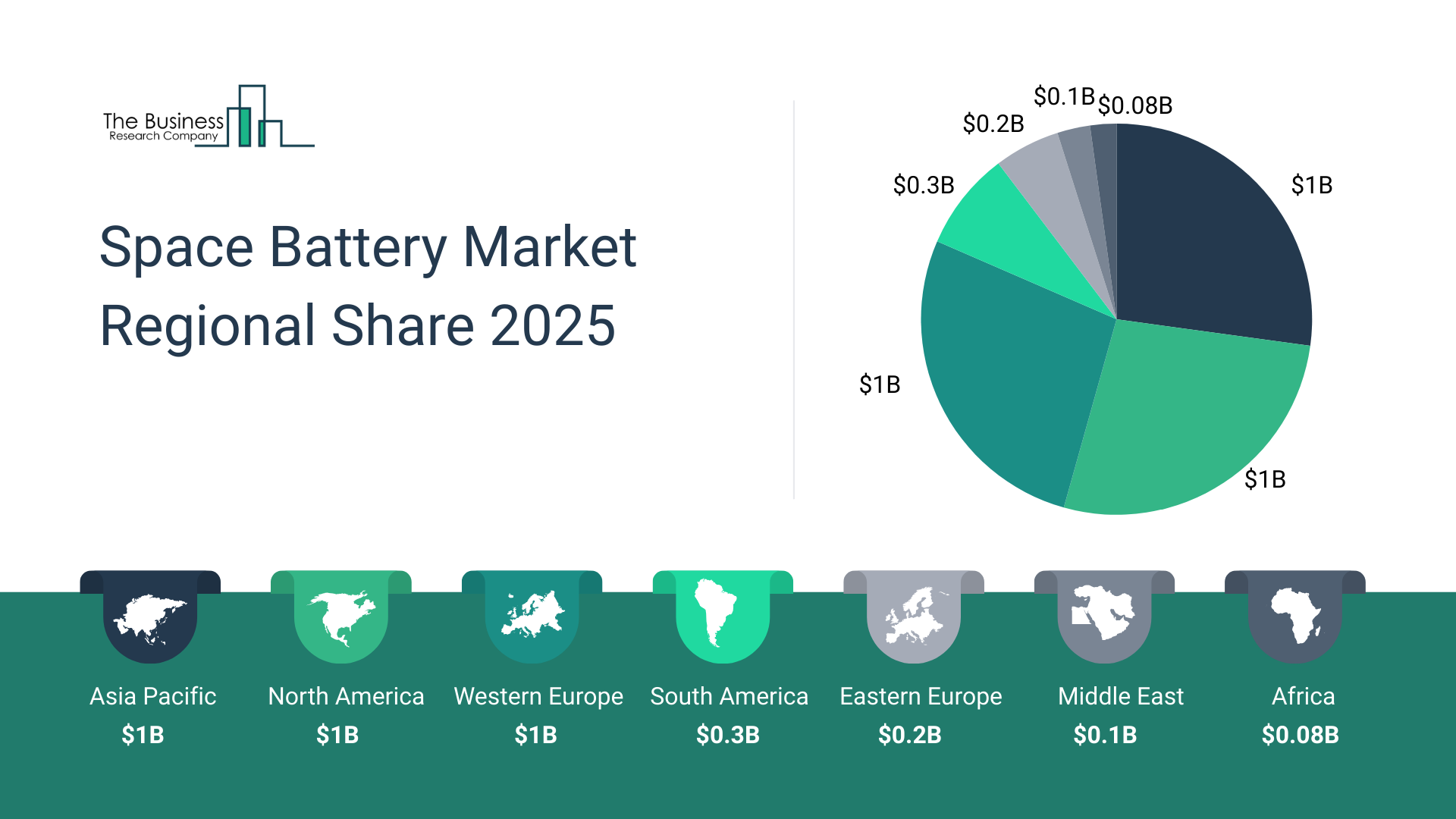
North America will be the largest region in the space battery market in 2029, valued at $1,645 million. The market is expected to grow from $1,327 million in 2024 at a compound annual growth rate (CAGR) of 4%. The steady growth in the forecast period can be attributed to the rising defence spending in space programs, growth of satellite internet and IoT applications and increasing government initiatives.
Which Will Be The Largest Country In The Space Battery Market In 2029?
The USA will be the largest country in the space battery market in 2029, valued at $1,402 million. The market is expected to grow from $1,143 million in 2024 at a compound annual growth rate (CAGR) of 4%. The steady growth in the forecast period can be attributed to the rising defence spending in space programs and increasing product launches.
Request a free sample of the Space Battery Market report
https://www.thebusinessresearchcompany.com/sample_request?id=19713&type=smp
What will be Largest Segment in the Space Battery Market in 2029?
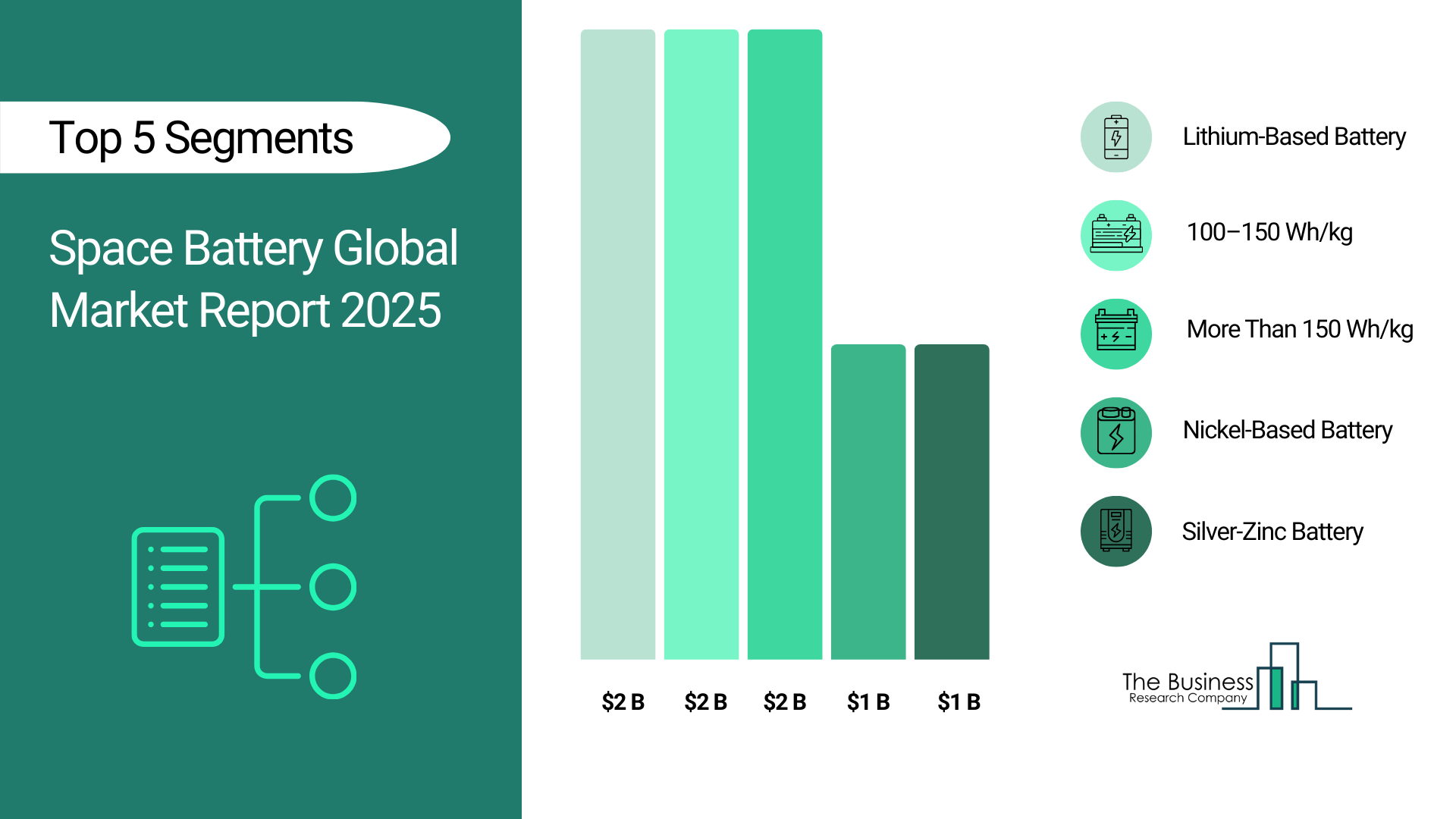
The space battery market is by type into nickel-based battery, lithium-based battery, silver-zinc battery, and other types. The lithium-based battery market will be the largest segment of the space battery market segmented by type, accounting for 55% or $2,729 million of the total in 2029. The lithium-based battery market will be supported by high energy density enabling longer mission durations, lighter weight that reduces overall payload mass, increasing use in modern LEO and GEO satellite systems, strong cycle life and charge retention, adaptability to multiple mission profiles including deep space and manned missions, growing demand from commercial satellite constellations and ability to deliver high-power pulses for propulsion systems and payloads.
The space battery market is segmented by platform into communication, earth observation, military surveillance, science, navigation, and other platforms. The communication market will be the largest segment of the space battery market segmented by platform, accounting for 34% or $1,686 million of the total in 2029. The communication market will be supported by by rising global investments in satellite internet constellations, growing deployment of LEO communication satellites, need for long battery cycles to support continuous data relay, expansion of government-backed communication satellite programs, increasing private-sector interest in satellite telecom services, greater emphasis on uninterrupted operation in high-radiation orbits and enhanced requirements for energy efficiency to maximize payload function. These satellites are often in geostationary or low Earth orbits, where solar energy alone is not sufficient during eclipses or shadowed phases, making advanced battery systems essential for uninterrupted service. With the global surge in demand for high-speed internet, satellite TV and mobile connectivity, especially in underserved and remote areas, communication satellites are being launched at a higher rate. This growing satellite deployment drives significant demand for high-performance space batteries, making communication the dominant application segment in the market.
The space battery market by energy type into less than 100 Watt-hour per kilogram (Wh/kg), 100–150 Wh/kg and more than 150 Wh/kg. The 100–150 Wh/kg market will be the largest segment of the space battery market segmented by energy type, accounting for 45% or $2,268 million of the total in 2029. The 100–150 Wh/kg market will be supported by balance between energy density and reliability, increasing deployment in mid-range satellite platforms, favourable safety and thermal performance in mixed mission profiles, use in both LEO and MEO satellites, compatibility with commercial off-the-shelf components, support for diverse power demands in multi-payload platforms and established qualification for space environment operations. Batteries in this range provide sufficient power capacity to support a wide variety of satellite operations, including communications, Earth observation, navigation, and scientific missions, without significantly increasing launch weight or cost. They are especially favoured for small to medium-sized satellites, which represent a large portion of current satellite deployments. Additionally, this energy density range aligns well with established lithium-ion battery technologies, which are widely adopted in the space sector due to their proven performance, safety, and ease of integration.
The space battery market is by orbit type into low earth orbit (LEO), medium earth orbit (MEO), geosynchronous orbit (GEO) and other orbit types. The low earth orbit (LEO), market will be the largest segment of the space battery market segmented by orbit type, accounting for 49% or $2,467 million of the total in 2029. The low earth orbit (LEO), market will be supported by surge in small satellite and mega constellation deployments, frequent launch schedules driving high battery demand, shorter revisit cycles needing efficient power use, requirement for quick charging and discharging cycles, increasing use in Earth observation and broadband internet, standardized bus platforms using advanced lithium-ion batteries and cost-effectiveness driving adoption by commercial startups. LEO satellites are increasingly being deployed by both government agencies and private players like SpaceX, a US-based space technology company, OneWeb, a Low Earth Orbit (LEO) satellite Internet provider and Amazon’s Project Kuiper, a low Earth orbit satellite broadband network, to provide global broadband internet and real-time Earth imaging. These missions require high-performance, compact, and lightweight battery systems to support power needs during eclipse periods and orbital operations. The shorter lifespan and higher turnover of LEO satellites also lead to more frequent battery replacements, further driving demand.
The space battery market by application into satellite, launch vehicle and other applications. The satellite market will be the largest segment of the space battery market segmented by application, accounting for 67% or $3,334 million of the total in 2029. The satellite market will be supported by increasing satellite launches for Earth observation, communication and navigation, miniaturization of satellite components enhancing power needs, shift toward all-electric propulsion systems, demand for uninterrupted power during eclipse periods, reliance on batteries for peak load conditions, rising interest in commercial CubeSat and Small spacecraft (Small Sats) missions and longer operational lifespans supported by durable battery systems.
What is the expected CAGR for the Space Battery Market leading up to 2029?
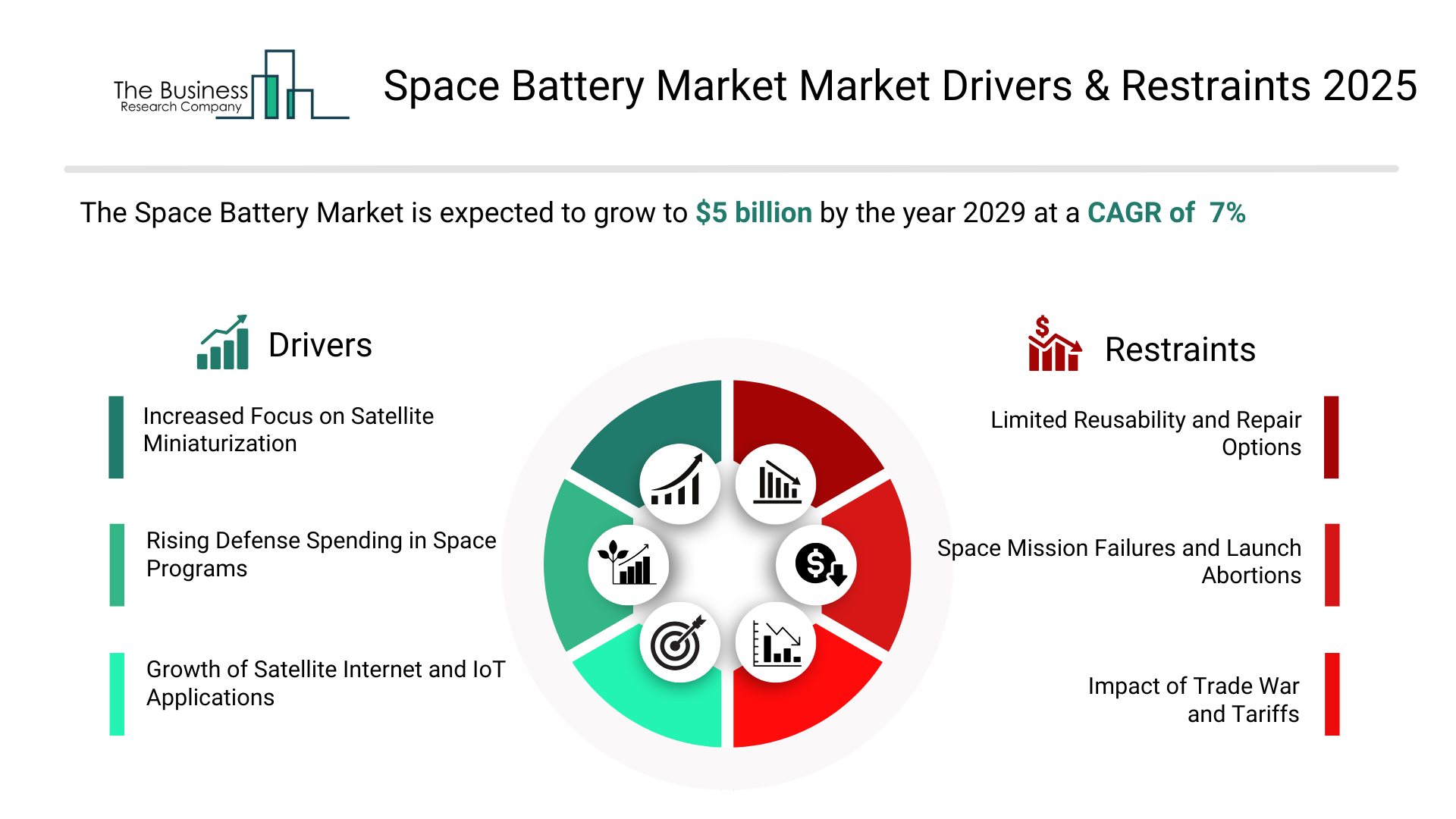
The expected CAGR for the space battery market leading up to 2029 is 7%.
What Will Be The Growth Driving Factors In The Space Battery Market In The Forecast Period?
The rapid growth of the global space battery market leading up to 2029 will be driven by the following key factors that are expected to reshape satellite manufacturing, mission design, and in-space power architectures worldwide.
Increased Focus On Satellite Miniaturization - The increased focus on satellite miniaturization will become a key driver of growth in the space battery market by 2029. The increased focus on satellite miniaturization boosts demands for compact, lightweight, and high-energy-density space batteries. Smaller satellites, such as CubeSats and nanosatellites, require efficient power sources that can deliver optimal performance within tight space and weight constraints. This pushes battery manufacturers to innovate in materials and designs, such as using lithium-ion or solid-state technologies. As a result, the increased focus on satellite miniaturization is anticipated to contributing to a 2.0% annual growth in the market.
Rising Défense Spending In Space Programs- The rising defence spending in space programs will emerge as a major factor driving the expansion of the space battery market by 2029. Increasing defence spending in space programs drives demand for advanced and reliable power systems, including high-performance space batteries, to support critical missions such as surveillance, communication, and navigation. These programs require batteries that can operate in extreme environments and deliver high energy density with long operational life. As military satellites and space-based defence systems expand, investments in space battery research and production scale up to meet stringent performance and safety standards. This, in turn, accelerates innovation and commercialization in the space battery market. Consequently, the rising defence spending in space programs is projected to contributing to a 1.5% annual growth in the market.
Growth Of Satellite And IoT Applications-The growth of satellite and IoT applications as a major factor driving the expansion of the space battery market by 2029. The rise of satellite internet and IoT applications drives demand for advanced space batteries by requiring longer-lasting, high-efficiency power sources to support continuous operation in orbit. Satellite constellations for global internet coverage, such as those from Starlink and OneWeb, need reliable batteries to maintain performance during eclipse periods when solar energy is unavailable. Similarly, IoT sensors deployed in space for Earth observation or tracking applications rely on compact, lightweight batteries with high energy density. Consequently, growth of satellite and IoT applications is projected to contributing to a 1.0% annual growth in the market.
Focus On Sustainability And End-Of-Life Satellite Management- The focus on sustainability and end-of-life satellite management will emerge as a major factor driving the expansion of the space battery market by 2029. The increasing focus on sustainability and end-of-life satellite management is driving demand for space batteries that are not only high-performing but also environmentally responsible. Manufacturers are developing batteries with longer lifespans, higher efficiency, and minimal hazardous materials to reduce orbital debris and ease satellite decommissioning. Recyclable components and energy-efficient production processes are also gaining importance in battery design. This trend aligns with global efforts to ensure cleaner, more sustainable space operations. Consequently, the focus on sustainability and end-of-life satellite management are projected to contributing to a 0.5% annual growth in the market.
Access the detailed Space Battery Market Market report here:
https://www.thebusinessresearchcompany.com/report/space-battery-global-market-report
What Are The Key Growth Opportunities In The Space Battery Market in 2029?
The most significant growth opportunities are anticipated the satellite space battery market, the lithium-based space battery market, the low earth orbit (LEO) space battery market, the high-energy (>150 Wh/kg) space battery market, and the space communication battery market. Collectively, these segments are projected to contribute over $4 billion in market value by 2029, driven by advances in high-density energy storage technologies, rising deployment of LEO mega constellations, the need for radiation-resistant and thermally stable batteries, and the growing demand for long-duration, high-reliability power solutions across satellite communications, Earth observation, and deep-space missions. This surge reflects the rapid expansion of next-generation space platforms that require lighter, safer, and more durable battery architectures, fuelling transformative growth within the broader space power and communication systems industry.
The satellite space battery market is projected to grow by $946 million, the lithium-based space battery market by $905 million, the low earth orbit (LEO) space battery market by $776 million, the high-energy (>150 Wh/kg) space battery market by $630 million, and the space communication battery market by $487 million over the next five years from 2024 to 2029.
The Business Research Company (www.thebusinessresearchcompany.com) is a leading market intelligence firm renowned for its expertise in company, market, and consumer research. We have published over 17,500 reports across 27 industries and 60+ geographies. Our research is powered by 1,500,000 datasets, extensive secondary research, and exclusive insights from interviews with industry leaders.
We provide continuous and custom research services, offering a range of specialized packages tailored to your needs, including Market Entry Research Package, Competitor Tracking Package, Supplier & Distributor Package and much more
Disclaimer: Please note that the findings, conclusions and recommendations that TBRC Business Research Pvt Ltd delivers are based on information gathered in good faith from both primary and secondary sources, whose accuracy we are not always in a position to guarantee. As such TBRC Business Research Pvt Ltd can accept no liability whatever for actions taken based on any information that may subsequently prove to be incorrect. Analysis and findings included in TBRC reports and presentations are our estimates, opinions and are not intended as statements of fact or investment guidance.
The Business Research Company
Americas +1 310-496-7795
Europe +44 7882 955267
Asia & Others +44 7882 955267 & +91 8897263534
Email: info@tbrc.info
Oliver Guirdham
The Business Research Company
+44 7882 955267
info@tbrc.info
Visit us on social media:
LinkedIn
Facebook
X
Legal Disclaimer:
EIN Presswire provides this news content "as is" without warranty of any kind. We do not accept any responsibility or liability for the accuracy, content, images, videos, licenses, completeness, legality, or reliability of the information contained in this article. If you have any complaints or copyright issues related to this article, kindly contact the author above.
