
MASH Treatment Market In 2029

MASH Treatment Market Competition Analysis 2026: How Players Are Shaping Growth
MASH Treatment Global Market Report 2026 – Market Size, Trends, And Forecast 2026-2035

MASH Treatment Global Market Report 2026 – Market Size, Trends, And Forecast 2026-2035
The Business Research Company’s MASH Treatment Global Market Report 2026 – Market Size, Trends, And Forecast 2026-2035
LONDON, GREATER LONDON, UNITED KINGDOM, January 6, 2026 /EINPresswire.com/ -- MASH Treatment Market to Surpass $7 billion in 2029. Within the broader Healthcare Services which is expected to be $10,759 billion by 2029, the MASH Treatment market is estimated to account for nearly 0.1% of the total market value.
Which Will Be the Biggest Region in the MASH Treatment Market in 2029
North America will be the largest region in the MASH (metabolic dysfunction-associated steatohepatitis) treatment market in 2029, valued at $3,100 million. The market is expected to grow from $1,198 million in 2024 at a compound annual growth rate (CAGR) of 21%. The exponential growth in the forecast period can be attributed to the growing prevalence of obesity and favorable government initiatives.
Which Will Be The Largest Country In The MASH Treatment Market In 2029?
The USA will be the largest country in the MASH (metabolic dysfunction-associated steatohepatitis) treatment market in 2029, valued at $2,772 million. The market is expected to grow from $1,082 million in 2024 at a compound annual growth rate (CAGR) of 21%. The exponential growth in the forecast period can be attributed to the growing prevalence of obesity and strategic collaboration and partnerships.
Request a free sample of the MASH Treatment Market report
https://www.thebusinessresearchcompany.com/sample_request?id=20876&type=smp
What will be Largest Segment in the MASH Treatment Market in 2029?
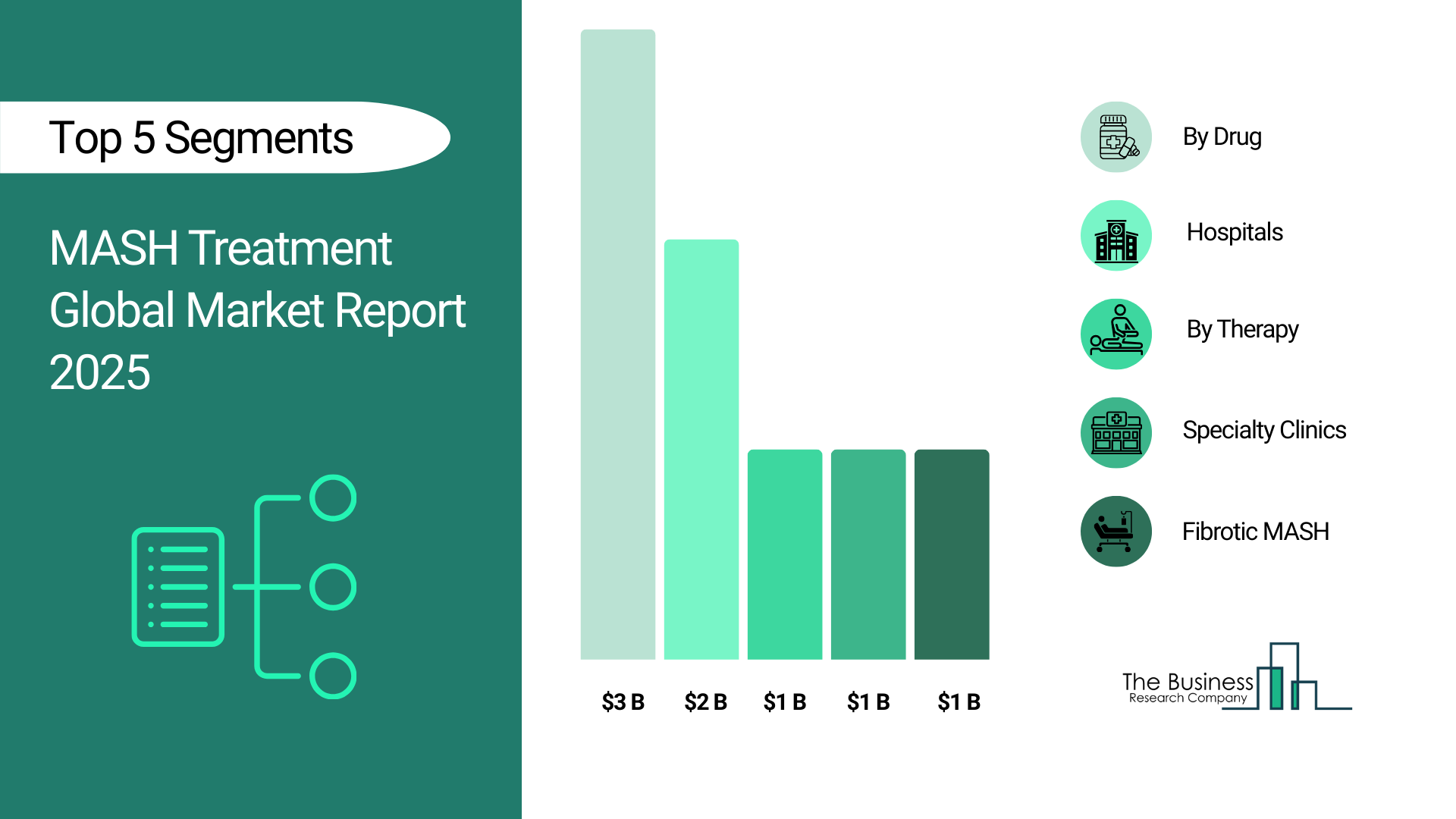
The MASH (metabolic dysfunction-associated steatohepatitis) treatment market by treatment into drug and therapy. The drug market will be the largest segment of MASH (metabolic dysfunction-associated steatohepatitis) treatment market segmented by treatment, accounting for 82% or $5,715 million of the total in 2029. The drug market is supported by increasing clinical trials for novel anti-fibrotic and anti-inflammatory agents, rising prevalence of obesity and type 2 diabetes fueling pharmaceutical demand, regulatory support through fast-track designations and orphan drug approvals, growing R&D investments by pharmaceutical companies targeting MASH, expanded pipeline of small molecule and biologic drug candidates, increasing physician awareness of disease progression and patient demand for non-invasive pharmacological solutions.
The MASH (metabolic dysfunction-associated steatohepatitis) treatment market is segmented by disease stage into simple fatty liver / MASLD (no or mild fibrosis), early MASH (significant/advanced fibrosis), fibrotic MASH, MASH cirrhosis, and liver failure / liver cancer mortality. The early MASH (significant/advanced fibrosis) market will be the largest segment of the MASH (metabolic dysfunction-associated steatohepatitis) treatment market segmented by disease stage, accounting for 43% or $3,003 millionof the total in 2029. The early MASH (significant/advanced fibrosis) market is supported by rising clinical trial activity targeting fibrosis regression, growing patient pool with moderate liver damage seeking treatment, increased physician focus on early intervention to prevent cirrhosis, expansion of biomarker-based diagnostics to detect fibrotic progression, heightened investment in anti-fibrotic drug development, emergence of combination therapies showing efficacy in fibrosis reduction and regulatory push for treatments addressing intermediate-stage liver damage. The increasing awareness and rising adoption of non-invasive diagnostic tools, such as transient elastography (FibroScan) and magnetic resonance imaging–proton density fat fraction (MRI-PDFF), have facilitated the earlier detection of patients with significant or advanced liver fibrosis. This has resulted in an expansion of the treatable patient population, thereby supporting the overall growth of the treatment market.
The MASH (metabolic dysfunction-associated steatohepatitis) treatment market by end-user into hospitals, specialty clinics, homecare, and other end-user. The hospitals market will be the largest segment of the MASH (metabolic dysfunction-associated steatohepatitis) treatment market segmented by end-user, accounting for 48% or $3,356 millionof the total in 2029. The hospitals market is supported by the presence of specialized hepatology departments, increasing inpatient admissions for advanced liver conditions, access to multidisciplinary care including endocrinology and nutrition, availability of advanced diagnostic and imaging tools, increased awareness among clinicians about early diagnosis and treatment of MASH, ongoing clinical trials being conducted in hospital settings and favorable reimbursement policies for hospital-based treatments.
What is the expected CAGR for the MASH Treatment Market leading up to 2029?
The expected CAGR for the MASH (metabolic dysfunction-associated steatohepatitis) treatment leading up to 2029 is 22%.
What Will Be The Growth Driving Factors In The MASH Treatment Market In The Forecast Period?
The rapid growth of the global MASH (metabolic dysfunction-associated steatohepatitis) treatment market leading up to 2029 will be driven by the following key factors that are expected to reshape liver disease management, clinical practice, and pharmaceutical innovation worldwide.
Growing Interest In Combination Therapies-The growing interest in combination therapies will become a key driver of growth in the MASH (metabolic dysfunction-associated steatohepatitis) treatment market by 2029. MASH involves intertwined pathological processes, including steatosis, inflammation, fibrosis, and metabolic dysregulation, making single-agent therapies often insufficient for robust efficacy. Combination therapies, which simultaneously address multiple pathways (such as pairing an FXR agonist for metabolic regulation with an anti-fibrotic or anti-inflammatory agent), have shown promise in improving histological outcomes and halting disease progression. Clinical trials increasingly focus on synergistic drug pairs, such as GLP-1 receptor agonists with THR-β agonists, to enhance metabolic benefits while reducing liver injury. As a result, growing interest in combination therapies is anticipated to contributing to a 1.5% annual growth in the market.
Increasing Incidence Of Non-Alcoholic Fatty Liver Disease (NAFLD)- the increasing incidence of non-alcoholic fatty liver disease (NAFLD) will become a key driver of growth in the MASH (metabolic dysfunction-associated steatohepatitis) treatment market by 2029. With rising global rates of obesity, type 2 diabetes, and metabolic syndrome, NAFLD prevalence has surged, leading more patients to progress to MASH, a more severe form characterized by liver inflammation and fibrosis. This epidemiological shift has amplified the need for treatments that can prevent disease progression to cirrhosis, liver failure, or hepatocellular carcinoma. Pharmaceutical and biotech companies are responding by accelerating the development of anti-fibrotic, anti-inflammatory, and metabolic-targeting drugs, with several candidates in late-stage clinical trials. As a result, the increasing incidence of non-alcoholic fatty liver disease (NAFLD) is anticipated to contributing to a 1.0% annual growth in the market.
Growing Prevalence Of Obesity- The growing prevalence of obesity will serve as a key growth catalyst MASH (metabolic dysfunction-associated steatohepatitis) treatment market by 2029. Excess adiposity, particularly visceral fat, drives insulin resistance, chronic inflammation, and dyslipidaemia key mechanisms that contribute to hepatic fat accumulation, liver injury, and fibrosis. With global obesity rates rising sharply, the pool of at-risk individuals for MASH is expanding rapidly, increasing the demand for effective therapies. This epidemiological trend has spurred pharmaceutical and biotech investments in drugs targeting metabolic pathways (GLP-1 agonists, THR-β agonists) and antifibrotic agents to halt disease progression. Therefore, this growing prevalence of obesity is projected to supporting to a 0.7% annual growth in the market.
Rising Demand For Liver Transplants- The rising demand for liver transplants will serve as a key growth catalyst for MASH (metabolic dysfunction-associated steatohepatitis) treatment market by 2029. As MASH progresses, it can lead to advanced fibrosis, cirrhosis, and liver failure, making transplantation the only viable option for many patients. However, the shortage of donor livers, high costs and post-transplant complications have intensified the need for effective pharmacological interventions that can halt or reverse disease progression before transplantation becomes necessary. This urgency has spurred accelerated R&D in MASH therapeutics, with pharmaceutical companies focusing on anti-fibrotic, metabolic, and anti-inflammatory drugs to prevent liver deterioration. Additionally, healthcare systems and insurers are increasingly incentivizing early treatment to reduce the long-term burden of transplant-related expenses. Therefore, this rising demand for liver transplants will is projected to supporting to a 0.5% annual growth in the market.
Access the detailed MASH Treatment Market report here:
https://www.thebusinessresearchcompany.com/report/metabolic-dysfunction-associated-steatohepatitis-mash-treatment-global-market-report
What Are The Key Growth Opportunities In MASH Treatment Market in 2029?
The most significant growth opportunities are anticipated in the mash therapeutics and drug market, the mash treatment for early-stage fibrosis market, and the mash treatment and hospital care market. Collectively, these segments are projected to contribute over $8 billion in market value by 2029, driven by the rising global prevalence of metabolic dysfunction-associated liver diseases, increasing diagnosis rates enabled by improved non-invasive screening tools, and robust pharmaceutical pipelines introducing advanced therapeutics targeting inflammation, fibrosis, and metabolic pathways. This surge reflects the accelerating shift toward earlier intervention, personalized treatment approaches, and hospital-based multidisciplinary care models factors that are collectively reshaping the future landscape of MASH management and clinical outcomes worldwide.
The mash therapeutics and drug market is projected to grow by $3,675 million, the mash treatment for early-stage fibrosis market by $2,098 million, and the mash treatment and hospital care market by $2,081 million over the next five years from 2024 to 2029.
The Business Research Company (www.thebusinessresearchcompany.com) is a leading market intelligence firm renowned for its expertise in company, market, and consumer research. We have published over 17,500 reports across 27 industries and 60+ geographies. Our research is powered by 1,500,000 datasets, extensive secondary research, and exclusive insights from interviews with industry leaders.
We provide continuous and custom research services, offering a range of specialized packages tailored to your needs, including Market Entry Research Package, Competitor Tracking Package, Supplier & Distributor Package and much more
Disclaimer: Please note that the findings, conclusions and recommendations that TBRC Business Research Pvt Ltd delivers are based on information gathered in good faith from both primary and secondary sources, whose accuracy we are not always in a position to guarantee. As such TBRC Business Research Pvt Ltd can accept no liability whatever for actions taken based on any information that may subsequently prove to be incorrect. Analysis and findings included in TBRC reports and presentations are our estimates, opinions and are not intended as statements of fact or investment guidance.
The Business Research Company
Americas +1 310-496-7795
Europe +44 7882 955267
Asia & Others +44 7882 955267 & +91 8897263534
Email: info@tbrc.info"
Oliver Guirdham
The Business Research Company
+44 7882 955267
info@tbrc.info
Legal Disclaimer:
EIN Presswire provides this news content "as is" without warranty of any kind. We do not accept any responsibility or liability for the accuracy, content, images, videos, licenses, completeness, legality, or reliability of the information contained in this article. If you have any complaints or copyright issues related to this article, kindly contact the author above.
