
New Study Improves Virtual Travel Experience with Efficient Avatar Task Migration
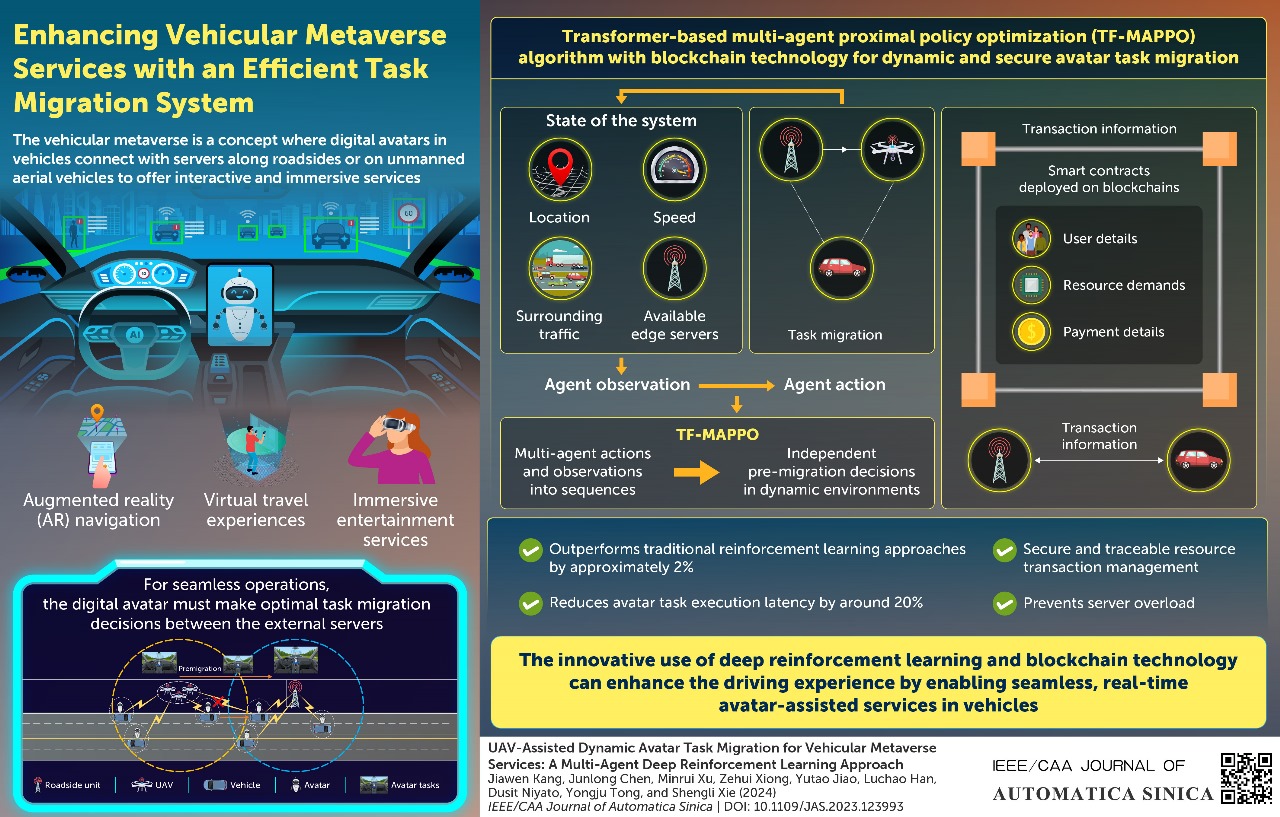
The system reduces total task execution latency, prevents server overload, and ensures the security of communications between edge servers and vehicles.
The system offers approximately 20% improvement over current methods and can pave the way for smart traffic management solutions
BEIJING, CHINA, June 19, 2024 /EINPresswire.com/ -- Vehicular Metaverse services where a digital avatar provides navigational services can enhance driving experiences, improve urban traffic management, and pave the way for advanced smart city infrastructures. In a new study, researchers propose a deep reinforcement learning and blockchain-based task migration system to manage the computational demands and ensure the security of these services. The proposed method effectively reduces avatar task execution latency by approximately 20%, ensuring real-time and immersive experiences for users.Imagine a world where driving no longer means relying solely on conventional GPS navigation. Instead, augmented reality systems project a digital avatar onto your vehicle’s dashboard, guiding you in real time. These digital avatars can interact dynamically with other vehicles and the environment to help you navigate through traffic, suggest points of interest, and assist with finding parking spots. This integration of vehicular navigation within the Metaverse combines the digital and physical worlds in ways that were previously not possible, creating opportunities for richer, more interactive experiences for drivers and passengers.
However, implementing such systems is challenging. The dynamic traffic conditions and the unpredictability of the urban environment demand significant computational resources for the digital avatar to perform its tasks effectively. A solution to this is to have the digital avatars transfer their tasks to external servers placed along the road or on unmanned aerial vehicles (UAVs) flying overhead.
To ensure seamless communication between the servers and the vehicles, researchers from Nanyang Technological University, Singapore University of Technology and Design, Guangdong University of Technology, Army Engineering University of PLA, and the National Natural Science Foundation of China have proposed a task migration system that intelligently determines the optimal time to move tasks between the vehicle and external servers. Their paper was published in the 2024 Issue 2 of the IEEE/CAA Journal of Automatica Sinica.
The novel task migration system, based on deep reinforcement learning and blockchain technology reduces total task execution latency, prevents server overload, and ensures the security of communications between edge servers and vehicles.
“The mobility of vehicles poses a significant challenge for UAV-assisted vehicular Metaverses to ensure the continuity of avatar services, especially when the vehicles leave coverage of their host edge servers. We propose a framework to address this issue. By using advanced computer algorithms, we can quickly and reliably determine the best server to handle each task, much like how a smart assistant would choose the best route based on current traffic conditions,” says Zehui Xiong, the corresponding author of the study and an Assistant Professor at Singapore University of Technology and Design.
Using multi-reinforcement learning algorithms, digital avatars or agents can be trained to make the most optimal task migration decisions. However, in dynamic environments such as city streets, the digital avatar faces moving vehicles and unpredictable obstacles, which makes training these models challenging. To address this, the researchers integrated transformers into a multi-agent proximal policy optimization (MAPPO) algorithm. MAPPO is a multi-agent deep reinforcement learning algorithm to train digital avatars to make decisions about task migration. In this process, the digital avatar or the agent migrates a task, based on its observations, such as its location, speed, traffic conditions, and available servers. To further optimize the decision-making, the transformer converts the actions and observations of multiple agents into sequences.
“This approach allows each vehicle to dynamically decide whether to perform an avatar task pre-migration, thereby reducing the average latency of all vehicles and improving the quality of avatar services,” says Dr. Xiong.
With the proposed system, a user who wants to access the digital avatar services sends the necessary resource requirements to the edge servers. The edge servers then determine the prices that the user must pay for these resources. Once the user pays for the requested resources, the edge servers allocate the appropriate resources for the avatar services.
To ensure the security of communications, the transactions between the vehicle and the external server are recorded using Smart Contracts deployed on blockchains. This acts as a public ledger, ensuring that sensitive details such as the user's address, resource demands placed on the server, and the payments made remain secure and cannot be altered.
To evaluate the effectiveness of the proposed method, the researchers conducted simulations where vehicles interacted with three edge servers along a main city road. They found that the method outperforms traditional reinforcement learning approaches by approximately 2% and reduces avatar task execution latency by around 20%. Thus, the proposed method paves the way for vehicular services in the Metaverse, with broad potential applications. Beyond assisting with navigation, it can contribute to creating smart urban environments where vehicles seamlessly communicate with each other to optimize traffic flow, reduce congestion, and minimize environmental impact.
“In the longer term, this research could lead to widespread adoption of highly interactive and immersive vehicular services, transforming the driving experience. The technology could also improve road safety through better navigation aids and real-time updates. Furthermore, the efficient use of computing resources and secure transactions could pave the way for more sustainable and scalable smart city infrastructures,” says Dr. Xiong.
You can hear directly from the researchers in this podcast, where they discuss their study and how vehicular services in the Metaverse can transform the future of transportation.
***
Reference
Title of original paper: UAV-Assisted Dynamic Avatar Task Migration for Vehicular Metaverse Services: A Multi-Agent Deep Reinforcement Learning Approach
Journal: IEEE/CAA Journal of Automatica Sinica
DOI: https://doi.org/10.1109/JAS.2023.123993
Authors: Jiawen Kang1, Junlong Chen1, Minrui Xu2, Zehui Xiong3, Yutao Jiao4, Luchao Han5, Dusit Niyato2, Yongju Tong1, and Shengli Xie1
Affiliations:
1 Guangdong University of Technology, China
2 Nanyang Technological University, Singapore
3 Singapore University of Technology and Design, Singapore
4 Army Engineering University of PLA, China
5 National Natural Science Foundation of China, China
Yan Ou
IEEE/CAA Journal of Automatica Sinica
+86 10 8254 4459
yan.ou@ia.ac.cn
Legal Disclaimer:
EIN Presswire provides this news content "as is" without warranty of any kind. We do not accept any responsibility or liability for the accuracy, content, images, videos, licenses, completeness, legality, or reliability of the information contained in this article. If you have any complaints or copyright issues related to this article, kindly contact the author above.
