
In-Store Analytics Market Driven by Demand for Personalized Shopping Experiences and Data-Driven Decisions
In Store Analytics Market Report
In-Store Analytics Market expands as retailers leverage data insights to optimize store operations and customer experience.
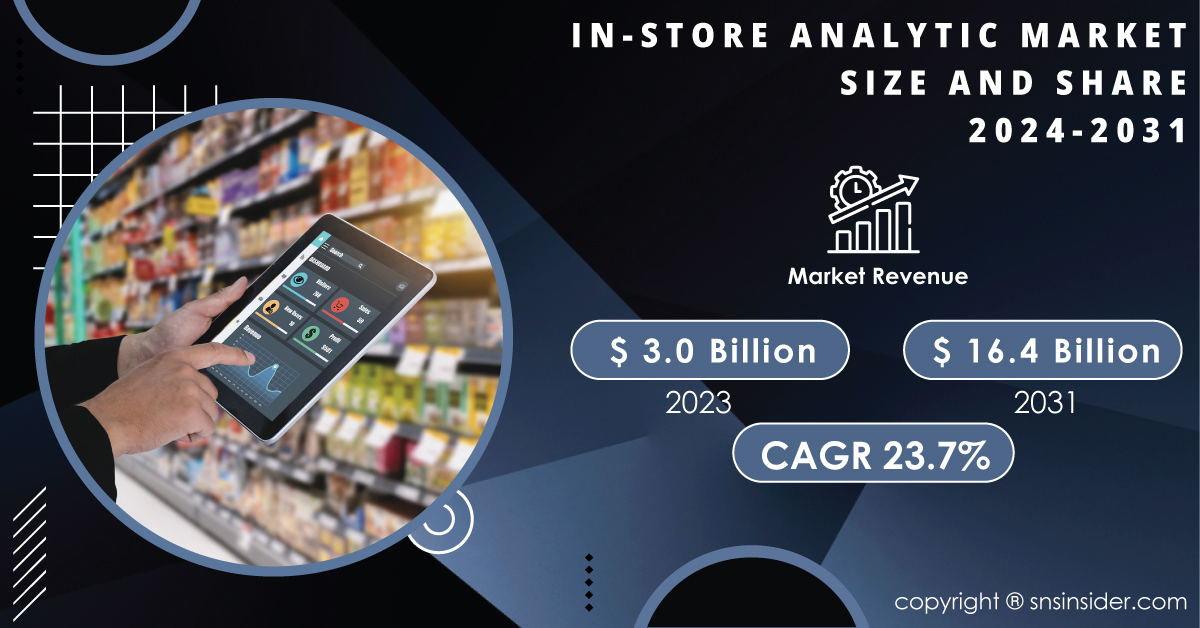
AUSTIN, TEXAS, UNITED STATES, May 27, 2024 /EINPresswire.com/ -- Market Scope and OverviewThe In-Store Analytics Market is poised for significant growth, with the SNS Insider report indicating a market size of USD 3.0 billion in 2023 and a projected reach of USD 16.4 billion by 2031 and grow at a CAGR of 23.7% over the forecast period 2024-2031. This growth is attributed to the increasing emphasis on personalized shopping experiences and data-driven decision-making in the retail sector.
The in-store analytics market offers a multitude of benefits for retailers, shaping the future of retail through innovation and customer-centricity. Data-driven insights allow retailers to personalize the shopping experience by offering targeted promotions and recommendations. Optimized store layouts based on customer flow analysis can improve product discoverability and sales. Real-time inventory management practices informed by analytics data help prevent stockouts and overstocking, leading to improved operational efficiency. Additionally, analytics solutions can deter shoplifting and enhance security by providing real-time data on customer behavior within the store. Integration with augmented reality (AR) allows for virtual try-on experiences and product visualization, further boosting customer engagement and sales. Finally, cloud-based in-store analytics solutions democratize access to data by offering cost-effective options, empowering smaller retailers to compete effectively through
data-driven strategies.
Get a Report Sample of In-Store Analytics Market @ https://www.snsinsider.com/sample-request/2622
Major Players Studied in this Report are:
➤ SAP SE
➤ Celect
➤ Capillary Technologies
➤ Inpixon
➤ Scanalytics
➤ Dor Technologies
➤ SemsEye
➤ RetailNext
➤ Mindtree Ltd
➤ Happiest Minds
➤ Others
Market Segmentation Analysis
Based on component, the software segment is expected to hold the largest market share throughout the forecast period. This dominance is driven by the increasing adoption of in-store analytics software by retailers for various functionalities. These software solutions enable stores to track sales data, identify customer preferences, and create data-driven business plans. Early identification of trends and anomalies helps in preventing stockouts and shoplifting incidents. Advancements in AI and integration capabilities of such software further enhance their value proposition by facilitating real-time demand forecasting.
On the deployment model front, the on-premises segment currently holds a dominant position. This preference stems from the desire of organizations to have complete control over their data and applications. On-premises solutions offer greater flexibility for customization based on specific organizational needs. Stores dealing with sensitive customer identity data often opt for on-premise deployments to ensure data security and privacy remain under their purview.
Market Segmentation and Sub-Segmentation Included Are:
On The Basis of Component
➤ Software
➤ Services
On The Basis of Deployment Mode
➤ On-premise
➤ Cloud
On The Basis of Organization Size
➤ Large Enterprises
➤ Small & Medium Enterprises
On The Basis of Application
➤ Customer Management
➤ Marketing Management
➤ Merchandising Analysis
➤ Store Operations Management
➤ Risk and Compliance Management
➤ Others
Impact of Global Disruptions
The ongoing Russia-Ukraine war has had a ripple effect on the in-store analytics market. Sanctions imposed on Russia and disruptions in global supply chains have led to a shortage of critical components like semiconductors, essential for manufacturing hardware used in in-store analytics solutions. This shortage, coupled with rising energy costs, can potentially lead to price hikes for these solutions, impacting both initial investments and ongoing operational costs for retailers. Additionally, consumer spending habits have shifted due to the war and rising inflation, with a growing focus on essential goods. This could lead to decreased foot traffic in stores selling non-essential items, impacting the in-store analytics market in those sectors. However, the war could also present unforeseen opportunities. For instance, there might be a rise in demand for analytics solutions that help retailers track inventory levels more effectively and manage potential stockouts of essential goods. The focus on cost-efficiency could also drive increased adoption of cloud-based analytics solutions with subscription models, as they are typically more affordable for retailers.
Regional Growth Dynamics
North America is currently at the forefront of in-store analytics adoption, driven by the presence of large retail chains with high demand for sophisticated systems like heat mapping, customer journey tracking, and AI-powered checkout optimization. While large retailers are major users, some small and medium-sized enterprises (SMEs) are also adopting in-store analytics solutions. Cloud-based solutions with affordable subscription models are making these tools more accessible for SMEs. These businesses might focus on simpler analytics to optimize store layout, improve staffing levels based on customer traffic data, and gain insights into customer behavior. A focus on enhancing customer experience, optimizing store operations, and increasing sales efficiency are key drivers for North American retailers. Additionally, data privacy regulations like CCPA (California Consumer Privacy Act) are shaping the market by requiring responsible data collection practices.
The Asia Pacific region is experiencing rapid growth in in-store analytics adoption. While large retailers are present, there's a significant number of SMEs with varying levels of technological adoption. Rising competition, growing disposable income leading to higher consumer expectations, and government support for retail modernization are key drivers in this region. SMEs in Asia Pacific often utilize simpler, cost-effective solutions like basic traffic counting or basic heat mapping tools.
Get a Discount @ https://www.snsinsider.com/discount/2622
Recent Developments
➤ In January 24, 2024: Integration of AR with In-Store Navigation - Google introduced an update to its ARCore platform, enabling integration with in-store navigation apps. This integration allows for features like AR wayfinding and product information overlays. This development signifies the growing potential of AR in enhancing the in-store experience by providing customers with interactive product information and navigation assistance.
Key Takeaways
➤ In-store analytics empowers retailers to personalize the shopping journey, leading to increased customer satisfaction and loyalty.
➤ Real-time customer insights derived from in-store analytics enable data-driven decision making, optimizing inventory management, staffing, and store operations.
➤ Cloud-based deployment models make in-store analytics solutions more accessible and affordable for retailers of all sizes.
➤ Advancements in AI and AR will unlock new possibilities for in-store analytics, further enhancing the customer experience and operational efficiency.
➤ Investing in in-store analytics solutions can provide retailers with a significant competitive advantage in the evolving retail landscape.
The in-store analytics market is expected to witness a significant upsurge in the coming years, driven by several factors. The increasing adoption of omnichannel retail experiences will necessitate a unified view of customer behavior across online and offline channels. This will drive the demand for in-store analytics solutions that integrate seamlessly with existing e-commerce platforms. Additionally, advancements in technologies like artificial intelligence (AI) and machine learning (ML) will unlock new possibilities for in-store analytics. AI-powered solutions can analyze vast amounts of customer data to personalize promotions in real-time, predict customer behavior, and optimize store operations for maximum efficiency. Furthermore, the growing focus on sustainability will lead to the adoption of analytics solutions that help retailers optimize energy consumption and minimize waste within stores.
Table of Contents - Major Key Points
1. Introduction
2. Research Methodology
3. Market Dynamics
4. Impact Analysis
4.1. Impact of Ukraine- Russia war
4.2. Impact of Ongoing Recession on Major Economies
5. Value Chain Analysis
6. Porter’s 5 Forces Model
7. PEST Analysis
8. In-Store Analytics Market Segmentation, by Component
9. In-Store Analytics Market Segmentation, by Deployment Mode
10. In-Store Analytics Market Segmentation, by Organization Size
11. In-Store Analytics Market Segmentation, by Application
12. Regional Analysis
13. Company Profile
14. Competitive Landscape
15. USE Cases and Best Practices
16. Conclusion
About Us
SNS Insider is one of the leading market research and consulting agencies that dominates the market research industry globally. Our company's aim is to give clients the knowledge they require in order to function in changing circumstances. In order to give you current, accurate market data, consumer insights, and opinions so that you can make decisions with confidence, we employ a variety of techniques, including surveys, video talks, and focus groups around the world.
Our staff is dedicated to giving our clients reliable information, and with expertise working in the majority of industrial sectors, we're proud to be recognized as one of the world's top market research firms. We can quickly design and implement pertinent research programs, including surveys and focus groups, and we have the resources and competence to deal with clients in practically any company sector.
Akash Anand
SNS Insider | Strategy and Stats
+1 415-230-0044
email us here
Visit us on social media:
Facebook
Twitter
LinkedIn
Instagram
YouTube
Legal Disclaimer:
EIN Presswire provides this news content "as is" without warranty of any kind. We do not accept any responsibility or liability for the accuracy, content, images, videos, licenses, completeness, legality, or reliability of the information contained in this article. If you have any complaints or copyright issues related to this article, kindly contact the author above.
