
Medical Tourism Market Projected to Reach USD 74.37 Billion by 2031, Fueled by Cost Disparities & Treatment Innovations
Medical Tourism Market
At 25.4% CAGR, Medical Tourism Market Shows Exponential Growth Driven by Rise of Affordable Cross-Border Care, Demand for Specialized Services
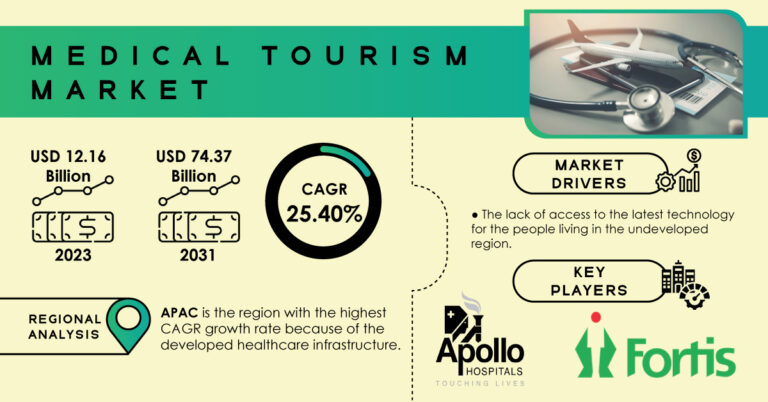
AUSTIN, TEXAS, UNITED STATES, May 22, 2024 /EINPresswire.com/ -- The Global Medical Tourism Market Size, valued at USD 12.16 billion in 2023, is projected to experience explosive growth, reaching USD 74.37 billion by 2031. This remarkable expansion, at a compound annual growth rate (CAGR) of 25.40% over the forecast period from 2024 to 2031, is driven by significant cost disparities in healthcare across countries, advancements in medical treatment options, and the increasing demand for specialized medical services.Medical tourism refers to the practice of individuals traveling across international borders to receive medical treatments, procedures, or healthcare services. This burgeoning industry encompasses everything from complex surgical procedures and fertility treatments to dental care, cosmetic treatments, alternative therapies, and more. Both private and public healthcare providers around the world are actively courting these globalized patient flows.
"Cost differential is the primary driver of medical tourism today, with patients from developed Western nations increasingly willing to travel for treatments that cost a fraction of the price back home," said Josef Woodman, CEO of Patients Beyond Borders. "However, we're also seeing the rise of emerging markets becoming fierce regional hubs by leveraging their healthcare quality, cultural experiences, and competitive pricing."
Download Free Sample Report of Medical Tourism Market @ https://www.snsinsider.com/sample-request/2907
List of Medical Tourism Companies Profiled in Report:
• Apollo Hospitals Enterprise Limited
• Asian Heart Institute
• Barbados Fertility Center
• Fortis Healthcare Limited
• Gleneagles hospitals
• KPJ Healthcare Berhad
• Livonta Global
• NTT Medical Center Tokyo
• Prince Court Medical Centre
• Samitivej PCL
• Seoul National University Hospital
• Uz Leuven
• Wooridul Spine Hospital
(To view Full list of companies, Ask for Sample Report)
Developed Economies Driving Outbound Travel
Prohibitively high costs for healthcare services like surgeries, cancer treatments, IVF cycles, and others in many Western nations are the primary impetus fueling outbound medical travel. For example, the average cost of a heart bypass surgery ranges from $144,000 in the U.S. to only $7,000-$13,000 in destinations like Thailand, Mexico, or Turkey with comparable quality outcomes. Even factoring travel expenses, the savings are substantial enough to drive millions across borders annually.
Similar cost disparities exist across dental care, cosmetic procedures, orthopedic surgeries, bariatric treatments, and other high-cost services. A 2021 study by the International Healthcare Research Center found U.S. employers could reduce costs by over 50% for major surgeries through the addition of medical travel benefits. This pricing arbitrage is stimulating both individual medical tourists and proactive cost-containment policies by insurers and employers.
"The massive cost differentials create a natural flow from regions like the U.S. and Western Europe to destinations providing affordable, quality healthcare services," explained Woodman. "This is a market force too powerful for any individual players to control."
Emerging Market Ascension
While countries like Mexico, Turkey, Thailand, and India have traditionally dominated lower-cost inbound medical tourism, numerous emerging markets are rapidly ascending as regional healthcare hubs. For example, the United Arab Emirates has invested heavily in world-class hospital infrastructure and quality services positioning Dubai and Abu Dhabi as prestigious destinations for treatments from reproductive care to orthopedics.
Similarly, Southeast Asian nations like Malaysia, Singapore, and South Korea are aggressively marketing specialized services to attract regional patient flows. With cutting-edge hospitals, highly trained medical workforces, and seamless patient experience ecosystems, these locales offer competitive quality and pricing compared to Western facilities.
According to the 2021 Visa and Mastercard Medical Tourism Survey, the top global destinations for outbound American travelers were Mexico, Canada, Costa Rica, India, Thailand, Turkey, and Singapore based on factors like quality care, cost savings, accreditation, and cultural appeal.
According to market research by Forbes Insights, over 14 million people traveled abroad for medical care in 2021, representing a market value of $65 billion. This rapid growth amid the COVID-19 pandemic demonstrated medical tourism's resilience and increasing global demand.
Innovations Enhancing Appeal
While cost will likely remain the primary factor, advancements in areas like remote care, digital health services, and travel ecosystems are further enhancing the attractiveness of medical tourism. For example, TeleHealth services like pre-arrival consultations and post-op follow-ups can now streamline patient journeys. Similarly, companies like Hospals are creating digital platforms connecting medical tourists with providers globally while simplifying logistics.
Furthermore, many providers are investing in amenities and concierge services catering to the unique wants and needs of medical tourists. From luxury recovery retreats and sightseeing experiences to VIP airport services and multilingual support, hospitality is becoming as important as clinical excellence for top destinations.
Additionally, new treatments ranging from cellular therapies and regenerative medicine to alternative and complementary medicine services are driving specialized travel. For ailments or procedures not available locally, pioneering care overseas provides hope.
Have Any Query? Ask Our Experts @ https://www.snsinsider.com/enquiry/2907
Medical Tourism Market Segmentation as Follows:
By Treatment Type
• Cardiovascular Treatment
• Orthopedic Treatment
• Cosmetic Treatment
• Bariatric Treatment
• Dental Treatment
• Ophthalmology Treatment
• Infertility Treatment
• Alternative Medicine
• Other Services
By Service Provider
• Public
• Private
Regional Outlook
The Asia-Pacific region is expected to capture over 40% of the global medical tourism market by 2031 and experience the fastest growth rate above 28% CAGR. This is fueled by the rise of regional powerhouse destinations combined with an immense outbound population from countries like China and India seeking affordable treatments abroad.
However, other emerging markets in the Middle East, Latin America, and even Europe are poised for robust growth by establishing niche areas of specialization and emphasizing their cultural experiences. Meanwhile, North America will retain its position as the largest outbound source market for international medical travel.
Key Takeaways:
- Medical tourism market projected to surge over 6x from $12.16B in 2023 to $74.37B by 2031
- 25.4% CAGR driven by cost differentials on treatments, demand for specialized care services
- Outbound flows from West to lower-cost providers, but emerging hubs rising rapidly
- Innovations in digital health, remote monitoring, and hospitality enhancing global appeal
- Asia-Pacific to dominate at over 40% share and 28% CAGR; Latin America also ascending
- North America will retain the largest outbound source of medical tourists
As the world's population ages, incidences of chronic illnesses rise, and the disparities in healthcare costs across borders persist, the forces driving medical tourism will only intensify. This convergence will propel the industry's momentum, attracting increased investment while fundamentally reshaping how patients globally access care and allocate healthcare spending. While challenges remain in standardizing quality and streamlining travel logistics, the medical tourism sector is poised to experience transformative growth in the coming decade.
Purchase Medical Tourism Market Report @ https://www.snsinsider.com/checkout/2907
Table of Content
Chapter 1 Introduction
Chapter 2 Research Methodology
Chapter 3 Medical Tourism Market Dynamics
Chapter 4 Impact Analysis (COVID-19, Ukraine- Russia war, Ongoing Recession on Major Economies)
Chapter 5 Value Chain Analysis
Chapter 6 Porter’s 5 forces model
Chapter 7 PEST Analysis
Chapter 8 Medical Tourism Market Segmentation, By Treatment Type
Chapter 9 Medical Tourism Market Segmentation, By Service Provider
Chapter 10 Regional Analysis
Chapter 11 Company profile
Chapter 12 Competitive Landscape
Chapter 13 Use Case and Best Practices
Chapter 14 Conclusion
Continued…
Akash Anand
SNS Insider Pvt. Ltd
+1 415-230-0044
email us here
Visit us on social media:
Facebook
Twitter
LinkedIn
Instagram
YouTube
Legal Disclaimer:
EIN Presswire provides this news content "as is" without warranty of any kind. We do not accept any responsibility or liability for the accuracy, content, images, videos, licenses, completeness, legality, or reliability of the information contained in this article. If you have any complaints or copyright issues related to this article, kindly contact the author above.
